

Vehicle Graphics · Local Marketing ROI
How Much Does a Vehicle Wrap Cost Per Impression?
What happens when you treat the vehicles your business already owns as advertising inventory?
Marketing departments spend a lot of time deciding where the next advertising dollar should go. Google Ads? Social media? Billboards? Direct mail? Sponsorships?
Meanwhile, there may be a company vehicle sitting in the parking lot that travels through the exact market the business wants to reach every single day.
The company is already paying for the vehicle. It is already paying for insurance. It is already paying for fuel. It is already paying an employee to drive it.
The question is: Should some of the marketing budget be used to turn that vehicle into an advertising asset?
When you look at vehicle graphics through the lens marketers use to evaluate other awareness channels—particularly cost per thousand impressions, or CPM—the economics can become surprisingly compelling.
Rather than repeating broad claims such as “vehicle wraps get tens of thousands of impressions every day,” this analysis takes a more disciplined approach. We built a conservative local example using a typical weekday trip between Santa Rosa and Petaluma, California, then calculated what a professionally produced vehicle wrap could cost per impression over several years.
The result makes a strong case for why vehicle and fleet graphics deserve a serious conversation during annual marketing-budget planning.
Key Takeaways
- A conservative local model estimates about 875,000 visual impressions per year from one recurring 20-mile weekday trip.
- In this model, a hypothetical $4,500 wrap reaches an estimated CPM of about $1.03 after five years in service.
- Vehicle graphics support repeated local awareness and can complement search, social media and other intent-driven channels.
First: What Is an Advertising Impression?
An impression is not simply every person or vehicle that passes nearby.
Out-of-home advertising measurement distinguishes between an opportunity to see an advertisement and the likelihood that someone actually notices it.
That distinction matters for vehicle-wrap advertising. If 5,000 people travel near a wrapped vehicle, it would be misleading to automatically claim that the wrap received 5,000 impressions. Some people will not be facing it. Some will be too far away. Some will never consciously notice the message.
That’s why our model intentionally discounts raw traffic exposure rather than presenting every nearby vehicle as a guaranteed advertising impression. Credibility matters more than the biggest possible number.
A Local Example: Santa Rosa to Petaluma
For our local model, we looked at a roughly 20-mile weekday trip from Santa Rosa to Petaluma, using the US-101 corridor during commuter traffic.
The model estimated approximately:
- 3,000–4,000 opposing-direction vehicles encountered
- 700–1,300 same-direction vehicle encounters
- 3,700–5,300 total vehicle exposure opportunities
- 4,500–7,000 people after considering vehicle occupancy
- 2,500–4,500 likely visual impressions after applying a further visibility/attention adjustment
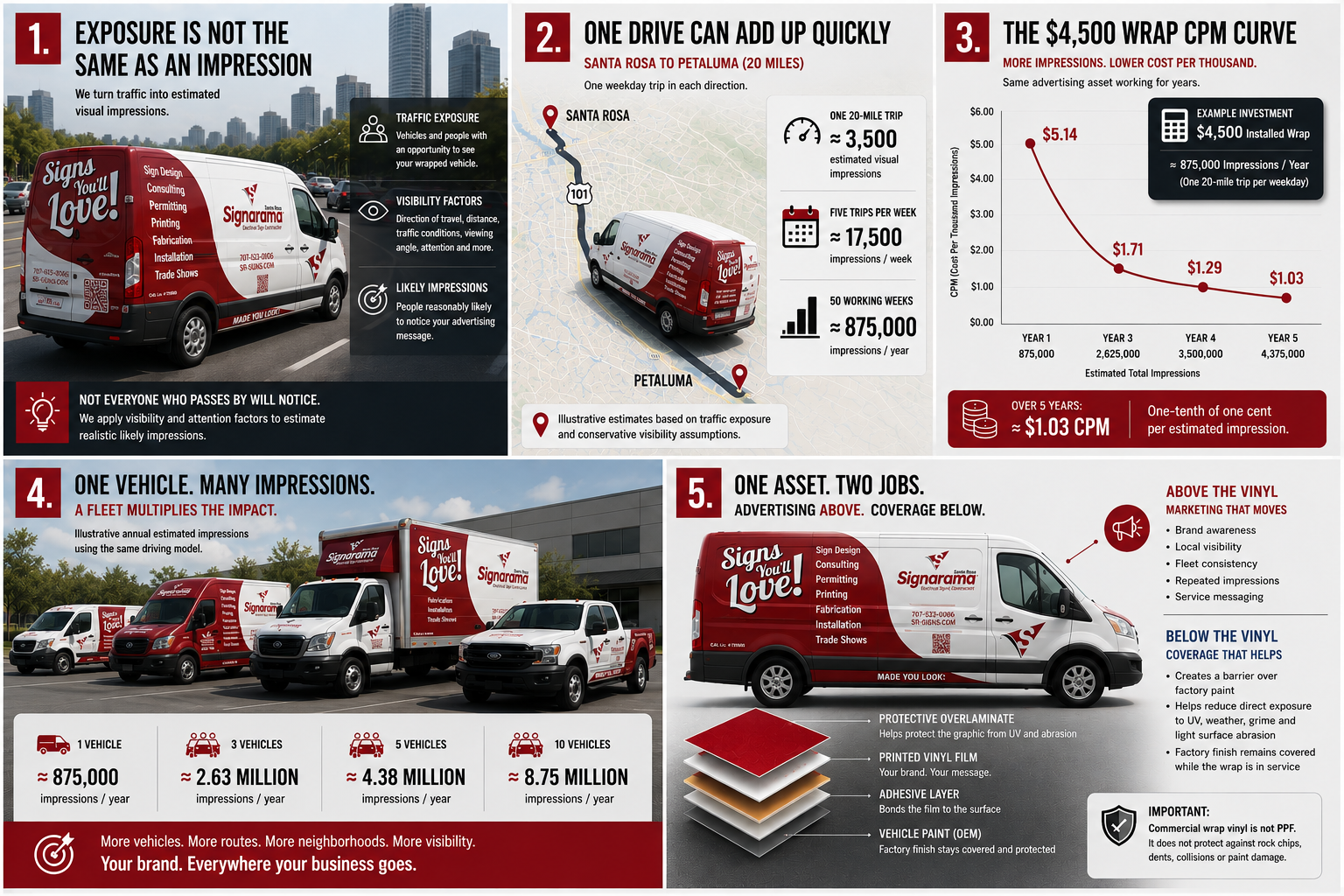
For planning purposes, we settled on approximately 3,500 estimated visual impressions for one 20-mile trip.
One 20-mile trip per day works out to approximately 17,500 impressions per week. Across 50 working weeks, that is approximately 875,000 estimated impressions per year.
If that same vehicle regularly makes the return trip, our model suggests the commute alone could potentially move into the neighborhood of 1.5–1.8 million estimated annual impressions.
Those figures are planning estimates—not audited audience measurements or guaranteed results.
Now Let’s Calculate the Cost Per Impression
CPM means cost per thousand impressions.
Suppose a business invests a hypothetical $4,500 in an installed vehicle wrap. Using our conservative estimate of 875,000 annual impressions, the economics become increasingly compelling the longer the graphics remain in service.
| Time in Service | Estimated Impressions | Estimated CPM | Cost Per Impression |
|---|---|---|---|
| 1 year | 875,000 | $5.14 | $0.0051 |
| 3 years | 2,625,000 | $1.71 | $0.0017 |
| 4 years | 3,500,000 | $1.29 | $0.0013 |
| 5 years | 4,375,000 | $1.03 | $0.0010 |
Over five years, that hypothetical investment works out to roughly one-tenth of one cent per estimated impression, or approximately $1.03 CPM.
This is not a promise that every $4,500 wrap will achieve a $1.03 CPM. It’s the result of a specific model: $4,500 installed cost, 875,000 estimated impressions annually and five years in service.
And that’s exactly why businesses should run the numbers using their vehicles, routes, mileage and expected service life.
Interactive planning tool
Estimate Your Vehicle Wrap Cost Per Impression
Enter a route and your operating assumptions to create a distance-adjusted planning estimate based on the article’s Santa Rosa-to-Petaluma model.
The calculator does not save the locations you enter. Selecting the Google Maps link sends those locations to Google Maps in a new tab.
Please enter positive numbers in every calculator field.
Illustrative estimate for Santa Rosa, CA to Petaluma, CA using 20 miles per trip.
Method: 3,500 estimated impressions per 20-mile trip (175 per route mile), multiplied by entered trips, working weeks, years and vehicles. This is an illustrative distance-adjusted estimate, not audited traffic or audience measurement. Actual exposure varies by route, traffic, visibility, creative execution and driving conditions.
The Same Advertising Asset Can Become More Efficient Over Time
The same $4,500 investment moves from an estimated $5.14 CPM after one year to $1.71 after three years, $1.29 after four and $1.03 after five.
Vehicle Wraps Do Not Replace Digital Advertising
The point of this math isn’t that businesses should stop investing in search, social media, or other lead-generation channels. They perform different jobs.
Search advertising can capture someone who is actively looking for a service right now. Vehicle graphics primarily create repeated local awareness and recognition.
A strong marketing program can use both. That’s particularly important because awareness isn’t always captured neatly by last-click attribution. Someone may see your vehicle repeatedly, later search for your company, hear your name from a friend and recognize the brand when it appears again.
The channels can reinforce each other.
One Vehicle Advertises. A Fleet Creates Repetition.
Now imagine applying the same conservative model across several vehicles.
Those aren’t necessarily unique people—and that’s part of the point.
A fleet creates repeated exposure. Customers begin seeing the same identity on highways, neighborhood streets, job sites, parking lots and throughout the company’s service area.
That’s where fleet consistency becomes especially important. Different vans, pickups, box trucks and service vehicles don’t need identical graphics, but they should clearly look like they belong to the same company.
Your Vehicle Does Not Have to Be Fully Wrapped to Work
Vehicle advertising isn’t all-or-nothing. Depending on your vehicle, brand, marketing objectives and budget, the right solution might be a:
- Full vehicle wrap
- Partial wrap
- Commercial vehicle graphics package
- Spot graphics
- Vehicle lettering
- Consistent fleet-identification system
The goal isn’t necessarily to cover every square inch of a vehicle. The goal is to create something people can notice, understand and remember.
What About the Paint?
There’s another potential benefit worth discussing, but this is an area where marketing claims need to remain accurate.
Professionally applied wrap vinyl covers the painted surface underneath and can reduce its direct exposure to some environmental elements.
Advertising wrap film is not Paint Protection Film (PPF). A commercial wrap should not be sold as protection against dents, collisions, rock chips or every form of paint damage.
The condition of the underlying paint also matters, particularly when graphics are eventually removed. For businesses operating leased vehicles, check the lease agreement before wrapping. Confirm that graphics are permitted and understand any removal and vehicle-return requirements.
How Should Businesses Measure Vehicle-Wrap ROI?
CPM is useful, but it’s not the same thing as revenue.
True return depends on the quality of the design, brand recognition, route, audience, number of vehicles, service category, close rate, average customer value and how the company tracks leads.
A vehicle generating millions of impressions but communicating nothing memorable won’t magically create revenue.
Businesses can look for indicators such as:
- “How did you hear about us?” responses
- Customers mentioning company vehicles
- Branded-search trends
- Direct website traffic
- Market-level brand awareness
- Customer surveys
- Lead and sales trends in areas where the fleet operates
Don’t expect every vehicle impression to turn into a traceable click. That’s not how awareness media works. The question is whether the fleet is contributing to the broader marketing system.
A Fleet Is Also a Trust Signal
A professionally branded vehicle can communicate something before an employee ever says a word.
It can suggest organization, consistency, professionalism and an established business presence.
That’s particularly relevant for plumbers, electricians, HVAC companies, contractors, landscapers, restoration companies and other businesses whose employees arrive at customers’ homes or workplaces.
The graphics don’t prove the quality of the service—but they absolutely contribute to the first impression.
When Vehicle Graphics Make the Most Sense
Vehicle advertising can be especially compelling for companies with:
- Local service territories
- Multiple vehicles
- High daily mileage
- Employees driving between jobs
- Vehicles parked at customer locations
- Strong visual branding
- High customer lifetime value
- Significant neighborhood exposure
These businesses are already paying to put those vehicles on the road. That’s why adding branding can create such an efficient incremental marketing opportunity.
So, Are Vehicle Wraps Worth It?
There isn’t one answer for every business.
But using our conservative local example, a vehicle making one regular 20-mile weekday trip could potentially generate around 875,000 estimated visual impressions per year.
At a hypothetical $4,500 installed cost, the model produces an estimated $1.71 CPM over three years, $1.29 CPM over four years and $1.03 CPM over five years.
Meanwhile, the graphics travel throughout the company’s actual service area—reinforcing the brand at job sites, on roads, in neighborhoods and wherever the vehicle is parked.
That’s an advertising asset marketing departments should at least put on the table when deciding where the next dollar goes.
The Marketing Question We Would Ask
Before spending that next advertising dollar, look at your parking lot.
How many company vehicles do you have? How many miles do they travel? How many neighborhoods do they enter? How many years will you own them? And how many are currently advertising absolutely nothing?
A vehicle doesn’t have to remain just another operating expense. With the right graphics, it can become an advertising asset that works every time someone turns the key.
Frequently Asked Questions
There is no universal CPM because vehicle cost, mileage, traffic exposure, service life and visibility vary. In the conservative example used here, a hypothetical $4,500 wrap generating an estimated 875,000 impressions annually produces an estimated CPM of approximately $1.71 over three years, $1.29 over four years and $1.03 over five years.
How many impressions does a vehicle wrap get?There is no credible single number that applies to every vehicle. Our Santa Rosa-to-Petaluma planning model estimates roughly 3,500 likely visual impressions for one 20-mile weekday trip, but that’s an illustrative local estimate rather than a guaranteed audience count.
What does CPM mean?CPM means cost per thousand impressions.
Are vehicle wraps cheaper than digital advertising?They shouldn’t be compared solely on price because the channels perform different jobs. Vehicle graphics primarily support awareness and recognition, while channels such as Google Search can capture active customer intent.
How long does a commercial vehicle wrap last?Service life varies significantly based on materials, exposure, climate, orientation, maintenance and installation. Three to five years can be a useful planning window, while specific manufacturer systems may carry different warranties under specified conditions.
Does a vehicle wrap protect the paint?A wrap covers the paint and can reduce its direct exposure to environmental elements. However, advertising wrap film isn’t equivalent to Paint Protection Film and shouldn’t be expected to prevent dents, rock chips, collisions or all paint damage.
Can you wrap a leased vehicle?Often, but businesses should review the lease agreement first and confirm graphics are permitted, including any removal or return-condition requirements.
Do I need a full wrap?No. Full wraps, partial wraps, spot graphics and lettering can all be effective depending on the vehicle, brand, budget and marketing objective.
Can different vehicles still look like one fleet?Yes. A well-designed fleet graphics system can adapt logos, colors, proportions and messaging across different vehicle makes and models while maintaining a recognizable identity.
Should vehicle graphics come from the marketing budget?If the purpose is advertising, brand awareness, visibility and customer recognition, marketing departments should at least evaluate fleet graphics alongside their other awareness investments.
Related Vehicle Graphics Resources
Ready to Put Your Fleet to Work?
Whether you operate one vehicle or one hundred, Signarama Santa Rosa can help evaluate how vehicle graphics fit into your broader branding and marketing strategy.
We can help with full vehicle wraps, partial wraps, commercial vehicle graphics, fleet branding, spot graphics, vehicle lettering, design adaptation across mixed fleets, color consistency, premium material selection and professional installation.
Your vehicles are already traveling through your market. Let’s make those miles work harder for your brand.
Talk With Our TeamMethodology Note
The Santa Rosa-to-Petaluma example is a planning model, not an audited audience measurement. Traffic exposure does not equal impressions. The model begins with estimated vehicle exposure and applies adjustments for occupancy and likely visibility/attention. Actual results will vary based on route, mileage, traffic, vehicle visibility, creative execution and other factors.
The supporting research references OAAA definitions, Caltrans traffic-volume resources, 3M vehicle-wrap documentation and other supporting material.