Local, Professional & Reliable
Your local team for custom business signs & vehicle graphics!


AI Artwork VS Graphic Designers - Why Designers are Still Necessary!
Jun 22, 2026 by Signarama - Fond du Lac
Item 1 of 2
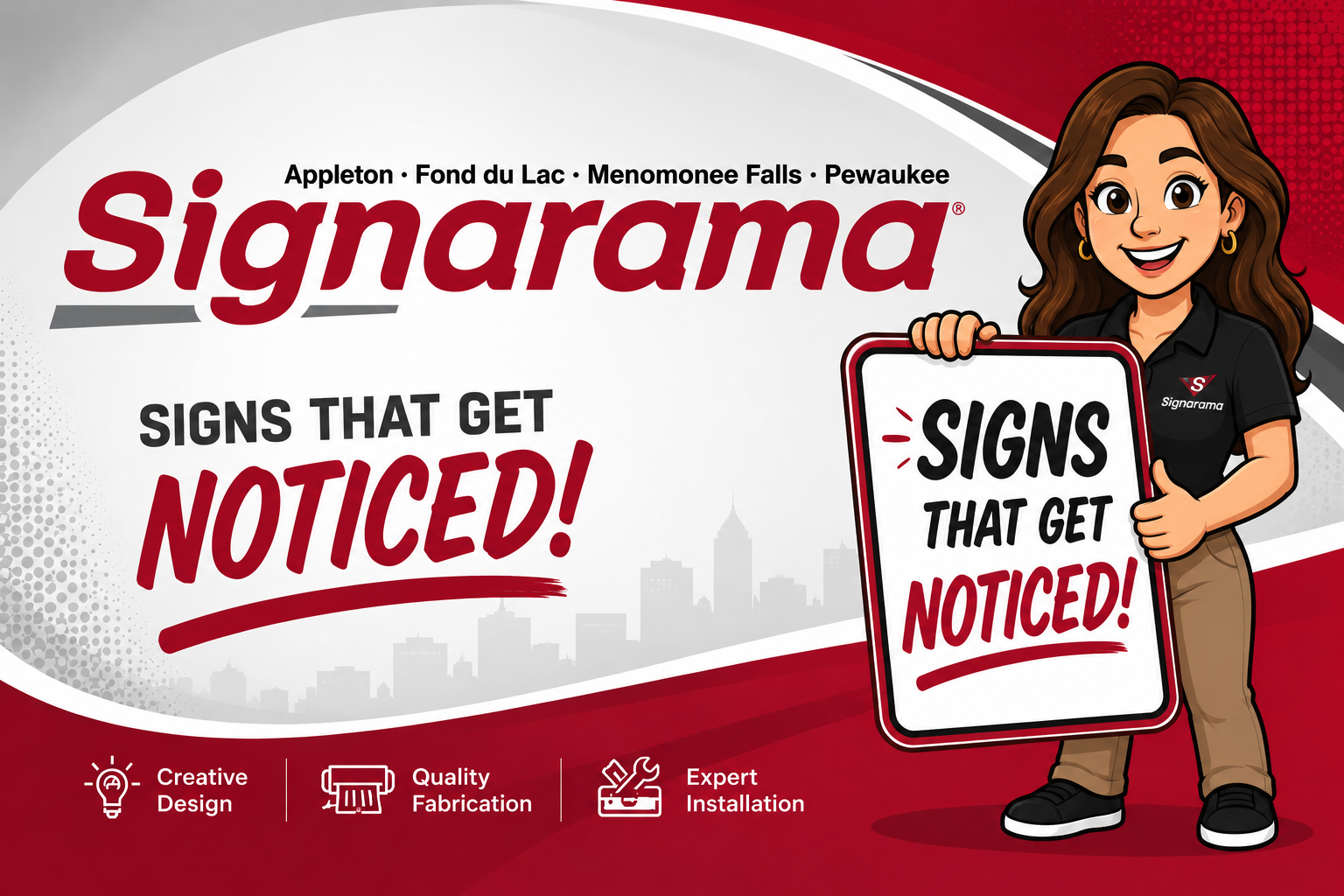
We’ve all seen what ChatGPT, Grok, Copilot, and other AI tools can do—and there’s no question: AI is one of the most powerful tools the sign industry has ever had.
It accelerates the first step. It turns a “maybe” into a real direction fast—often before a customer ever walks in. AI is excellent at generating concepts, layouts, wording, style options, and creative variations in minutes. If speed matters and budgets need focus, that momentum is priceless.
But here’s what many people don’t realize until it’s too late: AI is great at screen-ready design, not production-ready signage.
Most AI artwork is built for digital viewing—screens, previews, “looks good at a glance.” When you scale it up for large-format printing and real-world installation, the problems can appear quickly:
- Pixelation and low-resolution edges
- Blurry type and softened details
- Jagged lines and rough curves
- Distorted lettering and spacing that looks fine online but fails in print
- Gradients that band, break up, or shift when printed
- Color changes or inconsistent transitions in the final output
The result? The design looks impressive online, but it doesn’t translate cleanly to the finished sign.
That’s exactly where graphic designers make the real difference. Designers don’t slow you down—they protect quality. They take the AI concept and convert it into print-ready production files that are sharp, scalable, and accurate at the exact size you’re installing.
A skilled designer can:
- Clean up and rebuild lines, curves, and edges
- Re-vectorize artwork for true scalability
- Optimize typography and correct spacing
- Ensure the right resolution for your printer and materials
- Prepare files that match your specific production requirements
AI gets you to the idea faster.
Design expertise ensures the sign is built to look amazing in the real world—and stay that way long after installation.


Signarama Fond du Lac, WI
N5528 Miranda Way Ste 3
Fond du Lac Wisconsin 54937
Opening Hours:
Monday
8:00 am - 5:00 pm
Tuesday
8:00 am - 5:00 pm
Wednesday
8:00 am - 5:00 pm
Thursday
8:00 am - 5:00 pm
Friday
8:00 am - 4:00 pm
contact
Signarama Fond du Lac, WI
CLIENTS WE HAVE WORKED WITH: