Your Consultative Signs and Graphics Partner for Eastside Businesses


Signs for a Business Merger or Acquisition Announcement: A Planning Checklist
Oct 15, 2026 by Signarama Redmond

What if the first sign customers see after a merger makes the change feel less clear, not more? Planning signs for a business merger or acquisition announcement takes more than swapping logos on a storefront. Employees, visitors, and customers need consistent cues across the spaces they use. A phased transition can help explain what is changing and when.
Old and new branding may appear side by side during a transition, especially across multiple locations. A clear plan brings the pieces together without treating every sign as the same job. This checklist will help you choose signage for different audiences and spaces, set a practical sequence for updates, and decide where temporary and permanent signs fit.
Exterior building and storefront signs, lobby and office signs, and window graphics each have a role in the announcement. Signarama Redmond can coordinate design, permitting, fabrication, and installation to help keep your visual communications cohesive as the new brand takes shape.
Key Takeaways
- Keep the guide focused on physical signs that communicate an approved business transition, not clues that a deal may happen.
- Choose signs for a business merger or acquisition announcement by matching each sign’s purpose to its audience, location, and place in the brand transition.
- Inventory current signs and identify the spaces, audiences, and sign types to address before design begins.
- Use a clear checklist to organize message approval, site surveys, and installation planning across locations.
- Signarama Redmond coordinates design, permitting, fabrication, and installation to support a cohesive signage transition.
What signage should a business plan for a merger or acquisition announcement?
This guide covers physical signs that communicate an announced business transition, not workplace clues that a deal might be coming. Announcement signage is the coordinated use of signs and graphics across the spaces where employees, visitors, customers, and passersby encounter the organization. It helps people understand what is changing, where to go, and which brand to recognize.
The right signs for a business merger or acquisition announcement depend on who needs the information, where they’ll see it, what wording is approved, and how the new identity is being introduced. A lobby sign can orient employees and guests, while a storefront sign helps customers identify a location. Window graphics can share a brief update, and banners can support an announcement at an event. Give each sign a clear purpose instead of repeating the same message everywhere.
Merger and acquisition language varies, so align signage with the organization’s agreed terminology and communications plan. Understanding Mergers and Acquisitions can provide background on the terms and concepts involved, but public-facing sign copy should follow the organization’s approved wording.
Who needs to understand the announcement?
Consider each audience separately. Employees may need clear directions around the workplace and a concise explanation of the transition. Visitors need wayfinding and a recognizable name at entrances, reception, or meeting areas. Customers generally need a simple brand update that helps them identify the business and understand what to expect when they arrive.
Passersby have less time to read, so exterior signs should make the location or updated identity easy to recognize. Keep confidential, tentative, or unapproved deal details out of public-facing copy. A useful test: can each audience understand the sign without background information?
What should signage communicate at each stage?
An initial announcement and a later identity update have different purposes. Early signage may acknowledge the change using concise, approved language while retaining recognizable elements that help people identify the business. Later signs can reflect the finalized identity once the organization has agreed on the name and visual direction.
Build a simple message sequence with the communications team or a Global B2B PR Company before design begins:
- Announcement: Share only the approved transition message.
- Interim period: Help people connect familiar business names or locations with the announced change, where appropriate.
- Identity update: Introduce the approved brand consistently across selected spaces.
Not every sign needs to change at once. Prioritize by audience, visibility, and project readiness. For example, a business might first update interior notices and customer-facing window graphics, then plan exterior building or storefront signs as a later phase. Keep wording and visual cues consistent within each phase, and identify outdated signs that could conflict with the current message.
Which merger announcement sign types fit your business spaces?
Match each space with the people who use it and the message they need. A lobby sign can welcome employees and visitors, while a storefront sign helps customers recognize a business from outside. Signs for a business merger or acquisition announcement work best as a coordinated set, though the signs do not need to be identical.
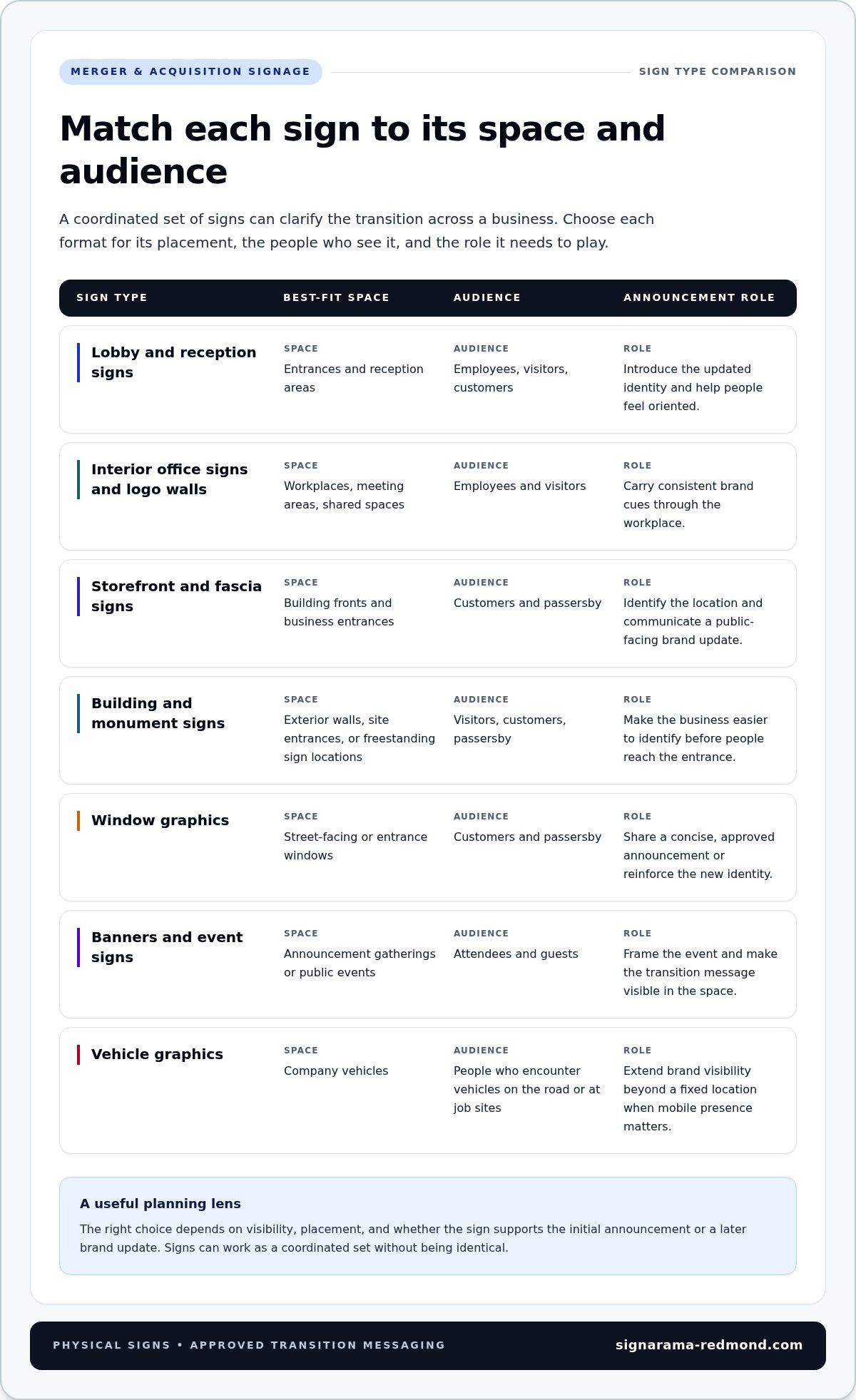
Use this comparison to identify a starting point. The right choice depends on visibility, placement, and whether the sign supports the initial announcement or a later brand update.
| Sign type | Best-fit space | Audience | Announcement role |
|---|---|---|---|
| Lobby and reception signs | Entrances and reception areas | Employees, visitors, customers | Introduce the updated identity and help people feel oriented. |
| Interior office signs and logo walls | Workplaces, meeting areas, shared spaces | Employees and visitors | Carry consistent brand cues through the workplace. |
| Storefront and fascia signs | Building fronts and business entrances | Customers and passersby | Identify the location and communicate a public-facing brand update. |
| Building and monument signs | Exterior walls, site entrances, or freestanding sign locations | Visitors, customers, passersby | Make the business easier to identify before people reach the entrance. |
| Window graphics | Street-facing or entrance windows | Customers and passersby | Share a concise, approved announcement or reinforce the new identity. |
| Banners and event signs | Announcement gatherings or public events | Attendees and guests | Frame the event and make the transition message visible in the space. |
| Vehicle graphics | Company vehicles | People who encounter vehicles on the road or at job sites | Extend brand visibility beyond a fixed location when mobile presence matters. |
Interior signs for employees and visitors
Reception signs, logo walls, dimensional letters, and office branding can make the transition feel coherent from the entrance through shared areas. Trace a visitor’s route: does the name at reception match the identity on meeting-room or office signs? Professional office signs in Redmond can support a consistent experience across these interior touchpoints.
Exterior, window, and event signs for public communication
Exterior formats serve different viewing situations. Illuminated channel letters can display a business name on a building, while cabinet signs present information in a contained sign face. Fascia signs sit on a building frontage, and monument signs identify a site near an entrance. Window graphics can carry a short message at eye level, while banners can support an announcement gathering. For window messaging, custom window decals are another format to consider.
Keep the message readable for the audience’s viewing distance and pace, and coordinate the design across formats. The broader communication plan matters too; Strategic Insights on M&A from HBR can inform how the announcement is framed. For a coordinated signage plan across Eastside locations, explore signage and graphics from Signarama Redmond.
How should you compare signage options before choosing?
A sign can look right on a design proof and still be a poor fit for its location or audience. Before selecting formats, compare each option against four questions: What should the message do? Who needs to see it? Where will they encounter it? Which stage of the brand transition does it support? This framework keeps signs for a business merger or acquisition announcement focused on communication, rather than treating every sign as a logo replacement.
List the proposed signs and assess each against the same criteria:
- Message purpose: Does it announce the transition, identify the business, provide wayfinding, or support an event?
- Audience: Is it intended for employees, visitors, customers, or people passing by?
- Viewing context: Will people see it indoors, on a building, through a window, or at a gathering?
- Transition stage: Does it suit the initial announcement, an interim period, or the later identity update?
For example, an interior reception sign may help visitors connect a familiar business name with the announced change. A building sign has a different job: identifying the location to people approaching from outside. A banner at an announcement event is temporary by design, so it should not be mistaken for ongoing building identification.
Choose by audience and viewing context
Prioritize clear interior communication for employees and visitors who need to navigate the workplace. Exterior placement should help customers and people approaching the business recognize the right entrance or location. For a gathering, use event messaging that serves that occasion without making it the permanent identifier. Consider viewing distance, approach direction, and how much time people have to read the sign.
Placement also shapes project planning. A sign inside a lobby has different site conditions from one mounted on a building or installed in a window. During planning, discuss the intended location, existing sign, and installation requirements. For exterior work, include permitting and code-compliant installation in the plan, while accounting for the fact that requirements can vary by sign and site.
Keep the visual transition coordinated
Consistency does not mean putting identical copy on every surface. It means aligning the business name, logo, colors, and approved wording across selected signs, while tailoring the amount of information to each audience. A window graphic might carry a short announcement; an interior logo wall may focus on the updated identity. Decide which existing graphics still fit and which could create confusion if they remain in place.
Before fabrication, review sign locations together and confirm how old and new visual elements will appear side by side. Include installation planning in that review, especially when signs are attached to a building or replace existing identification. Signarama Redmond coordinates design, permitting, fabrication, and installation to connect decisions from concept through completion. A site review helps account for the location and code-compliant installation requirements.
Merger and acquisition signage checklist: plan the transition
A practical sequence turns an approved announcement into a coordinated signage plan. Before design starts, bring together the message, locations, audiences, and existing signs. This makes it easier to identify which signs for a business merger or acquisition announcement need attention first and which can follow later.
Before design: align the message and map locations
- Approve the message. Gather the approved names, logo files, wording, and announcement timing from the stakeholders responsible for the transition. Distinguish between wording for employees and copy intended for public spaces.
- Map audiences and spaces. List the locations employees, visitors, customers, and passersby use. Note what each group needs to understand or find in each place.
- Inventory existing signs and graphics. Record what is currently in lobbies, offices, windows, storefronts, and on building exteriors. Note which signs identify the business, provide directions, or carry brand elements that may need review.
- Set priorities and sign categories. Match each location to a suitable sign type, such as an interior sign, window graphic, banner, or exterior sign. Identify what supports the initial announcement and what belongs in a later identity update.
- Review the sites. Use a site survey to discuss the physical space, potential sign placement, and project needs. This gives the design conversation a practical basis, especially when several locations or sign types are involved.
- Develop and review designs. Align names, logos, and approved wording across the selected signs. Review how new designs will appear alongside existing graphics that remain during the transition.
- Coordinate project stages. Plan design, permitting, fabrication, and installation in sequence. Include code-compliant installation in the plan, while accounting for requirements at each location.
- Plan installation details. Identify which signs are being replaced or added, how each location will be handled, and how temporary messaging relates to ongoing identification. Set the sequence around the project plan and approved announcement.
From site survey to installation planning
A site survey connects the communication plan to the spaces where signs will appear. It helps organize questions about placement, existing signs, and the scope of the proposed work before fabrication and installation. Signarama Redmond’s professional sign installation plan connects those details to the selected designs and locations.
Signarama Redmond works with Eastside businesses through a consultative design, permitting, fabrication, and installation process. The team offers a free site survey or quick quote to help shape the plan around your locations and signage needs.
Plan announcement signage with Signarama Redmond
A signage transition is easier to organize when the message, locations, and project stages are considered together. Signarama Redmond is a consultative signs and graphics partner for Eastside businesses, connecting sign choices with the spaces and audiences they need to serve. From interior and lobby signs to storefront signs, window graphics, and banners, the team helps develop a cohesive plan that reflects the approved brand direction.
Signarama Redmond coordinates design, permitting, fabrication, and installation as part of the project. Design responds to the message and site, permitting is included in the process, and fabrication and installation follow the project plan. Sign placement and site conditions help shape the work, including code-compliant installation. A conversation about your space, brand, budget, and permitting needs helps define the project.
What to bring to the initial conversation
You don’t need every project decision finalized before starting a conversation. Bringing a few essentials can make the discussion focused and productive. Share materials and details approved for the announcement, and flag decisions that are still being coordinated internally.
- Brand assets: Gather approved logos, business names, and any visual guidance for the transition.
- Announcement wording: Bring the approved message and note where wording may differ for employees, visitors, or customers.
- Location list: Identify the offices, storefronts, buildings, and other spaces included in the plan.
- Existing signs: Note which signs are in place and which may need updating, replacing, or review.
- Priorities and questions: Explain which audiences or locations matter most, the project budget, and any permitting questions to discuss.
This information helps shape the conversation around real needs, whether you’re planning a focused update at one location or coordinating graphics and signs across several spaces. If the transition will happen in stages, identify which locations belong to each phase so the proposed work reflects that sequence.
Start with a local signage conversation
Signarama Redmond works with businesses in Redmond, Bellevue, Kirkland, Seattle, Bothell, Woodinville, Renton, and Greater Seattle Metro. An on-site conversation connects your approved brand direction with practical details of the space, including existing signs, placement, and the audiences who use each location.
Use the meeting to discuss which signs and graphics fit your announcement, what should remain during the transition, and how design, permitting, fabrication, and installation can be organized. You can also discuss budget and site-specific questions without needing to settle every detail in advance. A free site survey or quick quote can help frame next steps around your locations and signage needs.
Make your next brand chapter clear from the start
A merger or acquisition gives your organization a chance to shape how people experience its next chapter. Treat signs for a business merger or acquisition announcement as part of that experience: connect the approved message to real locations, audiences, and project priorities before visual changes begin.
Signarama Redmond partners with your team through a consultative design, permitting, fabrication, and installation process. A site survey or quick quote helps ground the plan in your spaces, while permitting needs are considered as the project takes shape. The team serves Eastside communities and Greater Seattle Metro, supporting businesses coordinating a signage transition.
Bring your approved brand materials, location priorities, and questions about budget or permitting to start a useful conversation. Book a free 30-min on-site consultation and get a free site survey or quick quote.
Frequently Asked Questions
What signs should a business use to announce a merger or acquisition?
Choose signs that match the announcement’s purpose and the spaces people rely on. A company might use a reception sign to orient visitors, window graphics to share an approved public message, and an exterior sign to identify its location. The right mix depends on what the organization is ready to communicate. For signs for a business merger or acquisition announcement, start with the audience’s needs, then choose formats that support them.
Should a company update all its signs at once after an acquisition?
No. Signs can be updated in stages. For example, a business could prioritize locations where customers most need to recognize the company, then update less prominent interior graphics as the new identity rolls out. Record what changes in each phase and when, so staff can distinguish intentional transition materials from signs that were overlooked. Coordinate the sequence with the organization’s announcement and brand plans.
Can merger announcement signs use both company names?
Yes, signs can use both names if that wording and presentation have been approved for the transition. A clear visual hierarchy can help people understand the relationship between the names, such as showing one as the new identity and the other as a familiar former name. Keep the treatment consistent across locations and sign types. Avoid wording that suggests a relationship or status the organization hasn’t approved.
What should a merger announcement sign say?
Use brief, approved wording that states only what the audience needs to know. A sign might identify the new business name and, if approved, connect it to a familiar previous name. For visitors, add practical directions if the announcement affects where they should go. Avoid detailed explanations, confidential terms, or promises about future changes. Have the communications team approve the exact text before it goes into a sign design.
Do merger announcement signs need permits?
Some sign projects may involve permitting, particularly when exterior signs or changes to building identification are planned. Requirements can depend on the sign and its location, so include permitting in project planning rather than assuming one answer applies everywhere. Signarama Redmond coordinates permitting as part of the project, alongside design, fabrication, and installation. Keep approval and installation requirements in view when setting the rollout sequence.
How do businesses keep old and new branding consistent during an acquisition?
Create a simple transition reference for everyone working on signs: approved names, logo files, wording, and instructions for how old and new brand elements should appear together. Then apply it to each location and sign type. For instance, note whether an existing office logo wall stays in place while exterior identification is updated. Review proofs side by side to catch mismatched names, outdated logos, or inconsistent wording before signs are produced.
Can a local sign partner help with design, permits, and installation?
Yes. Signarama Redmond provides a consultative process for signs and graphics through design, permitting, fabrication, and installation, connecting brand decisions with the physical spaces. Its work includes interior, storefront, building, and window signage. Sharing approved brand materials, a location list, and project priorities gives the team useful context for planning a coordinated transition.

Signarama Redmond, WA
Summer Hours (July - August) - MON-THUR: 8.00AM - 6.30PM, FRI - SUN: CLOSED
contact
Signarama Redmond, WA