Your Consultative Signs and Graphics Partner for Eastside Businesses


Retail Sign Installation and Placement on the Sammamish Plateau
Oct 20, 2026 by Signarama Redmond
For Sammamish Plateau retail signage, placement rules depend on the sign type and location. A Type 1 non-A-frame temporary sign in the city right-of-way may be up to 4 square feet and 3 feet above grade, and may remain there for a maximum of 180 consecutive days per calendar year. Storefront signs and signs on private property follow different considerations.
Good placement helps customers notice your business while keeping the sign suited to its setting. Consider whether it faces a street, sits near a storefront, or is positioned in the public right-of-way.
This guide explains how Sammamish’s rules affect temporary signs and what to consider when choosing sign height, mounting, and placement. You’ll also learn how storefront and outdoor signage can support visibility, and how installation choices relate to the building and site, so you can plan signage for your business and its location on the Plateau.
Key Takeaways
Identify whether a temporary sign will sit in the city right-of-way or on private property, since placement changes the applicable limits.
Match the sign type to its allowed size, height, and display period before planning installation.
Plan posts and mounting with site conditions and clear-zone considerations in mind.
Use storefront and outdoor signage to make your business easier to see, while choosing placement and illumination to suit the setting.
Review Sammamish’s signage code references and consider how signs or graphics can support your storefront and customer-facing message.
Table of Contents
What retail signage services are available on the Sammamish Plateau?
Which sign shops serve Sammamish, Washington, and nearby areas?
Municipal and commercial sign installation
Commercial sign installation in Sammamish starts with the sign type, location, and applicable code. These choices shape the design, production, placement, and ongoing upkeep.
Permit Requirements and Fees
For business signs, distinguish permanent storefront signage from temporary signs and identify whether the sign sits on private property or in the city right-of-way. Sammamish’s signage references are Chapters 21A.45 and 21B.45 of the Sammamish Municipal Code; Town Center signage is referenced in Chapter 21B.45 SMC. Application fees depend on the application and review required, while sign type, placement, and installation scope shape the requirements.
Shopping Center and Landlord Rules
Shopping centers and landlords may set property-specific standards for storefront sign dimensions, mounting locations, materials, and visual consistency. Sammamish’s municipal code and a property’s signage criteria serve different purposes, so review both before producing a sign. For example, a design for a shared retail facade should account for neighboring storefronts, sightlines, and the landlord’s approved placement areas.
Local Signage Services and Providers
Sign design, production, and installation work best as a connected process: confirm the location, prepare artwork to fit the space, then install the finished sign. For retail signage, plan around the building surface, customer approach, and nearby traffic. Signarama Redmond takes a consultative approach to signs and graphics, including design, permitting, fabrication, and installation. Plan for upkeep by watching for visible wear, loose mounting, or damaged graphics.
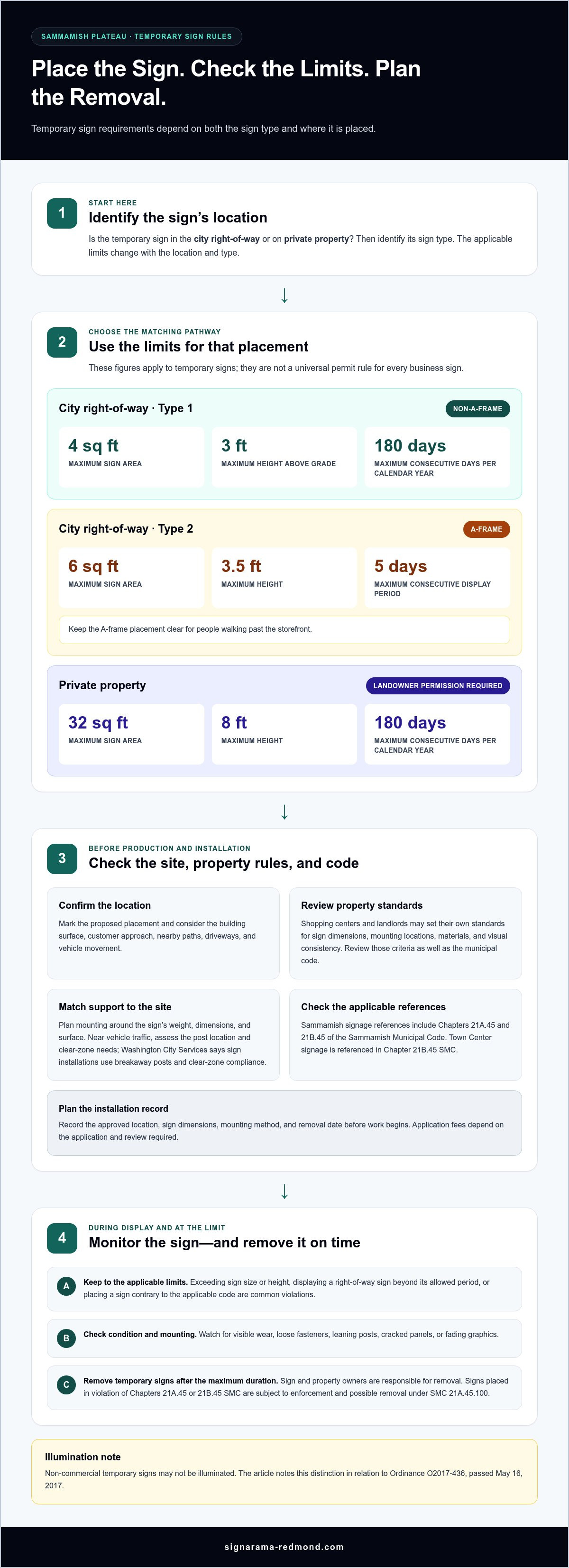
Temporary sign rules depend on sign type and location. In the city right-of-way, a Type 1 non-A-frame temporary sign may be up to 4 square feet and 3 feet above grade, with a maximum display period of 180 consecutive days per calendar year. A Type 2 A-frame may be up to 6 square feet and 3.5 feet high, and may remain there for 5 consecutive days.
On private property, temporary signs require the landowner’s permission and may remain for a maximum of 180 consecutive days per calendar year. A temporary sign there may be up to 32 square feet and 8 feet high. These limits address temporary signs, including the placement questions relevant to banners, window signs, and A-frames; they do not establish one universal permit rule or fee for every business sign.
Common violations include exceeding sign size or height limits, displaying a right-of-way sign beyond its allowed period, or placing a sign contrary to the applicable code. Sign and property owners are responsible for removing temporary signs after the maximum duration. Signs placed in violation of Chapters 21A.45 or 21B.45 SMC are subject to enforcement and possible removal under SMC 21A.45.100.
For installation and upkeep, record the approved location, sign dimensions, mounting method, and any removal date before work begins. Sammamish passed Ordinance O2017-436 on May 16, 2017, including new regulations related to non-commercial temporary signs. Non-commercial temporary signs may not be illuminated, so promotional lighting plans must account for that distinction.
Sign posts, mounting, heights, and offsets
Choose sign support based on the sign’s weight, mounting surface, and exact location. A storefront panel mounted to a wall needs a different plan from a freestanding sign beside a parking area. At a Sammamish retail site, mark the proposed location, then measure the sign’s height and distance from nearby paths, driveways, and vehicle movement.
For a Type 2 A-frame temporary sign in the city right-of-way, Sammamish allows up to 6 square feet in sign area and 3.5 feet in height. Those dimensions give businesses a clear planning limit for this sign type, not a general height rule for every sign. A-frame placement should also leave a clear route for people walking past the storefront.
Post selection matters when a sign sits near vehicle traffic. Washington City Services says sign installations use breakaway posts and clear-zone compliance. This guidance makes the roadside setting important: a post design suitable for a protected storefront area may not suit a location near moving vehicles. Confirm the installation point and intended support before production.
Custom design and fabrication should account for both the message and mounting method. A small business might use a wall sign for its name, a freestanding panel to direct visitors, and temporary signs for a promotional event. In shopping centers, wayfinding signs can help customers find entrances, parking, or individual businesses. Keep lettering readable at the expected viewing distance, and align the artwork with the sign’s final shape.
Wall-mounted signs: Match the mounting hardware to the wall surface and sign dimensions.
Post-mounted signs: Assess the site’s vehicle exposure and clear-zone needs.
A-frame signs: Apply the Sammamish right-of-way size and height limits when relevant.
Radar-activated lighting is a specialized example, not a standard retail sign requirement. At a Sammamish residential three-way stop, radar activated flashing lights as vehicles approached, rather than having the stop sign flash continuously 24/7. The City of Sammamish reported no citizen complaints after the flashing LED signs were installed. That case illustrates how activation can respond to traffic, but it does not establish a rule for business signage.
Include maintenance in the sign plan. During routine site checks, look for loose fasteners, leaning posts, cracked panels, or fading graphics. Repair should address the cause as well as visible damage, such as a weakened attachment or a support shifted out of position. For a project that needs custom proportions or mounting planning, explore sign layout options suited to the site.
Storefront and outdoor retail signage
For a storefront, choose signage customers can read as they approach, such as a building sign or window graphics. In Sammamish, the right option also depends on whether the sign is permanent, temporary, or outdoors.
For local weather conditions, assess each sign’s exposure and select materials, finishes, and mounting suited to that location. A sheltered window graphic and an outdoor sign facing open traffic have different placement and durability considerations.
Storefront Signage Options
Start with the storefront: note the entrance, windows, facade, and direction customers approach from. A building sign identifies the business outside, while window graphics can display store hours, a promotion, or product details at eye level. An illuminated storefront sign can remain visible during the day and at night. Choose a format that keeps the main message clear instead of competing with other window content.
For window graphics, map the viewing areas before designing the layout. Perforated window decals can display a message to people outside while preserving views from inside. Check the window’s shape and surrounding sightlines, then size the artwork to fit the glass. Consider permanent storefront signage separately from Sammamish’s limits on temporary signs.
Outdoor Retail Signage
Outdoor signage can direct customers toward an entrance, communicate a promotion, or identify a business from a parking area. Place each sign where it supports a clear decision, such as turning toward a storefront or locating a door. For a temporary A-frame in the city right-of-way, Sammamish allows a maximum of 5 consecutive days. That short display period makes it useful for a brief event or promotion, not ongoing identification.
On private property, a temporary sign may be up to 32 square feet and 8 feet high. These limits are distinct from permanent sign rules, and placement should account for the property boundary and customer path. Review Chapters 21A.45 and 21B.45 of the Sammamish Municipal Code, especially for Town Center locations referenced in Chapter 21B.45 SMC.
Before selecting an outdoor format, take these steps:
Identify whether the planned location is a window, building facade, private property, or city right-of-way.
Measure the available display area and note nearby entrances, walkways, and vehicle approaches.
Match materials and mounting to the sign’s exposure, then plan how its message will remain legible.
Illumination can help storefront signage stay visible after daylight, but non-commercial temporary signs in Sammamish may not be illuminated. Keep that distinction in mind when planning a sign’s message and lighting. Before production, review the placement for visibility from the customer’s approach, fit with the building’s appearance, and compliance with the relevant sign category.
What retail signage services are available on the Sammamish Plateau?
A retail signage project can bring together planning, design, production, installation, and upkeep. For a Sammamish storefront, start by deciding what customers need to notice, such as the business name, entrance, current promotion, or direction through a shopping center.
Different sign formats serve different moments in a customer’s visit. A building sign identifies the store from outside, window graphics communicate at eye level, and directional signs help visitors find an entrance or destination. A temporary sign can highlight a short-term promotion, while digital signage can display changing content that updates instantly.
Window graphics are useful when the glass itself is part of the storefront. Perforated window decals can show a message to people outside while preserving views from inside. A retailer might use them to feature a seasonal promotion, present a logo, or communicate store information. Plan around the glass area, message position, and what customers need to see through the window.
Outdoor signs work best when the message matches the viewing situation. A customer walking along a storefront can read different details than a driver passing the property. Use a concise business name or directional message for distant viewing, and reserve product details for a closer point of contact. Placement, dimensions, and visibility all affect how quickly people understand the sign.
Digital signage suits messages that change frequently. A retailer can use it to show current promotions or update displayed content without replacing a printed panel. Printed graphics, by contrast, provide a fixed message for windows, walls, or other surfaces, and installations can add dynamic visual effects through large-format lenticular printing. The choice depends on how often the content changes and where customers encounter it.
A coordinated project follows clear steps:
Define the purpose: Choose whether the sign identifies, directs, informs, or promotes.
Map the location: Note the customer approach, viewing distance, surface, and nearby visual clutter.
Prepare the design: Set the message hierarchy so the primary information stands out.
Plan installation: Match the sign format and mounting approach to its intended location.
Review after placement: Check legibility from the customer’s actual path and update or repair signs as needed.
For a Plateau business with a storefront and interior customer areas, align the signs as one system. Use consistent colors and lettering across the building sign, window graphics, and wayfinding pieces. Then review each sign from the customer’s viewpoint, from arrival through entry, so every message supports the next step instead of competing for attention.
Which sign shops serve Sammamish, Washington, and nearby areas?
Washington City Services lists Sammamish, Washington, ZIP codes 98074 and 98075 as areas served. Those ZIP codes offer a practical starting point when comparing a sign project’s location with a provider’s stated service area. For a Plateau storefront, note the project address and identify whether the work involves a building sign, window graphics, or a temporary display.
Service area is only one part of planning. The project also has a scope: design, production, installation, or replacement. A retailer updating window graphics has different site details to plan than a business adding a wall-mounted sign. Write down the sign’s purpose, location, dimensions, and viewing direction to make the project easier to describe clearly.
Use a short project brief to organize the details:
Location: Record the Sammamish address and ZIP code, such as 98074 or 98075.
Sign type: Identify a storefront sign, window graphic, directional sign, or temporary display.
Site information: Note the mounting surface, customer approach, and nearby vehicle or pedestrian paths.
Artwork: Gather the business name, logo, message, and any existing brand colors.
Timing: Describe the event or opening date if the sign supports a specific promotion.
A project brief helps distinguish a single sign from a coordinated project. A shop, for example, may need a storefront identifier and window graphics that repeat the same brand elements. A shopping-center business may also need directional messaging to help customers find its entrance. Naming each sign and its purpose helps establish a consistent design and placement plan.
For Sammamish businesses, the site matters as much as the ZIP code. A sign for a glass storefront needs different artwork and installation planning than a panel mounted to an exterior wall. A temporary sign also serves a different purpose from permanent business identification. Describe these details early so the project scope reflects the actual location and sign type.
Before production, organize the project information in one place. Include a photo or description of the display area, the customer’s approach, and the required message. Keep temporary promotions separate from permanent identification, and note whether window visibility must be preserved. These details help align the design, fabrication, and installation with the business’s goals.
Ready to turn a Sammamish storefront plan into a clear sign project? Start planning your retail signage with the location, sign type, and message in hand.
Sammamish has a population of 65,000 residents, making clear storefront identification useful to local businesses. Signarama Redmond states that 67% of consumers have made a purchase after seeing a sign.
Signarama: Signs
Signarama Redmond helps Sammamish businesses plan signs and graphics around their storefront, message, and intended placement. Turn to our team when you’re ready to move from sign requirements and location decisions to a clear project brief. A business name, logo, preferred sign location, and notes about the customer approach provide a useful starting point.
For example, a shop might need a sign identifying its entrance alongside graphics carrying a promotion across its windows. Sharing the purpose of each piece helps keep the visual message consistent across the storefront. Signarama Redmond can work with you on signs and graphics suited to your business’s communication needs.
Contact Signarama to discuss your Sammamish signage project, or visit Signarama online.
Make Your Next Signage Move With Purpose
Your storefront can keep working for your business as its priorities change. Treat signage as part of the customer experience: decide what visitors should notice first, then make each visual element support that intention. A thoughtful Sammamish Plateau retail signage plan can evolve with new promotions, refreshed branding, or changes in how customers move through your space.
Signarama Redmond provides signs and graphics to bring visual ideas to life. If you’re planning a new storefront display or updating existing visuals, come prepared with your business goals, preferred messaging, and a sense of where customers will see them. Those details set the stage for a focused conversation.
Contact Signarama about your signage and take the next step toward a storefront that feels clear, welcoming, and true to your business.
Frequently Asked Questions
What types of retail signs are permitted in Sammamish?
Permitted sign types depend on their location and the applicable Sammamish code provisions. For temporary signs in the city right-of-way, the city distinguishes Type 1 non-A-frame signs from Type 2 A-frame signs, with separate limits for each. Storefront signs, window graphics, and outdoor displays also need to fit their site and sign category. For Sammamish Plateau retail signage, identify the sign’s purpose and location before selecting a format.
What are Sammamish rules for sign size, height, placement, lighting, and materials?
Sammamish’s right-of-way limits differ by temporary sign type: Type 1 non-A-frame signs may reach 4 square feet and 3 feet above grade; Type 2 A-frames may reach 6 square feet and 3.5 feet high. Placement and other signage provisions are referenced in Chapters 21A.45 and 21B.45 SMC. Non-commercial temporary signs may not be illuminated. Material selection should account for the display location and installation surface.
How much do retail signs cost in Sammamish, including design, fabrication, and installation?
Retail sign pricing depends on the sign type, dimensions, design needs, materials, fabrication, and installation conditions. There isn’t one useful figure for every storefront: a window graphic and a mounted building sign involve different work. Signarama Redmond provides a free site survey or quick quote to scope a project. Share the sign’s purpose, location, and design needs to receive a project-specific quote.
How long does it take to design, permit, fabricate, and install a retail sign in Sammamish?
The project schedule depends on the sign’s design, permit review, fabrication requirements, and installation conditions. A straightforward window graphic follows a different path from a building sign that needs a permit and site-specific mounting. Finalize the message and location first, then complete the design and required review before fabrication and installation. Design revisions or changes to the proposed placement can affect later steps.

Signarama Redmond, WA
Summer Hours (July - August) - MON-THUR: 8.00AM - 6.30PM, FRI - SUN: CLOSED
contact
Signarama Redmond, WA