Your Consultative Signs and Graphics Partner for Eastside Businesses


Law Firm Lobby Signs in Kirkland: Create a Confident First Impression
Oct 9, 2026 by Signarama Redmond

What if your lobby sign could reassure a client before the first conversation begins? A clear, considered arrival experience helps visitors feel welcome and know where to go, while reflecting the care and professionalism they expect from your firm. If you’re planning law firm lobby signs Kirkland clients will see, choose a direction that feels like a natural part of your reception area, not a generic addition.
A polished sign should also support privacy and make navigation easier, not more confusing. This guide explains how to plan lobby signage around your firm’s identity, reception space, and client arrival. You’ll compare common sign styles, consider sightlines and privacy, and prepare a practical project brief. Signarama offers signs and graphics to help bring those project goals into a focused direction.
Key Takeaways
Use your firm’s logo, colors, and tone to shape a lobby sign that feels consistent with its identity.
Compare dimensional lettering, logo-focused panels, and glass graphics by their visual effect and fit with your reception area.
Plan for clients to recognize the firm and find their way while preserving a welcoming, private reception experience.
For law firm lobby signs Kirkland offices need, build a clear project brief around brand assets, space details, visitor needs, and design goals.
Work with Signarama on signs and graphics that support your goals and fit the reception space.
Table of Contents
Why law firm lobby signs in Kirkland shape the client’s first impression
Designing law firm lobby signs around identity, welcome, and privacy
Planning lobby signs for a Kirkland law firm: a practical checklist
Bring your Kirkland law firm lobby sign from idea to project
Why law firm lobby signs in Kirkland shape the client’s first impression
A client entering your office has practical questions: am I in the right place, and where should I go? Clear firm identification and an easy-to-understand reception area can make arrival feel more composed. A lobby sign isn’t a substitute for attentive service or legal expertise. It is one visible part of the experience, helping visitors recognize the firm and orient themselves.
A law firm lobby sign identifies the practice within the reception experience and helps visitors understand where to go. Keeping that purpose in mind connects the firm’s identity to a real visitor need, rather than treating the sign as decoration alone.
What clients need to understand when they enter a law office
Visitors may be focused on an appointment, unfamiliar with the building, or unsure which reception area serves their meeting. A well-placed sign helps answer the first questions without asking clients to search the walls or interrupt staff: does this reception belong to the right firm, and where should I check in?
Consider the visitor’s view in sequence. Is the firm’s name visible from the entrance? Can someone seated in reception still identify the office? Do existing directions or check-in instructions make sense alongside the sign? Clear identification can reduce avoidable uncertainty, but it can’t predict how a client will feel or how a legal matter will proceed. The welcome also depends on the people, space, and communication that follow.
For law firm lobby signs Kirkland offices use, start with the actual arrival route. Review sightlines from the entrance, reception desk, and nearby meeting-room doors. This helps the sign support orientation instead of competing with other information.
How Kirkland law firms can express a professional identity
A professional look doesn’t require elaborate graphics. Consistent use of the firm’s established logo, colors, and typography can make reception feel intentional. A firm with a traditional visual identity might favor a restrained treatment, while a contemporary brand may suit a cleaner, more open presentation. The point is to reflect what clients already encounter in the firm’s communications, not to adopt a trend for its own sake.
Include the office itself in the design decision. Wall color, lighting, furniture, and visual activity around reception all affect how the sign reads. Office space planning considers how workplace layouts and functions work together, a useful perspective when deciding how firm identification fits into a visitor’s path.
Every reception has its own constraints. A compact area may need especially clear identification, while a larger waiting area may call for a sign that relates to the desk and surrounding finishes. Begin with the firm’s identity and clients’ arrival needs. These give the sign a clear purpose and help it feel like part of the office.
Designing law firm lobby signs around identity, welcome, and privacy
A strong design brings three priorities together: visitors can identify the firm, the sign fits the reception area, and its placement respects the privacy of conversations and workspaces. Start with the firm’s existing logo, colors, typography, and tone. The goal is a coherent visual direction, not a new identity created just for the lobby.
For law firm lobby signs Kirkland offices can use effectively, assess the design in context. A sign that looks clear on a screen may be harder to notice against a busy wall or through nearby glass. Check how it reads from the entrance and reception seating, then account for the desk, lighting, and other visual elements.
What should a law firm lobby sign communicate?
Keep the core message focused on the firm’s name and recognizable brand elements. Clients generally need to identify the practice before they need additional detail, so concise wording is easier to absorb as they arrive. A long list of services or extra messages can compete with the firm name and make the sign harder to scan.
Use these questions to clarify the sign’s purpose:
Can a first-time visitor recognize the firm’s name at a glance?
Does the design match the logo, colors, and tone used in the firm’s other communications?
Does the sign avoid client names, matter details, appointment information, or other sensitive content?
Branding and confidential information serve different purposes. The lobby sign identifies the practice; it shouldn’t display details that belong in private client communications. Keep directions or check-in instructions separate from the main identity when that makes the arrival experience clearer.
Balancing visibility with a welcoming, private reception
Review sightlines from the entry, waiting area, and reception desk. A visitor approaching the office should be able to find the firm’s identification without searching, while someone seated should still be able to orient themselves. Check what else appears in the same view, including door labels, reception instructions, artwork, and glass partitions.
Glass can affect both visibility and privacy. Reflections, views through a glazed partition, and graphics on or near the glass may change how the sign reads. Consider the view from each visitor position: the firm name should remain easy to recognize, while confidential work areas and conversations should not become the visual focus. Graphics can contribute to the office environment, but plan them alongside the space’s privacy needs.
For a broader view of how signs and graphics can work across a professional environment, explore professional office signs in Redmond. A considered plan connects the lobby identity with how visitors use the rest of the office, rather than treating each visual element in isolation.
Once the firm’s identity, visitor sightlines, and privacy priorities are clear, they can guide a focused sign direction. Explore Signarama signs and graphics for ideas to shape around your reception space.
Comparing lobby sign styles for a Kirkland law office
Different sign approaches create different visual effects. Each should work with the reception space instead of competing with it. The comparison below can help narrow the direction for law firm lobby signs Kirkland firms are planning. These are general design approaches, and the right choice depends on the firm’s identity, the available wall or glass, and what visitors need to see.
Sign approach | Visual effect | Suitable reception context |
|---|---|---|
Dimensional lettering | Raised individual letters give the firm name a distinct presence on a wall. | A reception with suitable wall space where the name should stand out clearly. |
Logo-focused panel | A contained presentation groups the firm’s logo and name into one visual element. | A space where a defined sign area can bring brand elements together. |
Integrated glass graphics | Graphics on or near glazing can bring identity into the glass and surrounding view. | A reception with glass partitions or windows where visual separation is part of the design consideration. |
Dimensional lettering versus a logo-focused sign
Dimensional lettering presents the name directly on the wall, with each letter forming part of the composition. It can suit a firm that wants its name to be the main feature and has a wall that supports a clean layout. A logo-focused panel gathers the name and logo in a defined area. This can work well when the brand is best represented as a combined mark or when the wall calls for a contained visual element.
Neither approach is automatically more professional. Consider the firm’s existing identity and how much visual emphasis feels right in the room. A large wall may accommodate a prominent treatment, while a compact reception may benefit from a focused composition that leaves the surrounding space uncluttered. Choose what feels consistent with the firm, not simply what follows a current design trend—though for practices considering dynamic digital elements alongside physical signage, AV specialists like ETA Visual offer examples of how modern LED displays can elevate corporate reception areas.
When glass graphics may support the lobby experience
Glass graphics can extend the firm’s visual identity beyond a solid wall and contribute to visual separation in a reception area. Placement and coverage matter. Branding on glass doesn’t ensure confidentiality, so consider what visitors can see through or around the graphic, especially toward work areas and meeting spaces.
Keep each purpose clear. A decorative brand element identifies the firm; directional information helps visitors find a destination; privacy planning considers views into spaces where conversations may occur. These needs can overlap, but they aren’t interchangeable. For related glass and window graphic context, see custom window decals.
Choose by balancing visibility, brand fit, and room layout. Review each approach along the visitor’s likely path, then consider its relationship to reception furniture, surrounding surfaces, and the firm’s visual identity. That comparison turns broad inspiration into a direction suited to the space.
Planning lobby signs for a Kirkland law firm: a practical checklist
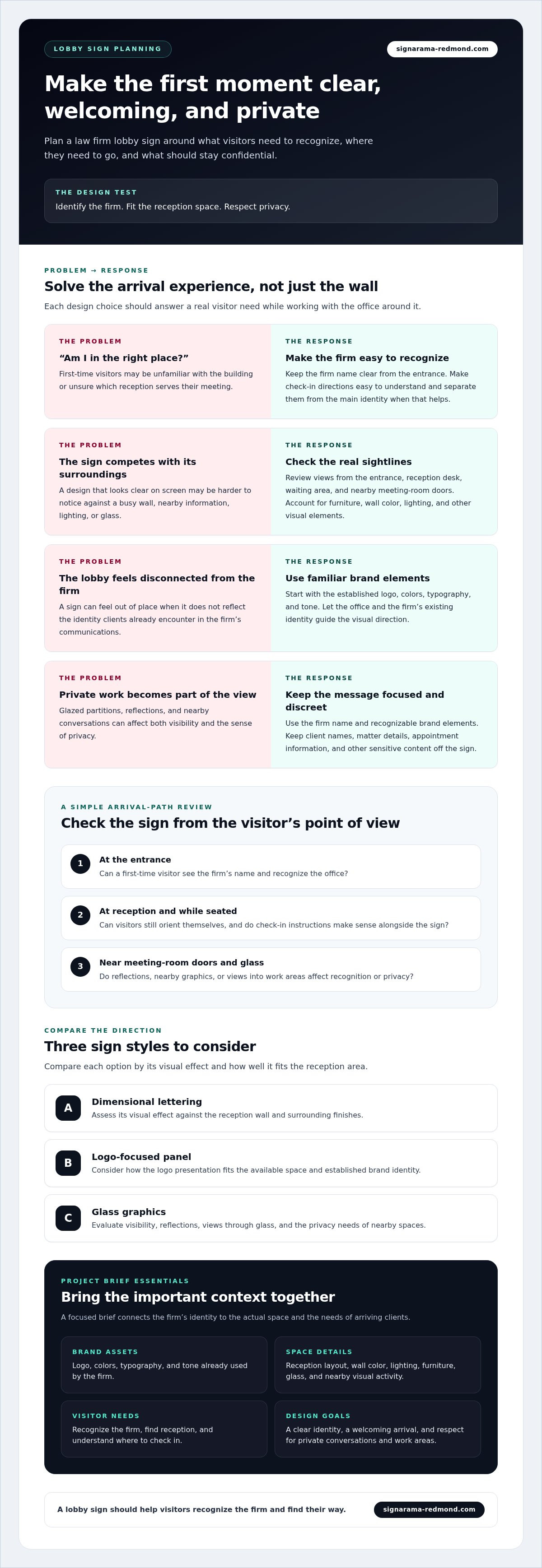
A clear plan turns a general idea into a sign direction that fits the firm and its reception area. For law firm lobby signs Kirkland firms are considering, work through decisions in order: define the purpose, gather references, review the space, and settle on a direction. This checklist is project-planning guidance, not a technical or regulatory assurance.
What to prepare before planning a lobby sign
Gather the information that will help everyone work from the same picture: the firm’s logo files, brand colors, preferred wording, and current photos of the reception area. Note who will approve the design, what visitors need to understand, and how the sign should support the office’s daily arrival flow.
Set the goal. Decide whether the sign’s main job is identifying the firm, helping visitors orient themselves, or doing both.
Collect brand assets. Bring together the logo, colors, preferred wording, and examples of the firm’s existing visual style.
Map the visitor route. Note the entrance, reception position, likely approach, and where clients wait or check in.
Record privacy priorities. Identify nearby meeting spaces, work areas, or views that should not become the focus of the reception design.
Assign design approval. Identify the decision-makers and agree on how the final direction will be reviewed.
How to account for the Kirkland office space
Use photos and an in-person review of the intended sign area to understand the room’s context. Wall surfaces, lighting, glass, furniture, and room proportions all influence how a design may appear. Check the view from the entrance and reception seating, along with anything that could obstruct or compete with the sign. These observations make the design discussion practical without assuming a particular material or technical specification.
Keep local and accessibility questions separate from general design guidance. Before making claims about permits, restrictions, or other City of Kirkland requirements, verify the current rules that apply to the sign and location. Assess accessibility considerations for the specific project against applicable standards and conditions. A planning checklist can flag questions, but it isn’t proof of compliance.
Include installation planning in the project discussion, since the chosen location and surrounding surfaces are part of the overall sign plan. Reviewing professional sign installation in Redmond offers related context for how installation fits into a sign project.
With goals, brand assets, space details, visitor needs, and approvals organized, you’ll have a focused brief for the next design decisions. Plan your law firm lobby sign with Signarama, using signs and graphics to bring the project together.
Bring your Kirkland law firm lobby sign from idea to project
A lobby sign project is easier to shape when the firm’s priorities are gathered in one place. Bring together the identity you want to express, how clients use the reception area, and the details of the space. This gives Signarama a useful starting point for a signs-and-graphics project focused on your Kirkland office rather than a one-size-fits-all template.
Turn the firm’s priorities into a clear design brief
A practical brief doesn’t need to be complicated. It should make clear what the sign needs to do and where it needs to fit. Include the firm’s logo and brand references, reception-area details, visitor needs, and the impression you want the space to create. Then identify the message clients should notice first, usually the firm’s name and recognizable identity.
Firm identity: Share logo files, brand colors, wording, and examples of the firm’s existing visual style.
Reception context: Describe the entry, reception desk, waiting area, nearby surfaces, and the views clients have as they arrive.
Visitor needs: Explain what clients should recognize or understand, including any wayfinding or privacy considerations.
Design goals: Describe the impression you want the sign to support, such as a restrained, welcoming, or contemporary feel.
Approval process: Identify who will review the direction and make the final decision.
These details keep the discussion specific. For example, a firm may want its name to be the first visual cue at arrival while keeping nearby meeting areas discreet. The brief can then focus the conversation on how the sign and other graphics should relate to that space and priority.
What to expect from a collaborative sign project
Expect a practical exchange: the firm shares its goals, brand assets, site context, and visitor considerations, and those details guide a sign and graphics direction. The purpose is to connect the visual idea to the real reception environment, then refine it around the firm’s preferences. Let the office layout and priorities lead the decisions rather than following a preset formula.
Keep project details such as schedule, pricing, materials, and specifications tied to the specific plan. These decisions depend on the project itself, so a clear brief helps frame them without relying on assumptions. As the direction takes shape, revisit the firm’s core needs: can visitors identify the practice, does the design feel consistent with its identity, and does it sit naturally within the reception area?
A well-planned sign supports a confident client arrival by making the firm easier to recognize and the reception experience more considered. When you’re ready to turn your goals and space details into a focused project, start planning your law firm lobby sign with Signarama.
Give your lobby sign project a clear next step
The most useful starting point isn’t choosing a style in isolation. It’s deciding what a client should notice and understand when entering your office. That goal can guide the next conversation, keep design decisions connected to the reception space, and help the sign feel like a natural part of the firm. With law firm lobby signs Kirkland clients encounter every day, a considered direction begins with the experience you want to create.
Bring your firm’s goals and office context to Signarama for a focused discussion about signs and graphics for the project. You don’t need every design detail settled before getting started. Begin with what matters most to your firm, then build from there. Start planning your law firm lobby sign with Signarama.
Frequently Asked Questions
What should a law firm lobby sign include?
Make the firm’s name easy to identify, with the logo or other established brand elements if they help visitors recognize the practice. Keep the message focused. If the reception desk already has check-in instructions, the main sign may not need to repeat them. Avoid putting client names, case details, or appointment information on public-facing signs. A useful test: could a new visitor understand whose office they’ve entered without reading a paragraph?
Which lobby sign style works best for a law office?
The best style is the one that fits the firm’s brand and reception space. Raised lettering can give the firm name a distinct presence, while a logo-focused sign groups the visual identity into one area. In an office with prominent glass, graphics may be worth considering as part of the broader design. Compare ideas against photos of the actual room, not only on a screen, since nearby surfaces and light affect the overall impression.
Can lobby signs help make a law firm reception feel more welcoming?
Yes. A clear sign can help clients feel oriented instead of unsure where to pause or check in. Pair it with a reception area that feels cared for: keep the firm identification visible, make visitor instructions easy to find, and avoid crowding the first view with competing messages. A sign alone can’t guarantee that someone will feel welcome, but it can support a calmer arrival when it works with the space and staff greeting.
Do law firm lobby signs need to meet accessibility requirements?
Some signs may be subject to accessibility standards, depending on what the sign identifies, where it’s placed, and the project conditions. Distinguish a brand sign from signs used to identify rooms or communicate directions, since their purposes may differ. Before finalizing placement or wording, review applicable accessibility requirements for the office and sign type. This FAQ is planning guidance, not a compliance determination for a particular Kirkland location.
How much do law firm lobby signs cost?
There isn’t one price that applies to every law firm lobby sign. The project scope, design approach, sign size, and details of the space can all affect the plan. A focused brief makes the discussion more useful: share the intended location, brand assets, preferred direction, and any related graphics needs. Signarama can shape the signs-and-graphics discussion around those project details instead of relying on a generic estimate that may not fit your office.
How long does it take to design and install a law firm lobby sign?
The schedule depends on the project’s design decisions, review process, and site conditions, so there’s no single timeline for every office. Keep the process clear by gathering brand files, confirming who approves the design, and sharing current reception-area details early. If the project involves multiple decision-makers or a change to the office layout, include those reviews in planning rather than leaving them until the last minute.
Can lobby signs include privacy-focused glass graphics?
Yes. Glass graphics can be part of a lobby sign and graphics plan, especially where glazed partitions are prominent. Their placement should respond to what needs to remain visible and what should be less exposed to waiting visitors. For example, a graphic may contribute to visual separation near a meeting room, but it shouldn’t be treated as a substitute for a firm’s privacy practices or a review of sightlines through the space.

Signarama Redmond, WA
Summer Hours (July - August) - MON-THUR: 8.00AM - 6.30PM, FRI - SUN: CLOSED
contact
Signarama Redmond, WA