Your Consultative Signs and Graphics Partner for Eastside Businesses


How to Compare Quotes from Different Sign Companies: A Practical Guide
Oct 8, 2026 by Signarama Redmond

The lowest number on a sign quote may not be the lowest-cost path to the finished sign. One proposal might cover design, fabrication, and installation, while another includes only sign production. To learn how to compare quotes from different sign companies, start by matching the result each quote promises, not by ranking the totals.
It’s understandable to find side-by-side review confusing when companies describe the same project in different ways. A lower quote may leave out work or materials you expected, and technical terms can make it difficult to spot what’s actually different. This guide will help you compare scope, specifications, schedule, and project fit so you can choose based on the sign you need, not price alone. You’ll also learn to identify exclusions, clarify who is responsible for each step, and understand the next steps before moving forward. With a shared view of the finished sign and the work behind it, you can make a more confident decision and have a clearer project conversation with Signarama Redmond.
Key Takeaways
To learn how to compare quotes from different sign companies, organize each proposal around the same project components and mark what’s included, excluded, unclear, or not applicable.
Compare materials, finishes, lighting, and mounting in context with the sign’s location and intended use.
Separate must-have requirements from preferences so your decision reflects what matters most for the project.
Use a scorecard to flag differences and record assumptions that still need resolution.
Bring the chosen scope, specifications, responsibilities, and key project documents together to create a clearer plan for moving forward.
Table of Contents
Why Quotes from Different Sign Companies Can Look So Different
Two proposals can start with the same logo and sign concept yet describe different finished projects. One may spell out dimensions, materials, finish, and mounting, while another uses a broad description that leaves those details open. That doesn’t automatically make either quote wrong. It means the totals may represent different scopes, so the first step in learning how to compare quotes from different sign companies is understanding what each proposal actually includes.
Why the same sign concept can produce different proposals
A logo or rendering helps communicate appearance, but it may not specify the finished sign’s size, construction, surface finish, or how it will be mounted. Without those details, each company may base its proposal on different assumptions. The result can look similar in a concept image but differ in the materials, build, or work described in the quote.
Location matters, too. A sign intended for an indoor lobby has a different setting from one exposed outdoors. The site and expected exposure help shape which material, finish, and mounting details belong in the project brief. For example, two proposals for a storefront sign with the same logo might use different dimensions or construction assumptions. Their totals would not be directly comparable until those choices are visible.
A Request for Quotation (RFQ) provides a useful model: give each company the same project information so its proposal responds to a shared brief. Clear inputs make differences easier to understand without treating any one quote as inherently misleading.
What “apples to apples” means for sign quotes
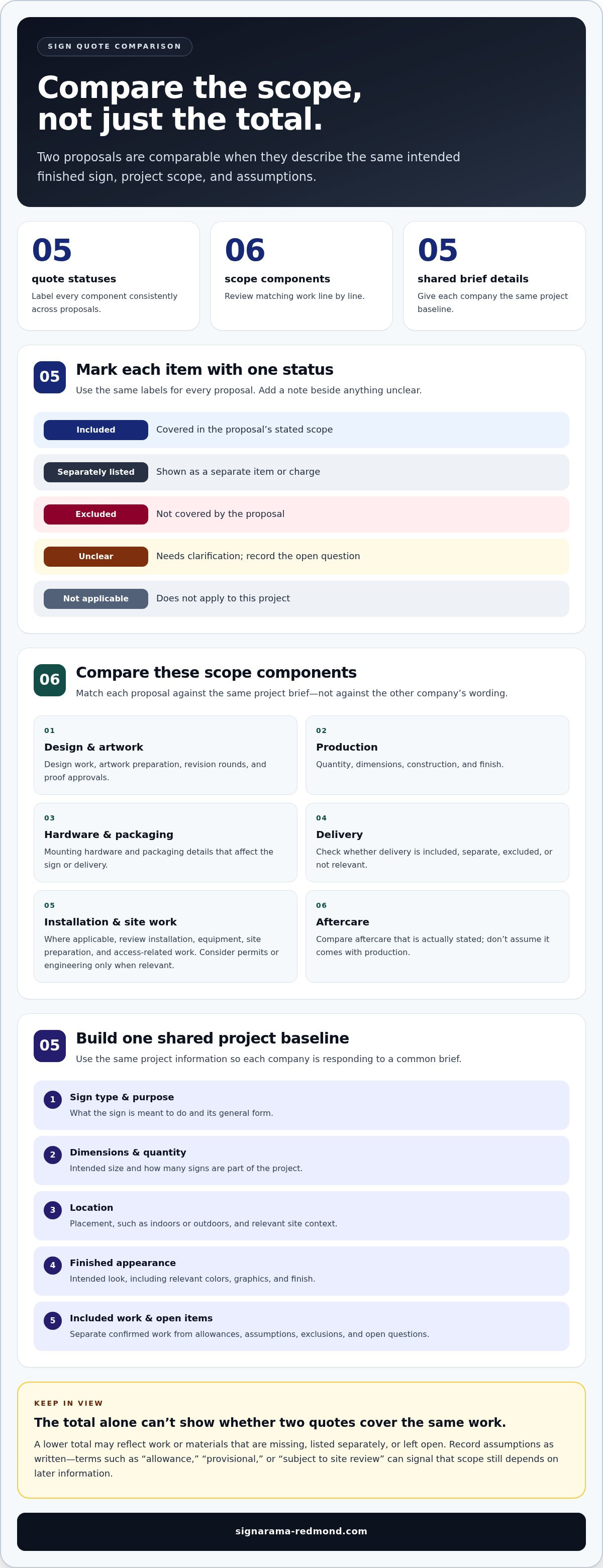
A comparable sign quote describes the same intended finished result, based on the same project scope and clearly stated assumptions. Use a shared baseline before weighing the totals. Record the details that define the sign and its context:
Sign type and purpose: Describe what the sign is meant to do and the general form being considered.
Dimensions and quantity: Note the intended size and how many signs are part of the project.
Location: Include where the sign will be placed, such as indoors or outdoors, and relevant site context.
Finished appearance: Describe the intended look, including relevant colors, graphics, and finish.
Included work: Separate items explicitly covered from items listed as allowances, assumptions, exclusions, or open questions.
Keep confirmed project details distinct from estimates or assumptions. If one proposal specifies a dimension and another leaves it open, record that difference instead of treating the descriptions as equivalent. For a project in Redmond, site context should be part of the brief where it affects the sign’s placement or project requirements. Any jurisdiction-specific requirements should be verified for the actual site rather than assumed from the city name alone. Once the brief is aligned, you can judge which proposal best fits the sign you want and the work required to achieve it.
How to Compare Sign Quote Scope Line by Line
Once you have the proposals in hand, turn each one into the same simple checklist. Compare matching project components rather than trying to interpret each company’s layout or relying on the final total. A line-by-line review helps you see whether a difference is a true scope difference, a separate charge, or simply a detail described another way.
Use one column for each proposal and record a status for every component: included, separately listed, excluded, unclear, or not applicable. Add a note beside unclear items so they don’t disappear from the comparison. This approach makes how to compare quotes from different sign companies more manageable, even when the proposals use different formats.
Design and artwork: Look for design work, artwork preparation, revision rounds, and how proof approvals are described.
Production: Compare the listed sign quantity, dimensions, construction, and finish against the agreed project brief.
Hardware and packaging: Note mounting hardware and packaging details if they affect the finished sign or its delivery.
Delivery: Record whether delivery is included, separately listed, excluded, or not relevant to the project.
Installation and site work: Where applicable, mark installation, equipment, site preparation, and access-related work separately. Consider permits or engineering only when relevant to the project.
Aftercare: Compare any aftercare that is actually stated, and don’t assume it’s included just because the quote covers production.
The total alone can’t show whether two sign quotes cover the same work, because each price may reflect a different set of included, separate, or excluded items. A proposal with delivery or installation listed separately may look different from one that groups those items into a single scope. As a general purchasing practice, evaluating supplier responses means looking beyond the headline amount to the details that shape the offer.
Separate firm specifications from assumptions
Next, distinguish definite commitments from placeholders. Words such as “allowance,” “provisional,” or “subject to site review” signal that an item may depend on later information. Record those phrases as written. They aren’t necessarily a problem, but they mean the scope isn’t fully settled yet.
Pay close attention to who is responsible for approvals, arranging site access, and coordinating project details. If a proposal leaves responsibility unstated, mark it unclear rather than filling in the gap yourself. For a sign project that includes installation, keep the installation scope distinct from production; Signarama Redmond’s sign quote review and planning can help frame a collaborative discussion around the intended result.
Before comparing totals, revisit every “unclear” or “separately listed” line and note what would need to be resolved for the proposals to describe the same finished project. For Redmond projects, keep site-specific considerations tied to the actual location instead of assuming requirements based on the city name.
Compare Sign Materials, Site Fit, and Project Evidence
A quote’s material and construction details matter only in relation to the sign’s intended setting. Consider where it will be placed, how far away people need to read it, what conditions it may face, and how long it’s intended to serve. There’s no universal “best” substrate: a specification that suits an indoor display may not be the right fit for an outdoor sign, just as exterior window graphics demand specific vinyl and adhesive grades.
Make the differences visible with a simple table. Use “included,” “unclear,” or “not applicable” where those labels fit, and add a brief note when two descriptions use different terms.
Comparison point | Quote A | Quote B |
|---|---|---|
Substrate and thickness | Record stated material and thickness | Record stated material and thickness |
Finish or protective treatment | Record stated finish or mark unclear | Record stated finish or mark unclear |
Lighting and electrical components | List details, or mark not applicable | List details, or mark not applicable |
Mounting method | Record stated method or mark unclear | Record stated method or mark unclear |
Evidence supplied | Note drawings, mockups, or site references | Note drawings, mockups, or site references |
Match proposed materials and construction to the sign location
When a proposal names a substrate, thickness, finish, or protective treatment, write down the exact description instead of reducing it to a broad label such as “metal” or “weather-resistant.” Those details help you assess whether the proposed construction suits the intended location and use. For an illuminated sign, record the lighting approach and any listed electrical components separately. Similar-looking descriptions don’t prove that the components or finished results are equivalent.
Think in terms of fit, not a universal ranking. The useful question is whether the stated construction makes sense for this particular sign, its exposure, viewing distance, and expected lifespan. If you are evaluating bids for multimedia or smart digital signage, specialized solutions from providers like YNON demonstrate how hardware specifications, screen technology, and software support require just as much scrutiny as traditional physical substrates. If an important detail is absent, mark it as unclear instead of assuming the proposals match.
Use site details and visuals to test project fit
Site photographs and references can help put a proposal in context. Review the intended placement, mounting surface, access conditions, and available power information when those details matter to the project. A rendering can communicate appearance, scale, and position, but it can’t replace written dimensions or construction specifications. Keep those records together so the visual concept and quoted scope can be read side by side.
For Redmond projects, treat local requirements as site-specific and verify them before describing a proposal as compliant or stating that a permit is needed. A careful review of how to compare quotes from different sign companies looks at materials, site fit, and supporting project evidence as parts of one decision, not as isolated technical details.
Build a Sign Quote Scorecard Before Choosing
A scorecard turns separate proposals into a consistent decision record. It isn’t a universal rating system or a substitute for reviewing the actual scope. Use it to make differences visible, identify what matters most for your project, and capture open questions before choosing. This gives you a practical framework for how to compare quotes from different sign companies without letting the lowest total decide by default.
Score each quote against the same decision criteria
Start with four steps: normalize the scope, flag differences, rank priorities, and record unresolved assumptions. Make a copyable scorecard with the same fields for every quote. For each criterion, record the proposal’s details, its status, and how important that item is to your project.
Scope match: Does the proposal describe the intended sign and the work needed to achieve it?
Specification clarity: Are relevant dimensions, materials, finishes, and construction details stated?
Site fit: Does the described solution suit the location and intended use?
Schedule: What timing is stated, and is it a priority for this project?
Documented responsibilities: Does the proposal explain who handles relevant approvals, access, coordination, or other project tasks?
Price: Record the total, but compare it only after you’ve established that the proposals cover a sufficiently similar finished scope.
For each line, include space for importance, Quote A notes, Quote B notes, and open questions. Rank importance based on your needs. A fixed schedule may be essential for one project and a preference for another; appearance or additional services may also carry different weight depending on your goals. Don’t apply a standard weighted score just because it looks precise.
Resolve quote differences without losing project priorities
Be specific about status. “Excluded” is a clear statement that an item isn’t part of the quoted scope. “Unclear” means the proposal doesn’t establish whether it’s included. Those are different decision points: an exclusion may call for a revised scope, while an unclear item needs clarification before you can compare like with like.
Focus first on gaps that could change the finished sign, the installation plan, or who is responsible for an important task. Then separate non-negotiables from preferences. If a must-have isn’t addressed, don’t let strong ratings elsewhere hide that gap. Keep a short decision record noting the selected proposal, the priorities it meets, the trade-offs you accepted, and any assumptions that remain.
A scorecard works best as a straightforward working document you can adapt to the project, not as a promise that one quote is objectively best. To connect your comparison with sign and graphics options, explore Signarama Redmond’s sign and graphics solutions.
Turn Your Sign Quote Comparison into a Clear Project Plan
Choosing a proposal is only part of the work. Turn the comparison into a concise project brief that explains what you’ve selected, what the proposal covers, and what still needs to be resolved. This gives everyone involved a shared reference, whether you’re planning a sign for a storefront, an office interior, or another setting.
Prepare a concise project brief for the next step
Bring together the information that shaped your decision. Include the sign’s purpose, approximate dimensions, quantity, intended location, and preferred appearance. Add current artwork, useful site photos, and any known details about access or the mounting surface. If the project involves interior signage, note where people will encounter it and what it needs to communicate in that space.
Keep the brief practical. It doesn’t need to repeat every line from every proposal. Instead, summarize the selected scope and specifications, the responsibilities described, the desired completion milestone, and any assumptions that remain open. Keep supporting documents together so the brief can be understood alongside the artwork and site context.
Selected scope: State the sign or graphics project and the work included in the chosen proposal.
Key specifications: Record written dimensions, quantity, material or finish details, and relevant mounting information.
Project responsibilities: Summarize who is responsible for the tasks stated in the proposal, such as approvals or access arrangements.
Open assumptions: List unresolved details clearly instead of leaving stakeholders to infer them.
Target milestone: Note the completion milestone you’re working toward without treating it as a confirmed schedule unless the proposal states it.
Make the decision easier to approve and communicate
When you share the recommendation, explain why the selected scope fits the sign’s intended use and project priorities. For example, a concise summary might say that the proposal matches the planned placement and appearance, states the relevant specifications, and identifies the responsibilities important to the project. This tells decision-makers what guided the choice without asking them to reread every quote line.
Keep approved artwork, written dimensions, site references, and the final proposal in one organized project folder. Give unresolved assumptions their own short list, with a note about how each could affect the scope or next decision. That simple record helps prevent an estimate or visual mockup from being mistaken for a finalized specification.
Comparing quotes is most useful when it leads to a clear conversation about the sign or graphics project you want to complete. Bring your brief and supporting materials to a discussion with Signarama Redmond, and start a sign project conversation with Signarama Redmond.
Move Forward with a Clearer Sign Project Decision
A quote comparison can do more than help you select a proposal. It can give your team a shared basis for approving the project and a clear starting point for the next conversation. Keep your decision notes close at hand, especially if stakeholders need to understand why one option better suits the intended result.
As you move forward, focus on turning the chosen direction into a shared understanding of what success looks like. That might mean agreeing on how the sign should support visibility, guide visitors, or fit the space. The same thoughtful approach to how to compare quotes from different sign companies can help you shape signs and graphics around practical goals, not just a line item in a budget.
With Signarama Redmond, you can bring your project priorities into a collaborative discussion and work toward a clear direction for your sign or graphics project. Discuss your sign project with Signarama Redmond, and take the next step with confidence.
Frequently Asked Questions
Can I compare sign quotes if each company proposed a different design?
Yes, but separate the design decision from the scope comparison. First decide which concepts meet your goals for visibility, brand presentation, and the sign’s setting. Then compare proposals based on the design direction you’re seriously considering. If you’re still choosing among concepts, note that a design difference may affect materials or construction, so the proposals may not represent equivalent finished signs. Keep design preference and quote scope as distinct parts of your decision.
How much detail should I include when requesting sign quotes?
Share enough information for each proposal to address the same project. Include the sign’s purpose, intended placement, approximate dimensions, quantity, indoor or outdoor setting, and any timing milestone that matters. Add a site photo and existing logo or artwork if available. Mention who the sign needs to reach and from what general viewing distance. This shared brief makes it easier to see which differences reflect a genuine design choice rather than missing project context.
Is a rendering enough to approve a sign proposal?
No. A rendering helps you picture appearance and placement, but perspective can make scale difficult to judge, and screen colors may not match a finished sign exactly. Review the artwork carefully for spelling, logo details, color relationships, and the prominence of key information. Make sure the proposal’s written specifications describe the version you intend to approve. Treat the rendering as a visual aid, not the sole record of what the final sign should communicate.
What does an allowance mean in a sign quote?
An allowance is a placeholder for an item whose final scope or selection hasn’t been fully determined. It may cover a project component based on stated assumptions, rather than a finalized specification. Check what the allowance applies to, what assumptions it uses, and how any difference will be handled if the actual requirement changes. For example, an allowance tied to an undecided finish should not be mistaken for approval of a specific finish or completed selection.
How long is a sign quote valid?
There isn’t one validity period that applies to every sign quote. Look for an issue date and any written expiration date or validity terms in the proposal. If the quote doesn’t state how long it remains current, don’t infer a deadline. Before approving an older proposal, request an updated version so you can confirm that its scope and terms still reflect the project you plan to proceed with.
What happens if the sign project changes after quote approval?
A change to the design, quantity, dimensions, materials, or site conditions may affect the agreed scope and timing. Record the requested change in writing and ask for a revised proposal that identifies what is changing and what remains the same. Keep the original and updated versions together, and make sure the people approving the project are working from the same revision. This creates a clear record before the changed direction moves forward.
What artwork files should I prepare for a sign quote?
Gather the original logo and artwork files rather than relying only on a screenshot or image copied from a website. Vector artwork is useful when available because it can be resized without the same loss of sharpness as a small raster image. Also include brand color references, fonts or font files if relevant, and notes about any elements that must remain unchanged. File needs vary with the sign and production method, so label draft artwork clearly.

Signarama Redmond, WA
Summer Hours (July - August) - MON-THUR: 8.00AM - 6.30PM, FRI - SUN: CLOSED
contact
Signarama Redmond, WA