Your Consultative Signs and Graphics Partner for Eastside Businesses


How Landlord Criteria Shape Projecting Blade Sign Placement
Nov 17, 2026 by Signarama Redmond
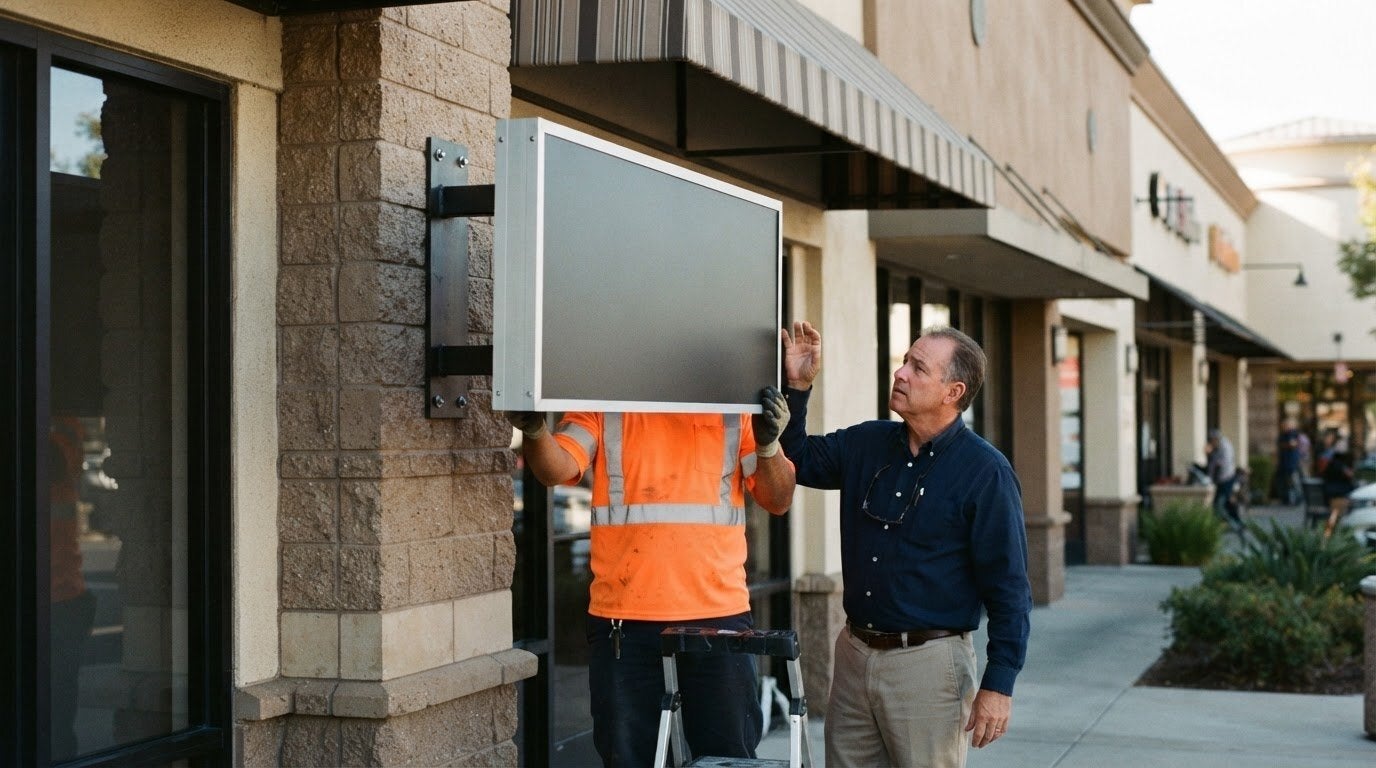
A landlord’s approval is an important step, but it doesn’t give a projecting blade sign automatic clearance to be installed. To understand how to get landlord approval for a projecting blade sign, start with the property’s current sign criteria and lease requirements, then submit a design for written review before fabrication. Municipal approval is a separate step.
A landlord’s rules may cover more than appearance. They can address sign dimensions, mounting, illumination, materials, and placement on the building. Shopping centers may have a separate review process, too, so approval for a storefront sign does not necessarily cover a projecting sign.
This article explains what landlord sign criteria cover, how lease and property approvals fit together, and why landlord approval does not guarantee a city permit. It also outlines what drawings should show and why the municipality and any design district matter before a blade sign is fabricated.
Key Takeaways
Get the property’s current sign criteria and review your lease before finalizing a blade sign design.
Prepare drawings that show the sign’s dimensions, projection, mounting, and illumination for property review.
Secure landlord and any shopping-center approvals before fabrication, then pursue the separate municipal approvals that apply.
Confirm the governing municipality and any special design district, since local rules can affect placement and clearance.
Table of Contents
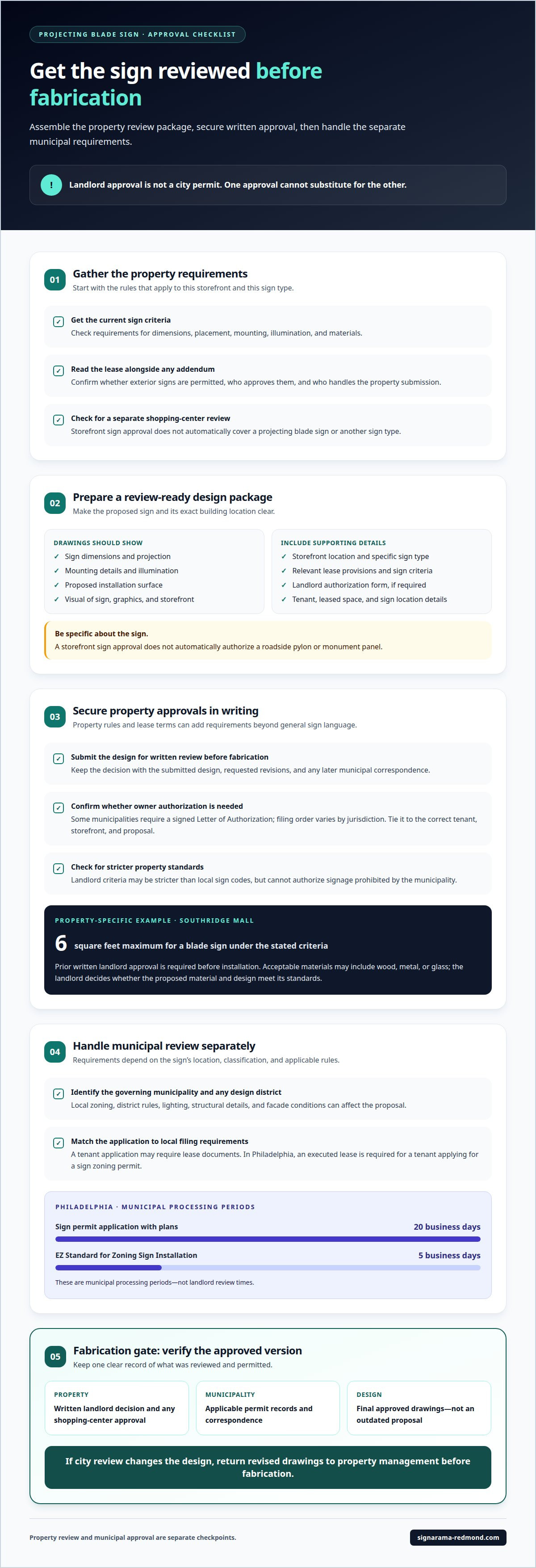
Does landlord approval guarantee a city permit?
No. A landlord’s written approval and a municipal sign permit are separate approvals. The property review addresses whether the proposed sign fits the building’s criteria, while the municipality reviews applicable local sign rules. In Denver-area communities, requirements can vary by municipality and special district. Treating one approval as a substitute for the other can leave a tenant with a design that cannot proceed as proposed.
Document property approval before authorizing fabrication. Keep the landlord’s written decision with the submitted design, requested revisions, and any later municipal correspondence. A signed Letter of Authorization may also be required for a sign application, and submission order varies by jurisdiction. If city review requires a material design change, send the revised drawings back to property management for review before fabrication.
To prepare a blade sign approval request, provide the storefront location, available lease or sign criteria, and proposed design. Drawings should show dimensions, projection, mounting, and illumination, along with a visual of how the sign and any custom graphics relate to the storefront. Identify the proposed installation surface so reviewers can assess the actual building location.
Include supporting documents that clarify the request, such as relevant lease provisions, property sign criteria, and any landlord authorization form. This helps the property manager assess the proposal against restrictions on placement, appearance, or mounting. A storefront approval does not automatically authorize a roadside pylon or monument panel, so identify the specific sign type in your submission.
Municipal costs and application steps also depend on sign classification and location. For commercial projects navigating complex agency submittals, permit expediting services such as cornerstonepermit.com can help streamline municipal filings alongside landlord reviews. The city fee is separate from landlord review. Keep the property decision, municipal permit records, and final approved drawings together. This creates a clear record of which design received approval and helps prevent fabrication from proceeding on an outdated or unapproved version.
What Is Landlord Sign Criteria?
Landlord sign criteria are property-specific rules that guide signage design and placement on a building. Understanding how to get landlord approval for a projecting blade sign starts with knowing how property requirements interact with lease terms and municipal review.
Authorization for Sign Applications
Landlord authorization is written permission allowing a tenant to submit a sign application for a property. Some municipalities require the owner’s signed Letter of Authorization as part of the filing, though submission order varies by jurisdiction. A Long Island sign permit application may require landlord authorization. Tie the authorization to the correct tenant, storefront, and sign proposal so the property owner’s consent is clear.
Tenant Applications and Lease Documents
A tenant application brings together lease documents and sign information for review. In Philadelphia, a tenant applying for a sign zoning permit must provide an executed lease agreement. If you are considering how to get landlord approval for a projecting blade sign, the lease can clarify who handles the property submission and what exterior signage is permitted. Keep the tenant name, leased space, and sign location consistent throughout the application.
Municipal filing methods and processing periods depend on the application type. In Philadelphia, sign permit applications with plans are processed within 20 business days, while applications using the EZ Standard for Zoning Sign Installation are processed within 5 business days. Those are municipal processing periods, not landlord review times. A property manager may use a separate submission process and review criteria.
Compliance With Applicable Laws
Compliance means meeting property criteria as well as applicable municipal requirements. Landlord standards can be stricter than local sign codes, but they cannot authorize signage the municipality prohibits. Zoning, district rules, lighting, structural details, and facade conditions can all affect a proposal. A design that meets the landlord’s visual preferences must still comply with the rules for its location.
Before completing an application, match the sign type and proposed location to the relevant property requirements. A projecting blade sign, for example, may be reviewed differently from an awning or storefront panel. Consistent lease documents and application details help reviewers understand the request and identify the applicable standards.
Landlord, lease, and shopping-center sign approvals
A projecting sign may go through separate lease and property reviews before fabrication. The lease, current sign criteria, and shopping-center process together define what the tenant can submit.
Sign Criteria as a Lease Addendum
Landlord sign criteria are property rules that may be attached to a commercial lease as an addendum. They matter because they can set design and installation limits beyond the lease’s general sign language. At Southridge Mall, the landlord must give prior written approval before a tenant installs a projecting or suspended blade sign. Shop drawings for signs, logos, and graphics visible from common areas also go to the landlord for review.
Southridge Mall criteria allow a blade sign up to 6 square feet and require acceptable materials such as wood, metal, or glass. The landlord decides whether the proposed material and design meet its standards. A projecting sign may be considered when the landlord believes the storefront’s visibility or location merits additional signage.
Lease Restrictions on Exterior Signs
A commercial lease typically describes whether exterior signs are allowed, who approves them, and which party handles related responsibilities. Read its sign provisions alongside any addendum: a sample lease clause requires tenant signage within 30 days after the tenant opens for business. A landlord may also require a tenant to change brand colors or a logo unless those elements were protected during initial lease negotiations.
Lease terms and property criteria can also cover removal and repair. One sample lease clause requires removal within 90 days after a specified lease termination or loss of signage eligibility. At Southridge Mall, tenants are responsible for signs, permits, power sources, connections, and installations. Another sample clause requires tenants to pay reasonable sign-repair costs within 30 days after receiving an invoice.
If your landlord denies a blade sign request, use the stated criteria to identify the issue, then submit a revised design or propose another placement for review. Find out whether the concern involves illuminated letters, electrical connections, mounting, or visibility. A monument panel and a storefront sign may have separate approval limits, so do not treat approval for one as approval for the other.
Projection, mounting height, and pedestrian clearance
Blade sign drawings should show dimensions, projection, mounting, and illumination. The permitted design depends on the property’s criteria and the rules for its location.
Projection and Pedestrian Clearance
Projection describes how far a sign extends outward from the building, while mounting height affects the space below it. Both details matter when a sign sits above a pedestrian walkway or public right-of-way. In San Jose, a projecting sign must have at least 8 feet of clearance above sidewalk grade. Southridge Mall requires a blade sign to be at least 9 feet above the finished floor.
Show the sign and bracket together in elevation drawings so reviewers can assess the full projection and lowest point. The mounting zone also needs to suit the facade and avoid conflicts with architectural features. These details help property managers and municipal reviewers assess placement before installation.
Blade Sign Design and Projection Limits
Blade sign size and projection limits vary by municipality, property, and district, so there is no single dimension that applies across U.S. cities. For example, Southridge Mall limits a blade sign’s maximum projection, including its bracket, to 3 feet 6 inches. That property-specific limit shows why a tenant’s proposed dimensions must fit both the site criteria and applicable local rules.
Design review may also cover materials, illumination, colors, mounting zones, and how the sign relates to the storefront. A property may require direct stud mounting or a raceway, or prohibit one of those methods. Mounting hardware should suit the facade substrate and expected loads. Structural calculations can help show that a blade sign is designed to withstand expected wind loads.
Include clear structural and installation details in the submission, along with views that show the sign mounted on the exterior. If the proposed position conflicts with a facade feature or clearance requirement, revise the placement before fabrication. Discuss your projecting sign design with a sign professional to develop drawings that clearly communicate dimensions, mounting, and visual intent.
Signarama Redmond, WA : Signs
Signarama Redmond helps turn your design direction into a sign concept that reflects your storefront and brand. We start with a conversation, not just a quote. If landlord criteria call for changes to colors, materials, dimensions, or placement, those requirements can guide the signs and graphics designed for your business.
Bring the property’s sign criteria, lease requirements, and landlord feedback to the design discussion. This gives your sign professional useful context for developing a proposal that addresses both the building’s visual standards and your needs. Keep municipal review separate, since landlord approval alone does not secure a city permit.
When you’re ready to discuss a projecting blade sign for your space, contact Signarama.
Move Your Sign Plan Forward
Understanding how to get landlord approval for a projecting blade sign is a starting point for planning a storefront presence that feels intentional. Next, shape the design around your business identity and the building’s character. Clear priorities for visibility, brand expression, and placement can keep landlord discussions focused as the project develops.
Signarama Redmond provides signs and graphics to help bring your visual direction into a cohesive storefront concept. Share your design goals and property requirements, then work through options with those constraints in view. The sign should support your business while fitting its setting, rather than being treated as an isolated element.
Ready to explore a sign concept for your space? Start a conversation with Signarama, and take the next step toward a storefront presence that feels like yours.
Frequently Asked Questions
What should a Denver business consider before ordering a blade sign?
Identify the governing municipality and any special design district before committing to a design. Requirements can differ among Denver, nearby Front Range municipalities, and special districts, with rules addressing zoning, sign area, projection, mounting height, illumination, and placement relative to public rights-of-way. Historic buildings and design-review districts may add standards for materials, lighting, or architectural fit. These factors can shape the sign before fabrication.
What drawings, dimensions, materials, and installation details can a sign professional prepare for blade sign approval?
A sign professional can prepare drawings that show the proposed sign’s dimensions, projection, mounting, and illumination, along with a visual of how it fits the storefront. The design package can also identify the installation surface and proposed materials. For example, Southridge Mall considers materials such as wood, metal, or glass, with acceptability determined by its landlord. These details help reviewers assess the specific proposal rather than a general concept.
How can a sign professional identify local zoning and building-code rules for projecting blade signs?
A sign professional can begin by identifying the property’s municipality, zoning context, and any special design district, then compare the proposed sign’s placement and features with applicable requirements. This matters because Denver and surrounding Front Range communities can differ on projection, sign area, illumination, and right-of-way placement. For a historic property, additional design-review standards may affect materials or lighting, so the address and building context matter.
What permits are required for a projecting blade sign in Denver?
Permit requirements depend on the sign’s location and design, so identify the city or state before determining the application path. For example, San Jose requires an electrical permit for an illuminated projecting sign. A sign extending into a public right-of-way can also involve additional review in some jurisdictions. The sign’s illumination and exact placement help establish which permits or reviews apply.
What insurance, licensed contractor, and structural requirements apply to installing a blade sign?
Insurance and contractor requirements depend on the property’s lease criteria and the rules governing the installation location. Structural details matter, too: mounting hardware should suit the facade substrate and expected loads. Long Island municipalities require structural calculations showing that blade signs can resist wind loads. Signarama can include relevant mounting information in the proposal, while applicable property and local requirements determine what documentation must accompany it.
How long does landlord and municipal approval for a blade sign typically take?
Approval timing depends on the review process and whether the application is complete or needs revisions. Municipal examples show the range: San Jose blade-sign permits typically take 4-8 weeks from submittal to approval. In Philadelphia, sign permit applications with plans are processed within 20 business days, while applications using the EZ Standard for Zoning Sign Installation are processed within 5 business days. Landlord review is a separate process.

Signarama Redmond, WA
Summer Hours (July - August) - MON-THUR: 8.00AM - 6.30PM, FRI - SUN: CLOSED
contact
Signarama Redmond, WA