Your Consultative Signs and Graphics Partner for Eastside Businesses


Guide: What to Do If Your Sign Violates City Code
Oct 6, 2026 by Signarama Redmond

A city notice about a brand-new sign can make full replacement seem inevitable. But before deciding what to do if your new sign violates city code, identify exactly what the notice says is wrong. The concern may involve one sign element, its placement, or its approval. Pinpointing the issue helps you focus on a possible correction instead of assuming the entire sign must go.
It’s understandable to worry about deadlines, removal, or another disruption to your project. Read the notice carefully, note any response date, and contact the city official named on it if the concern or next step isn’t clear. Requirements and procedures vary by municipality, so use the notice and current local guidance rather than assuming a deadline or correction option applies.
This guide explains how to interpret a sign-code notice, document the issue, and compare practical options before committing to replacement. It also explains how Signarama Redmond’s sign and graphics team can help you review the physical sign and develop a correction concept to bring back for city review. The goal is a clear, documented path toward resolving the concern, not a rushed decision.
Key Takeaways
To decide what to do if your new sign violates city code, identify the specific sign element and requirement named in the notice.
Keep the notice, photograph the sign, and record important dates to create a useful reference for the correction process.
Compare adjustments, component changes, relocation, redesign, and replacement before choosing a solution.
Ask the city what revised materials or review steps are needed, then keep a record of its response.
A sign professional can help compare the existing sign with city feedback and develop practical correction concepts.
Table of Contents
Compare Sign-Code Correction Options Before Replacing the Sign
How to Document a Sign Correction and Coordinate City Review
First Steps If Your Sign Violates City Code
A notice about a new sign calls for a careful response, not automatic full replacement. Before deciding what to do if your new sign violates city code, preserve the details and identify what the city says needs attention. The required steps depend on the jurisdiction and the notice, so don’t assume that a process used elsewhere applies in Redmond.
Start with this checklist:
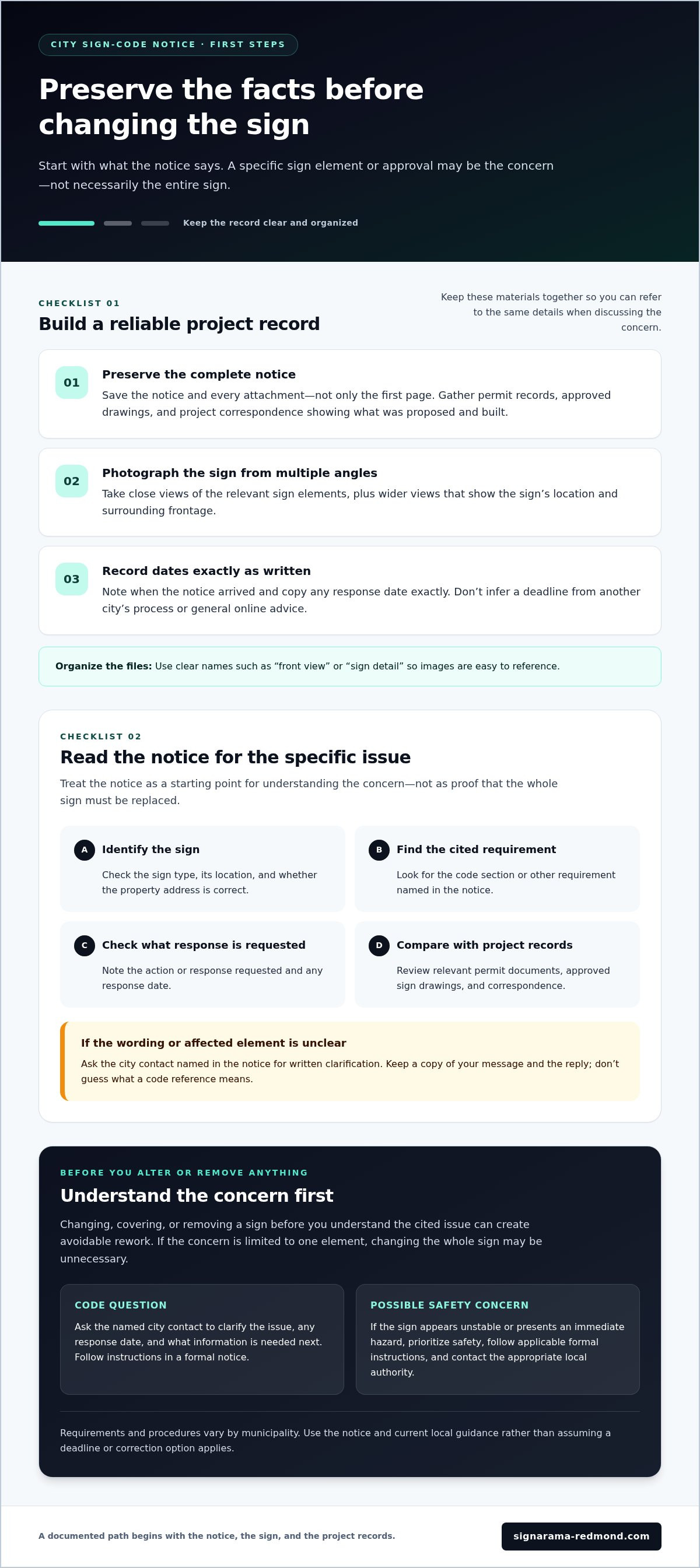
Preserve the records. Save the complete notice and every attachment. Gather permit records, approved drawings, and project correspondence that show what was proposed and what was built.
Photograph the sign. Take clear pictures from multiple angles. Include close views of the relevant sign elements and wider shots that show the sign’s location and surrounding frontage.
Record the dates. Note when the notice arrived and copy any response date exactly as written. Don’t infer a deadline from another city’s process or general online advice.
Keep the files together and name them consistently, such as “front view” or “sign detail,” so you can refer to the same image when discussing the concern. A Notice of violation generally communicates an alleged breach of a rule and may describe steps to address it. Use the notice and current guidance from the relevant city office to determine your next move.
What information should you preserve immediately?
Keep the full notice, not just the page that first caught your attention. An attachment may identify the sign feature, cited requirement, or requested response. Compare those details with your drawings and project correspondence, but don’t treat prior approval documents as proof that the current concern has been resolved. Together, these records can help you ask focused questions and track any changes.
Should you remove or change the sign right away?
Changing, covering, or removing a sign before you understand the cited issue can create avoidable rework. If the concern is limited to one element, for example, altering the whole sign may be unnecessary. Still, follow any instruction in a formal notice. If something is unclear, promptly request written clarification from the city contact named there.
Separate a possible safety concern from a code question. If the sign appears unstable or presents an immediate hazard, prioritize safety and follow any applicable formal instructions while contacting the appropriate local authority. For a compliance question, ask the named city contact to clarify the issue, any response date, and what information is needed next. Keep a copy of your message and the reply. Check Redmond requirements and procedures against current city guidance and the notice.
How to Understand a City Sign-Code Violation Notice
A sign-code violation notice identifies an alleged mismatch between a sign and a requirement that may apply to it. It should point you toward the concern, but the wording can be technical or brief. Treat it as a starting point for understanding the issue, not as proof that the whole sign must be replaced.
For a Redmond, Washington, property, start with the notice and current City of Redmond guidance. The applicable rule and responsible city office can depend on the property and the concern cited. Don’t rely on requirements from another city or an outdated sign-code reference.
Which details in the notice matter most?
Look for the sign type and location, the code section or other requirement cited, and the action or response requested. Check that the property address is correct. Then compare the notice with relevant permit documents, approved sign drawings, and project records. This can help you identify whether the concern appears to involve the sign’s approval or a particular feature.
A permit-related concern may differ from one about design, placement, dimensions, illumination, or a property-specific approval condition. These are possible categories, not conclusions about your sign. In cases where notices involve broader administrative or municipal permitting hurdles, consulting expediting specialists such as Cornerstone Permit Company can help clarify how jurisdictions process building violation responses and permit corrections. If the notice uses unclear terms, cites information that seems inconsistent, or doesn’t identify the affected element, ask the city contact named in the notice for written clarification. Don’t guess what a code reference means.
How do you verify the rule that applies in Redmond?
Use the official City of Redmond source or contact identified in your notice to check the current code wording and any relevant amendments. Look for conditions tied to the property’s approval as well, since a general code provision may not tell the full story. If you can’t locate the cited provision, ask the city contact to identify the applicable language and explain how it relates to the sign.
Keep your question specific: name the sign and property, quote the reference in the notice, and ask what feature needs attention and what response is expected. Check that any copied excerpt is current and applies to that property. Don’t infer dimensions, exemptions, deadlines, penalties, or appeal procedures from a general search result. Verify those details with the city.
Once the concern is clearer, Signarama Redmond’s sign and graphics team can compare the existing sign and its drawings with the city’s written feedback and develop practical design alternatives. That gives you a clearer basis for deciding what to discuss with the city next. Explore sign and graphics support as you work toward a revised sign plan.
Compare Sign-Code Correction Options Before Replacing the Sign
Once you understand the issue named in the notice, compare possible corrections against that specific requirement. Replacement is one option, not the default. The right response depends on the notice, site conditions, existing approvals, and rules that apply to the property. Even a small change may need city review, so don’t assume the sign can remain in place during a proposed change unless the city confirms it.
Use this comparison to frame the options, not to decide compliance on your own:
Option | Possible issue addressed | Effect on existing sign | City review |
|---|---|---|---|
Adjustment | A cited concern that may relate to position or alignment | May preserve most or all existing elements | Ask whether the proposed change needs review |
Component modification | A concern tied to one part, such as a panel or graphic element | Changes a specific component while potentially retaining others | Confirm whether revised drawings or review are required |
Relocation | A concern that may relate to the sign’s placement on the site | Retains the sign but changes its location | Check the proposed location against applicable requirements |
Redesign | A concern that the current configuration may not address through a limited change | Reworks some or several existing elements | Clarify what plans or review the city requires |
Replacement | A verified issue that cannot be resolved with a suitable change to the existing sign | Replaces the sign, though suitable components may be considered for reuse | Ask the city what review applies to the new plan |
When might a smaller adjustment address the cited issue?
Depending on the requirement, an adjustment could involve repositioning the sign or changing one element while retaining the rest. These are examples, not assurances that a change will resolve the violation. Match each proposed adjustment to the exact concern in the notice, then ask the city whether it addresses that concern and whether review is needed. A change that looks minor can still affect an approval.
When might redesign or replacement be considered?
Redesign may be worth exploring if the existing configuration can’t meet verified requirements through a focused adjustment or component change. Full replacement may be appropriate if the sign’s overall form or condition makes other options unsuitable. Before choosing, compare a revised concept that reuses appropriate existing components with a new sign plan. Signarama Redmond’s sign and graphics team can work with you to interpret documented city feedback and develop practical alternatives, without assuming any concept is approved.
If you’re weighing what to do if your new sign violates city code, make a short list of options and note which cited issue each one is meant to address. Bring that comparison, along with the city’s written direction, into the next review conversation. This keeps the decision tied to the actual concern rather than a premature assumption that everything must be replaced.
How to Document a Sign Correction and Coordinate City Review
A clear correction record connects the city’s feedback to the proposed change and the final sign. If you’re deciding what to do if your new sign violates city code, keep the process in order: clarify the cited requirement, prepare a revised concept, ask the city what materials or review are needed, and save its response. The city determines whether revised drawings, an application, or another review is required. Don’t assume a proposal is approved just because you submitted it.
What belongs in a sign correction file?
Build one organized file so you can follow the issue from notice to resolution. Include:
The complete notice and any attachments.
Photos of the existing sign and its location.
Permit records, approved drawings, and relevant project correspondence.
Dated notes describing each proposed revision and how it responds to the cited concern.
Copies of questions, submissions, city responses, and any approval or inspection records you receive.
Make the proposed change easy to compare with the installed sign. Label drawings or notes with the same sign element or code reference named in the notice. For example, if the notice points to a particular panel, identify it clearly in both the existing and revised views. Keep earlier versions too, so it’s clear which concept the city reviewed and what changed afterward.
How should you communicate with the city?
Use the contact and submission method provided by the city or stated in the notice. Ask focused questions: Which requirement applies to the sign? What feature needs correction? Does the proposed concept require revised drawings, an application, or another review? What response date or next step is stated for this case? For a Redmond property, verify current procedures and submission materials with the relevant city source or contact. Don’t rely on assumptions about local requirements or timelines.
After each conversation, save a dated summary and any written reply. If you submit revised materials, retain the exact version and note when and how it was sent. After the work is completed, keep records that show what changed and any city response or follow-up. This creates a practical record without treating a proposed correction as accepted before the city says so.
If the documented feedback points to a revised sign plan, Signarama Redmond’s sign and graphics team can compare the existing sign with the proposed changes and develop a clear concept for discussion. For related project context, see this guide to professional sign installation in Redmond. Learn more about local sign planning support as you organize your next steps.
How a Sign Professional Can Help Resolve a Code Problem
Once you’ve gathered the notice and city feedback, Signarama Redmond’s sign and graphics team can help turn the concern into practical design options. The team can review photographs of the existing sign, available drawings, and the specific issue described in the notice, then compare those details with a proposed revision. That gives you an organized basis for discussing possible changes with the city.
That collaboration is useful when you’re weighing what to do if your new sign violates city code. The goal is to explore sign or graphics concepts that respond to the information you’ve received, not to promise a particular outcome. The city decides whether a proposed change meets its requirements and what review is needed.
What can a sign team contribute to a correction plan?
A sign team can help you consider the physical sign alongside the documented concern. If the notice identifies a specific element, focus the discussion on that part rather than assuming the entire sign needs to change. Depending on the issue, possible concepts might involve adjusting the design, revising a component, or developing a broader redesign. Consider each option against the city’s written feedback.
Share any new city response as the discussion develops. That keeps design revisions connected to the latest information and your business goals. Signarama Redmond’s team can develop concepts and coordinate design changes with your city review process, while the city determines whether it will approve a proposal or consider the concern resolved.
What should you bring to a project discussion?
Bring the complete notice, permit records, approved drawings, photographs of the sign, and correspondence with the city. Point out the sign’s location and the specific change or concern identified. Explain what the sign needs to communicate for your business as well. A clear brief focuses the conversation on practical choices, while the city’s written feedback keeps the correction discussion grounded.
If the cited issue involves window graphics, such as a window-sign element identified in the notice, examples of custom window decals for Redmond businesses may help frame a relevant design conversation. If the notice concerns another sign type, keep the discussion focused on that sign.
Bring the records and city feedback to a discussion with Signarama Redmond to explore a correction plan that reflects the issue and your business needs. Discuss your sign correction plan with the local team.
Take the Next Step With a Clear Correction Plan
A city notice doesn’t automatically mean your sign needs full replacement. Start by identifying the specific concern, preserving the notice and project records, and checking the city’s current guidance for the property. Then compare possible adjustments, component changes, relocation, redesign, or replacement against the issue actually cited.
For what to do if your new sign violates city code, keep the process documented. Ask the city what review or materials a proposed correction requires, and save its response alongside your revised concept and project records. Signarama Redmond’s sign and graphics team can help compare the physical sign with documented feedback and explore practical design options, while the city determines whether its requirements are met.
Move forward with a clear record and a correction concept tied to the city’s feedback. Discuss your sign correction plan with Signarama Redmond.
Frequently Asked Questions
What should I do first if my new sign violates city code?
Preserve the complete notice and attachments, photograph the sign from several angles, and record when the notice arrived and any response date it states. Then identify the sign element and requirement cited. If the notice is unclear, contact the city representative named in it and ask for written clarification. The steps for what to do if your new sign violates city code depend on the notice and jurisdiction.
Can I keep my sign up while I work on a correction?
Don’t assume you can keep the sign in place while considering a correction. Read the notice for any specific instruction about the sign, and contact the city representative named there if you’re unsure what to do next. Ask in writing whether the sign may remain while the proposed correction is reviewed. Follow any formal directions you’ve received, and don’t treat a submitted proposal as permission to leave the sign unchanged.
Does a sign-code violation mean I have to replace the entire sign?
No. A notice doesn’t automatically mean full replacement is necessary. The right option depends on the specific issue, site conditions, existing approvals, and applicable rules. Depending on what the city identifies, possible options may include an adjustment, component modification, relocation, redesign, or replacement. Compare each option with the cited concern, and ask the city what review is needed before treating a proposed change as a resolution.
How do I find out which sign rule the city says I violated?
Look for the code reference, sign type or element, property address, and requested response in the notice. Compare those details with your permit records and approved drawings. If a reference is missing, unclear, or seems inconsistent with the sign, ask the city contact named in the notice to identify the applicable requirement and explain how it relates to your sign. For a Redmond property, use current official city guidance.
Can a sign company help correct a sign that violates city code?
Yes. Signarama Redmond’s sign and graphics team can review photographs of the sign, available drawings, and documented city feedback with you, then help develop practical sign or graphics concepts for consideration. This connects the cited concern to possible design changes without assuming full replacement is needed. The city decides whether a proposed correction meets its requirements and what review applies.
What documents should I gather before proposing a sign correction?
Gather the complete violation notice and attachments, photographs of the sign and its location, permit records, approved drawings, and relevant project correspondence. Include any written city responses and dated notes describing proposed revisions. Label images or drawings so they clearly identify the sign elements mentioned in the notice. Keeping the records together helps explain what exists, what the city identified, and how a proposed correction responds to the concern.
How do I check whether a sign correction needs city review?
Ask the city contact named in the notice whether your specific proposed change requires revised drawings, an application, or another form of review. Use the city’s stated contact and submission method, and check current official guidance for the property’s jurisdiction. Keep the question and response in writing with your project records. Requirements vary, so don’t assume a small adjustment is exempt or that submitting a proposal means it has been approved.

Signarama Redmond, WA
Summer Hours (July - August) - MON-THUR: 8.00AM - 6.30PM, FRI - SUN: CLOSED
contact
Signarama Redmond, WA