Your Consultative Signs and Graphics Partner for Eastside Businesses


Evaluating Sign Portfolios: A Redmond Business Guide
Sep 8, 2026 by Signarama Redmond

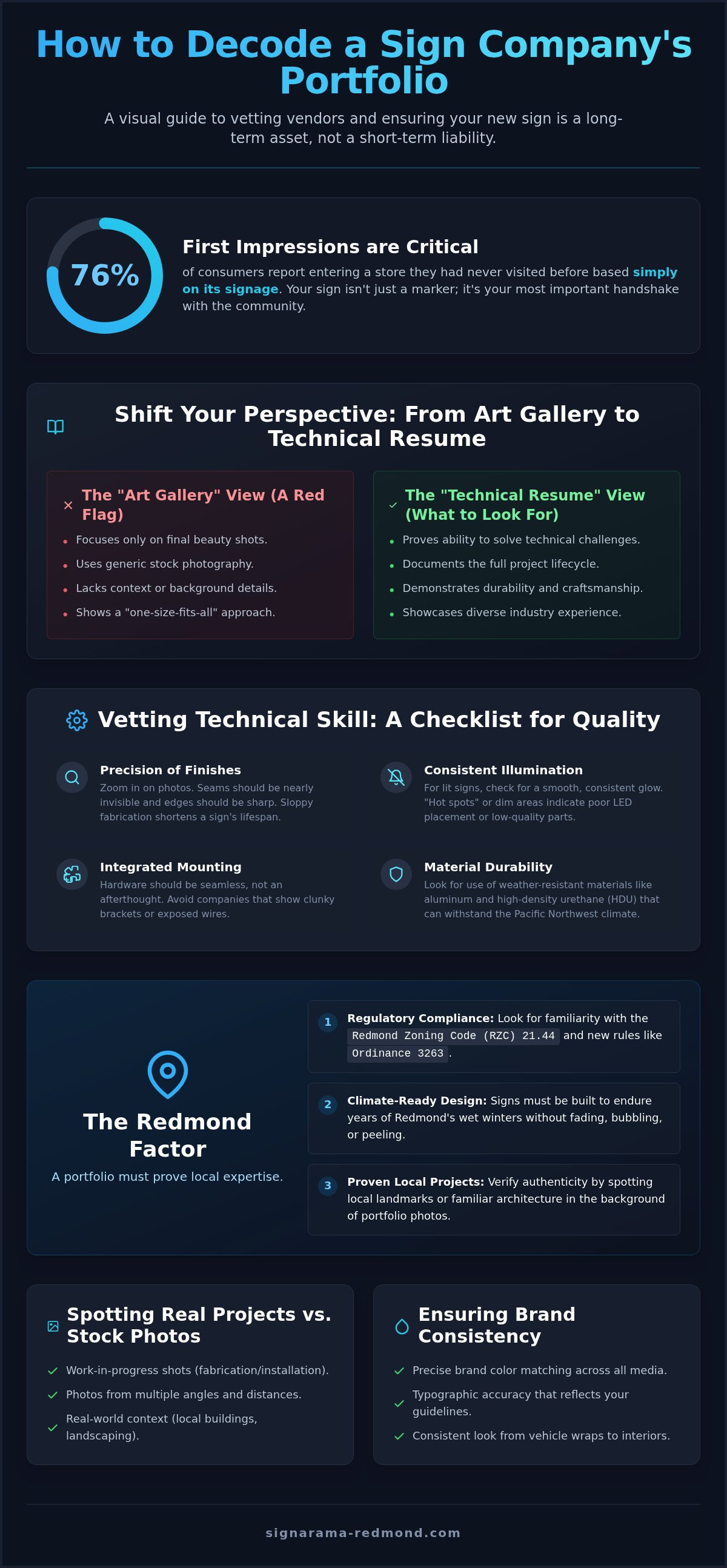
Did you know that 76 percent of consumers report walking into a store they had never visited before based simply on its signage? This statistic from August 2026 highlights why your storefront is your most important handshake with the Redmond community. When you are vetting potential partners, knowing exactly what to look for in a sign company's portfolio is the difference between a sign that fails in the first Pacific Northwest winter and one that drives growth for years. You likely worry about brand colors being slightly off or your investment failing to meet strict local standards.
We understand that a professional portfolio should be a record of solved technical and regulatory challenges, not just a gallery of art. In this guide, you'll learn how to decode a vendor's past work to ensure they have the technical skill and design range your project requires. We will provide a framework to judge material durability against our local weather and verify that a company understands the Redmond Zoning Code (RZC) 21.44. From navigating the new requirements of Ordinance 3263 to ensuring your blade sign meets the six square foot limit, we'll help you choose a collaborator who removes the uncertainty from your next project.
Key Takeaways
- Learn to treat a portfolio as a technical resume that proves a vendor's ability to handle complex installations rather than just displaying curated stock photography.
- Discover exactly what to look for in a sign company's portfolio by examining the precision of finishes and how seamlessly mounting hardware is integrated into the final project.
- Verify brand consistency by checking past work for precise color matching and typographic accuracy across different media, from vehicle wraps to office interiors.
- Identify signs built for longevity by looking for evidence of weather-resistant materials and designs that align with Redmond's specific permitting and compliance standards.
- Use existing portfolio pieces as inspiration anchors during your consultation to streamline the collaborative process from initial design to final installation.
Why a Sign Portfolio is More Than Just a Pretty Picture
A high-quality portfolio serves as a technical resume. It documents a company's ability to execute a complete project lifecycle from initial concept to final installation. You want to see that a vendor can manage every stage, ensuring that the design on the screen translates perfectly to the physical world. This holistic approach is vital for maintaining project timelines and quality control. When you are determining what to look for in a sign company's portfolio, prioritize evidence of durability and technical precision. A sign might look great on day one; however, the portfolio should suggest it will still look professional after five years of exposure to Redmond's wet climate. High-resolution images of completed work allow you to inspect the craftsmanship. You can see if the seams are tight, the colors are vibrant, and the materials, such as aluminum or high-density urethane (HDU), are used correctly.
Stock Photos vs. Real Projects: How to Tell
Generic stock photos are a red flag. They don't prove a company can actually build or install anything. To verify authenticity, look for local Redmond landmarks in the background of project photos. You might recognize a familiar street in Downtown Redmond or an office park near the Microsoft campus. Real projects often include:
- Work-in-progress shots: Photos of signs being fabricated in a shop or mounted on a building prove the company owns the process.
- Multiple angles: Seeing a sign from different perspectives proves it exists in a real-world environment rather than a digital mockup.
- Installation context: Genuine portfolios show signs interacting with local architecture, landscaping, and lighting.
The Portfolio as Proof of Partnership
A portfolio should showcase a collaborative partnership across diverse industries. If you only see one type of sign, the company might lack the flexibility your specific brand requires. Look for evidence that they can match exact brand guidelines and colors across different media. A "one-size-fits-all" approach often leads to signs that feel disconnected from your business identity. A diverse portfolio proves the team has the problem-solving skills to handle unique architectural challenges or strict local permitting requirements. This is a critical factor in what to look for in a sign company's portfolio if you want a hassle-free experience. We believe your sign provider should act as a competent collaborator. They should demonstrate experience with everything from retail storefronts to corporate interiors. This variety ensures they have the background to handle your specific project with professional execution.
Vetting Technical Skill: What to Look for in the Details
Determining what to look for in a sign company's portfolio requires a keen eye for technical execution rather than just a glance at the design. High-resolution photos allow you to zoom in on the "finish" of a project. Look closely at the edges of letters and the seams of lightboxes. In a professional build, seams should be nearly invisible. This level of detail isn't just about aesthetics; it's a marker of how well the sign will hold up against moisture and debris. If the fabrication is sloppy, the sign's lifespan will be significantly shorter. You want a partner who treats every joint and weld with precision.
Next, evaluate the mounting hardware. You shouldn't see exposed wires or clunky brackets that look like they were bought at a hardware store as an afterthought. A competent collaborator integrates the mounting into the design so it feels like a natural part of the building. For illuminated signs, check for "hot spots" or uneven lighting. A quality sign has a smooth, consistent glow across the entire face. If a portfolio shows spotty illumination, it's often a sign of poor LED placement or low-quality components. Finally, verify the scale of their work. A company that only displays small decals might not have the engineering capacity for large-scale monument signs that require structural permits and heavy machinery. You can view our gallery of completed work to see how we handle these complex technical requirements.
Material Integrity and Durability
Redmond's climate is notoriously tough on exterior graphics. When you review past work, look for evidence of weather-resistant materials. High-quality vinyl applications shouldn't bubble or peel at the edges, even after years of exposure to the Pacific Northwest's rain and wind. Durable materials like aluminum, acrylics, and high-density urethane (HDU) are preferred for local exterior projects because they don't warp or rust. If a company can show photos of projects that have aged gracefully over several years, it proves they select materials designed for longevity rather than just a low price point.
Complexity and Customization
A diverse portfolio should include more than just flat, standard signs. Look for examples of custom window decals to see how the team handles intricate detail work and surface adhesion. Seek out "difficult" installs, such as signs mounted on uneven masonry or at high elevations. These projects prove the vendor has the specialized equipment and safety training to handle non-standard requests. Evaluate the range of textures and finishes they offer. A company that successfully mixes matte acrylics with brushed metals shows a higher level of craftsmanship and a better understanding of modern brand aesthetics.
Assessing Brand Consistency Across Different Media
A professional sign company should act as a brand guardian for your business. When you are determining what to look for in a sign company's portfolio, you must look for evidence that they respect and maintain original brand guidelines across every project. Consistency isn't accidental; it's the result of rigorous technical calibration. If a company's portfolio shows a logo that looks bright red on a storefront but appears burgundy on a lobby sign, it indicates a lack of color management expertise. This visual disconnect can subtly erode customer trust before they even walk through your door. Your signs should provide a seamless experience that reinforces your professional identity at every touchpoint; to extend this consistency to your digital presence, you can learn more about BrandLume and their integrated branding solutions.
Typography is another critical area where consistency often falters. A competent collaborator won't settle for a font that is "close enough" to your original branding. They will use the exact typeface specified in your brand book. In a high-quality portfolio, you should see that the kerning, weight, and style of the text remain identical across diverse materials. Whether the brand is displayed on a textured masonry wall or a smooth glass partition, the character of the typography must remain intact. This attention to detail proves the sign shop understands the value of your intellectual property and has the software and skill to reproduce it accurately.
Interior and Office Signage Harmony
Review their office signs Redmond gallery for professional lobby integration. Your interior graphics should feel like a natural extension of your exterior brand. While browsing, look for ADA compliance markers in their interior signage photos. Accessibility requirements are a legal necessity; however, they should still look like part of your design. A great portfolio demonstrates how a company maintains brand aesthetics while meeting these strict standards. Assess how they handle various materials such as glass, wood, or brushed metal. A reliable partner ensures your logo looks identical whether it is etched into a glass door or mounted as a dimensional metal sign.
The Redmond Factor: Portfolio Evidence of Local Expertise
Recognizing a local business name in a gallery is more than a coincidence; it's a validation of reliability. When you see a storefront from Redmond Town Center or an office park near Marymoor Park, you know the vendor understands our community's standards. This local presence is a vital part of what to look for in a sign company's portfolio. It proves they aren't a distant online printer but a nearby collaborator invested in the region's success. These examples of sign installation Redmond projects demonstrate that the team can navigate our specific geography and architectural styles. A portfolio filled with local work suggests the company has a track record of successful project management within King County. Seeing familiar names gives you the confidence that they can handle the unique logistical needs of our area.
Redmond Sign Permits and Compliance
A beautiful sign is useless if it doesn't meet the Redmond Zoning Code (RZC) 21.44. Your portfolio review should look for "permit-ready" designs that align with local regulations. For instance, Redmond limits projecting blade signs to 6 square feet per face. If you see signs in a portfolio that clearly exceed these limits without a specific variance, the company might not be looking out for your legal compliance. You should also look for an understanding of new regulations, such as Ordinance 3263, which establishes a framework for temporary signage starting January 1, 2027. The permit approval process in our area typically takes 4 to 6 weeks, and application fees can be around $525. A local expert will factor these timelines and costs into your project plan from the start. You can partner with a local expert to ensure your next project meets every municipal requirement.
Durability in the Pacific Northwest
Redmond's weather is a unique challenge for any physical asset. A portfolio should show signs that have clearly survived multiple PNW winters without fading, rusting, or rotting. Moisture is the primary enemy here. Look for evidence of moisture-resistant materials and secure mounting systems designed to withstand local wind loads. UV-resistant coatings are also essential for outdoor graphics to prevent the sun from bleaching your brand colors during our brighter months. If a company's past work looks crisp and vibrant after years in the rain, it's a sign of superior material selection. Ask if their monument signs include proper drainage and if their wall mounts use non-corrosive hardware. These small technical choices determine whether your investment lasts for two years or twenty.
Plan Your Project with Signarama Redmond's Portfolio
Think of our portfolio as more than a gallery of past work. It's a practical toolbox for your next big idea. When you are deciding what to look for in a sign company's portfolio, use our completed projects as "inspiration anchors" during your initial consultation. Seeing a physical result helps you move past abstract concepts and into concrete planning. Our "Our Work" section provides a transparent look at the full project lifecycle. You can see how an initial design sketch evolves into a finished product that stands proudly in the Redmond community. This transparency ensures there are no surprises when your own installation day arrives. We take pride in being a competent collaborator that manages every detail from concept to completion.
A collaborative partnership starts with a shared vision. We encourage you to identify the specific materials and styles that resonate with your business goals. Perhaps you like the sleek look of brushed aluminum or the modern feel of backlit acrylic. By referencing our past Redmond success stories, we can quickly determine the technical requirements for your specific site. This proactive approach saves time and ensures your final sign aligns perfectly with your brand's personality and the local architectural environment. It's about finding a solution that drives growth and increases your visibility.
Finding Your Sign Style
Every business has a unique personality that its signage must reflect. If you're preparing for an industry event, browse our trade show displays Redmond projects for creative ideas that grab attention in crowded halls. For your permanent location, consider which lobby sign styles fit your office environment:
- Acrylic Signs: These offer a modern, clean look with high-gloss finishes and sophisticated mounting.
- Backlit Displays: Use these to create a premium, high-impact presence that works day or night.
- Metal Lettering: Choose brushed or polished metals for a sense of permanence and professional prestige.
Before our meeting, write down two or three links from our gallery. Sharing these specific examples helps us understand your aesthetic preferences immediately. It allows us to provide a more accurate quote and a streamlined design process. We want to ensure your investment delivers the maximum return for your brand.
Next Steps: From Portfolio to Production
We don't just replicate old photos; we bridge the gap between a design you admire and a custom sign that works for your unique space. Our project managers play a vital role in this transition. They ensure that the portfolio-level quality you see online is exactly what is delivered to your doorstep. They manage the timelines, the permits, and the professional execution of every detail. This structured management approach removes the uncertainty often associated with custom fabrication. We invite you to schedule a visit to our Redmond facility. You can see physical material samples and discuss your vision with our expert team in person.
Build Your Brand with a Trusted Redmond Partner
Your business signage is a long-term investment in your visibility and growth. By understanding what to look for in a sign company's portfolio, you can move beyond simple aesthetics to verify technical durability and brand consistency. A professional gallery should prove a vendor's ability to navigate Redmond's specific zoning codes while using materials that withstand our Pacific Northwest winters. You deserve a collaborator who treats your brand guidelines with the same respect you do. This ensures every color and font is reproduced with absolute precision across all your physical assets.
We invite you to take the next step toward a high-impact storefront. Our team provides expert local sign installation in Redmond and a collaborative design process for every project. We offer comprehensive solutions from concept to completion, removing the uncertainty from your project lifecycle. Explore the Signarama Redmond Portfolio and Start Your Partnership Today. We look forward to helping you create a sign that represents your business with excellence and supports our local community goals.
Frequently Asked Questions
How can I tell if a sign company actually installed the signs in their portfolio?
You can verify authenticity by looking for local Redmond landmarks or street signs in the background of the images. Genuine portfolios often include work-in-progress photos showing the team in branded apparel during the fabrication or installation stages. If all the photos look like polished studio shots with generic backgrounds, they might be stock images. Authentic work usually features realistic environmental contexts that prove the company owns the entire project lifecycle.
Should I look for a specific industry in a sign company's past work?
It's beneficial to see work within your sector, but a broad portfolio proves versatile problem-solving skills. If a company successfully handles complex requirements for retail, healthcare, and corporate offices, they likely have the technical range to adapt to your needs. When determining what to look for in a sign company's portfolio, prioritize technical execution and material variety over industry-specific examples. A competent collaborator can translate their expertise across different business types effectively.
What if a company doesn't have a portfolio for the specific sign type I need?
Look for projects that share similar materials, lighting styles, or installation complexities. If you need a custom illuminated sign but only see non-lit versions, check for other electrical work like digital displays or backlit channel letters. This demonstrates their capacity to handle wiring and electrical permits. A diverse portfolio suggests a team that isn't afraid of custom requests and has the foundational skills to tackle new, unique signage challenges for your Redmond business.
Is it okay to ask for the address of a sign in their portfolio so I can see it in person?
Yes, requesting a physical address is an excellent way to verify quality and durability. Seeing a sign in person allows you to inspect how it has aged against the Pacific Northwest weather. You can check for fading, peeling, or rust that might not be visible in a professional photo. Most reputable companies are proud to share the locations of their work in Redmond and the surrounding municipalities to demonstrate their long-term reliability.
How many projects should a 'good' sign company portfolio have?
A high-quality portfolio focuses on a diverse range of projects rather than a massive quantity of similar photos. You should look for at least 15 to 20 distinct projects that showcase different materials, sizes, and installation environments. This variety proves the company isn't a "one-trick pony" and can handle everything from vehicle graphics to large monument signs. A curated selection of successful work is always more valuable than a repetitive gallery of basic decals.
Does a portfolio show if a sign company handles permits and city codes?
It does, specifically through the presence of permanent, large-scale installations like monument or pylon signs. These types of projects always require municipal permits and adherence to the Redmond Zoning Code. When you are deciding what to look for in a sign company's portfolio, look for signs that are clearly integrated into the local landscape. This suggests the company has successfully navigated the local regulatory framework and the design review board process for their clients.
What is the difference between a sign gallery and a sign case study?
A sign gallery is a visual collection of finished products designed to show style and variety. A case study goes deeper by explaining the specific problem, the design process, and the final solution. Case studies are particularly useful because they highlight a company's role as a proactive partner. They show how the team overcame architectural hurdles or strict permitting limits, providing a more comprehensive look at their project management skills and professional execution.
Can a portfolio help me estimate the cost of my own sign project?
While a portfolio doesn't list specific prices, it helps you understand the complexity and material costs involved. Higher-end materials like brushed metals or complex LED illumination naturally require a larger investment than flat vinyl graphics. You can use portfolio images to show your project manager exactly what you want. This helps them provide a more accurate quote based on the specific styles and finishes that align with your budget and business goals.

Signarama Redmond, WA
Summer Hours (July - August) - MON-THUR: 8.00AM - 6.30PM, FRI - SUN: CLOSED
contact
Signarama Redmond, WA