Your Consultative Signs and Graphics Partner for Eastside Businesses


Dimensional Lettering for Walls: The Complete Guide to 3D Office Signage
Jun 10, 2026 by Alex Fong
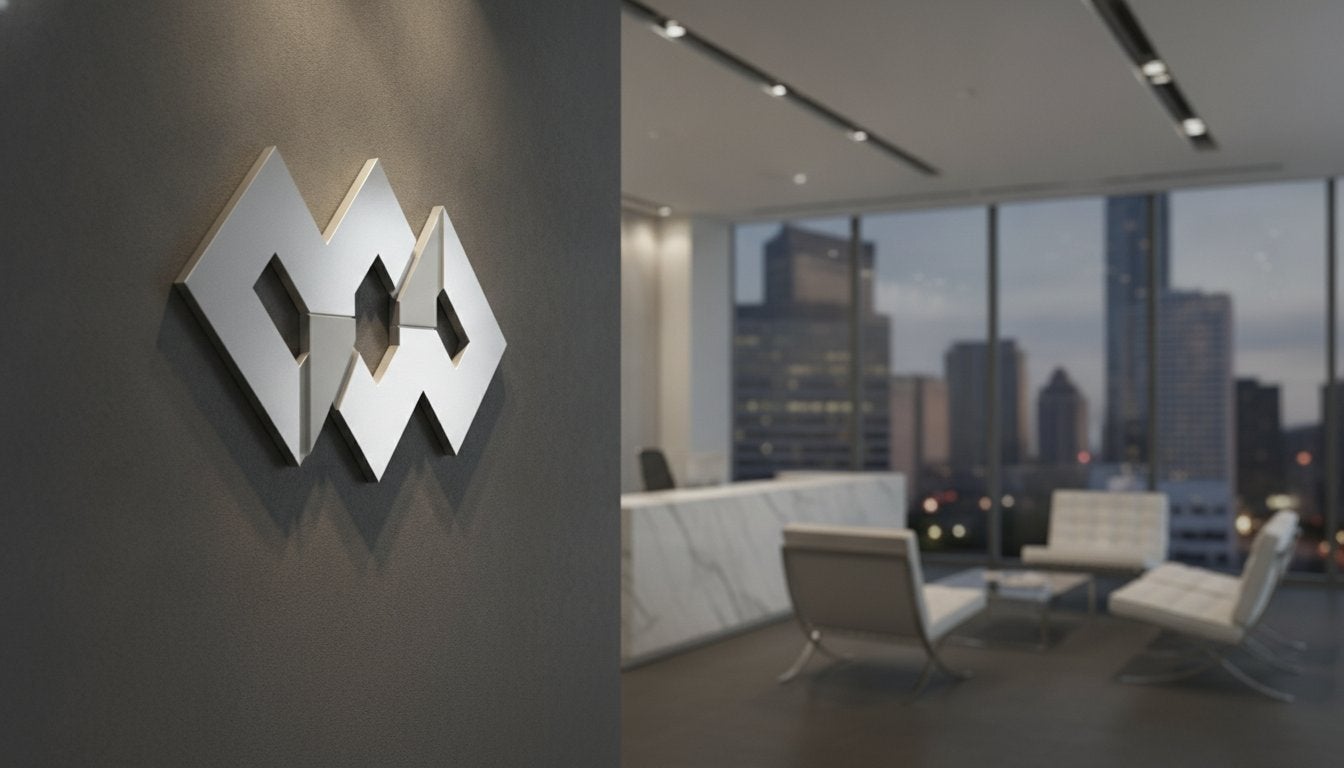
Flat vinyl graphics might work for a temporary window sale, but they often fall short when you're trying to establish true brand authority in your lobby or boardroom. You've likely noticed that a two-dimensional sticker simply doesn't command the same respect as a physical, architectural element. It's a common concern for growing businesses that want to look established without the "cheap" feel of basic decals. Choosing high-quality dimensional lettering for walls is the most effective way to bridge the gap between simple graphic design and professional interior architecture.
We understand that selecting the right signage involves more than just picking a font. You might worry about damaging your office walls during installation or feel overwhelmed by the choice between premium metals and budget-friendly plastics. This guide promises to simplify that process. We'll break down the durability of different materials, explain how metal options can last up to a decade, and help you match your signage to your budget. You'll learn how to achieve a high-end look that impresses every client who walks through your door. From the initial concept to the final mounting, we're here to ensure your brand stands out in three dimensions.
Key Takeaways
- Learn how the "Visual Magnitude" effect uses physical depth to create a premium brand feel that standard flat signs simply cannot replicate.
- Compare the durability and costs of high-quality materials for dimensional lettering for walls, including professional-grade metal, versatile acrylic, and lightweight foam.
- Discover why your 2D logo requires careful translation for 3D surfaces, focusing on critical design elements like kerning and strategic lighting.
- Identify the correct mounting methods for different wall types to ensure your signage is perfectly aligned and securely installed without damaging your property.
- Explore a collaborative, process-driven approach to signage that moves your project seamlessly from initial concept to professional completion in the Greater Eastside.
What is Dimensional Lettering and Why it Outperforms Flat Signs
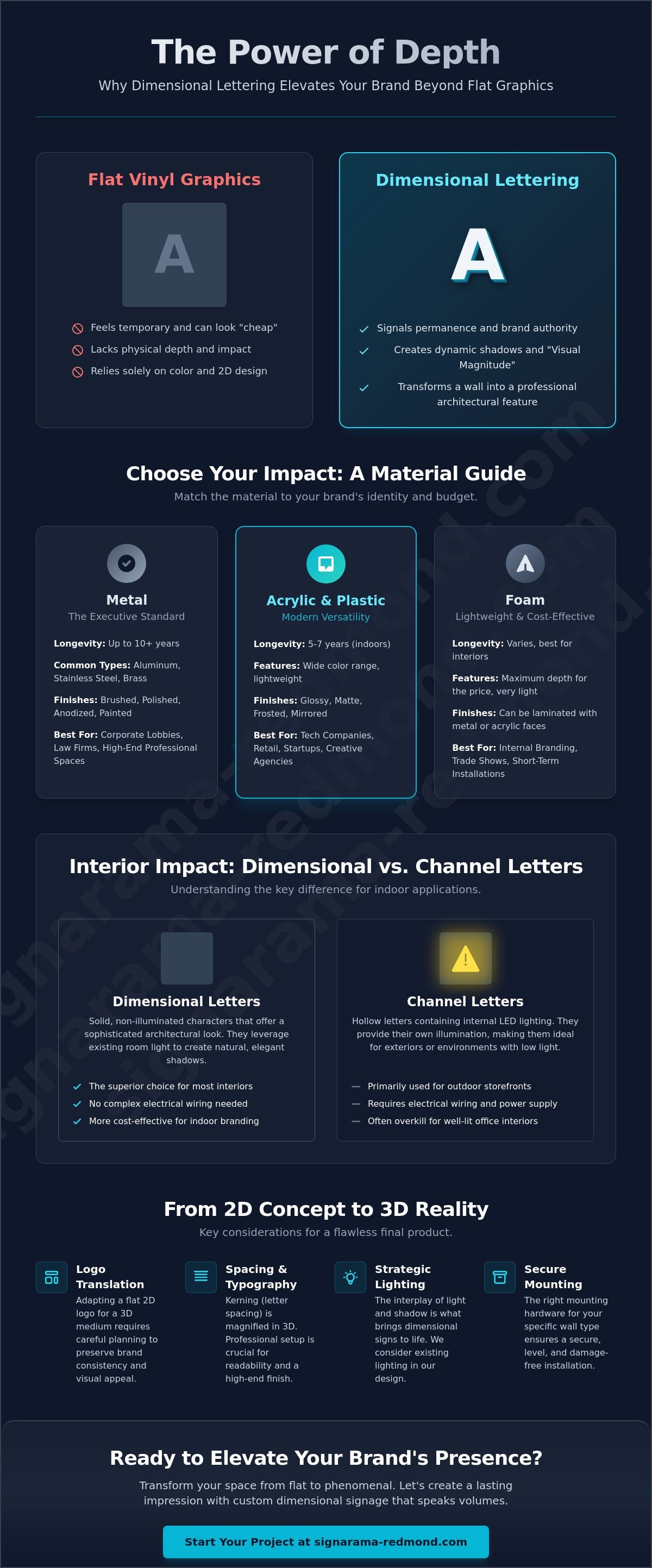
Dimensional lettering for walls consists of individual 3D characters, logos, or symbols that are precision-cut from solid materials and mounted directly to a surface. Unlike flat vinyl graphics or printed decals that sit flush against a wall, these signs possess physical depth and texture. This physical presence creates what designers call the "Visual Magnitude" effect. As light moves across your office throughout the day, the shadows cast by the letters shift and change. This creates a dynamic, high-end appearance that flat signage simply cannot replicate. For businesses in Redmond and the Greater Eastside, this isn't just about aesthetics; it's a strategic investment in how your brand is perceived by every visitor who enters your space.
While vinyl graphics are excellent for temporary promotions or window displays, they often lack the "wow factor" required for a corporate headquarters or a professional medical clinic. Dimensional signs are designed for longevity and impact. You'll commonly find these high-impact signs in several key areas:
- Corporate Lobbies: Creating a powerful first impression for clients and new hires.
- Conference Rooms: Reinforcing brand identity during high-stakes meetings.
- Retail Storefronts: Using depth to catch the eye of passersby in busy shopping centers.
- Wayfinding: Providing clear, readable directions that stand out from the wall.
The Psychology of 3D Branding
Physical depth signals stability and permanence to your clients. In our digital-first world, most brand interactions happen behind a screen, which can feel fleeting. A tactile, physical sign provides a sense of "weight" and history. When a visitor sees thick, well-crafted dimensional lettering for walls in your reception area, they subconsciously associate that physical presence with a reliable, established company. It transforms a generic office into a branded environment that feels both intentional and professional. This tactile experience is especially critical in high-traffic areas where you want to communicate authority and attention to detail.
Dimensional Letters vs. Channel Letters
It's helpful to understand the technical difference between dimensional letters and channel letters. While they look similar from a distance, the primary distinction is illumination. Channel letters are hollow boxes that contain internal LED lighting. Dimensional letters, by contrast, are solid and non-illuminated. For interior office walls that already benefit from professional lighting or large windows, dimensional signs are often the superior choice. They offer a sophisticated, architectural look without the need for complex electrical wiring or power supplies behind your drywall. This makes them a more cost-effective solution for interior branding while still delivering a premium, three-dimensional finish.
Choosing the Right Materials: Metal, Acrylic, and Foam
Selecting the right material is the most critical step in your signage project. It's where your design vision meets your budget and functional needs. In 2026, we're seeing a surge in mixed-material designs that combine the sleekness of metal with the vibrant colors of acrylic. Your choice will ultimately depend on where the sign is placed and the specific message you want to convey about your brand's quality. While aesthetic goals are important, you also need to consider material longevity. High-quality dimensional lettering for walls can last between 7 to 10 years when crafted from durable metals, making it a reliable long-term investment for your workspace.
Metal Letters: The Executive Standard
Metal remains the gold standard for businesses that want to project an image of permanence and high-end professionalism. Aluminum is a favorite for businesses in Redmond because it's naturally rust-proof and handles our Pacific Northwest humidity without issue. It's incredibly versatile and can be painted to match any brand color or left with a classic brushed or anodized finish. For an even more upscale look, stainless steel and brass offer a heavy, premium feel that's perfect for law firms or executive suites. These materials resist fading and maintain their polished or satin appearance for years with minimal maintenance.
Acrylic and Plastic Letters: Color and Versatility
Acrylic is the go-to material for modern tech offices and creative spaces. Because it's laser-cut, we can achieve incredibly sharp edges and replicate intricate logo details with high precision. It's available in a vast array of standard colors, or it can be back-painted to match your specific brand guidelines exactly. If you want the look of metal but need to keep the weight down, formed plastic is another excellent alternative. It provides a rounded, architectural depth that adds a sophisticated touch to any interior wall without the higher cost of solid plate metal.
High-Density Foam: Impact on a Budget
If you're looking for extreme depth, high-density foam is the most effective solution. It allows you to create letters that are two or three inches thick without requiring heavy-duty mounting hardware. This makes it ideal for lightweight interior walls or temporary branded displays. To get the best of both worlds, many clients choose metal-laminated foam. This product features a thin layer of real aluminum or brass over a foam core, giving you the executive "look" of solid metal at a much more accessible price point. If you're unsure which material fits your lobby, our team can help you compare custom signage options during a quick consultation.
Designing for Impact: Spacing, Typography, and Lighting
Translating a digital logo into physical dimensional lettering for walls requires more than just adding depth to a flat file. A design that looks perfect on a business card or a website header can become unreadable when rendered in three dimensions. This "translation" process involves adjusting the kerning, or the space between individual letters. In 3D signage, every character casts a physical shadow. If characters are spaced too closely, these shadows overlap, making the words appear muddy or blurred from a distance. We typically recommend slightly wider spacing for dimensional projects to ensure each character remains distinct and legible under various lighting conditions.
Choosing the right thickness is equally vital to the final impact. A small logo in a narrow hallway usually only needs 1/4 inch or 3/8 inch of depth. However, for a large lobby wall in a corporate headquarters, you might opt for 1 inch or even 2 inch thickness to ensure the sign has enough "weight" to command the room. Thicker letters create more dramatic shadows, which enhances that premium, architectural feel. If your signage needs to be readable from 50 meters away, a combination of bold stroke width and significant thickness is essential for maintaining clarity.
Font Selection for 3D Success
Not all fonts are created equal when it comes to physical fabrication. We often advise our partners to avoid overly thin serif fonts. These delicate features can become fragile during the cutting process and are prone to snapping during installation or cleaning. Sans-serif fonts are generally the executive standard for metal and acrylic because their clean, consistent lines maximize the architectural aesthetic. Additionally, for interior directional signage, we ensure your 3D lettering meets ADA compliance standards regarding character height and tactile finishes, keeping your Redmond office accessible for everyone.
Lighting Strategies for Dimensional Signs
Lighting is the secret ingredient that brings 3D signage to life. You don't always need internal LEDs to make a massive impact. Utilizing your office's existing track lighting can create dramatic drop shadows that emphasize the depth of each letter. If you prefer a softer, more modern look, we can mount non-illuminated letters using spacers or "stand-offs." This creates a halo effect, allowing ambient light to pass behind the sign and create a glowing silhouette on the wall. When working with polished metal or high-gloss acrylic, we carefully position the letters to avoid harsh glare from overhead fixtures, ensuring your brand remains visible and professional from every angle.
Professional Installation: Mounting Methods and Wall Types
The final stage of your branding project is arguably the most critical. Even the most expensive metal characters look unprofessional if they're crooked or spaced incorrectly. We use precision-cut mounting templates for every project to ensure every character aligns perfectly with your brand's specific design. This eliminates guesswork and ensures a level finish across the entire wall. Professional installation also guarantees safety. Heavy metal letters require secure anchoring to prevent them from falling, which protects both your property and your visitors. When you invest in dimensional lettering for walls, the installation should be as high-quality as the sign itself.
Different wall surfaces require specialized hardware and techniques. Drywall is common in most offices but requires specific anchors for proper weight distribution. If your Redmond headquarters features industrial brick or textured stone, we use masonry bits and specialized adhesives to ensure a permanent bond. For glass partitions in modern office suites, we utilize visual-grade adhesives that maintain a clean, professional look from both sides of the window. Our goal is to ensure your signage looks like a natural, built-in part of your interior architecture.
Common Mounting Techniques
- Stud Mounting: This is our primary recommendation for heavy-duty metal characters. We drill small holes into the wall and insert threaded studs attached to the back of the letters for maximum security.
- Pad Mounting: This is ideal for surfaces like tile or marble where deep drilling is risky. We use specialized adhesive pads that distribute the weight of the letter across the surface.
- Tape or Adhesive Mounting: This is the best solution for lightweight acrylic or foam on smooth interior walls. It provides a clean, drill-free finish that's easy to maintain.
Preparing Your Redmond Office for Install
Proper preparation ensures a seamless installation day. If you've recently repainted your office, the paint must cure for at least two weeks before we arrive. Installing dimensional lettering for walls on fresh paint often leads to adhesive failure as the paint continues to outgas. We also help you determine the optimal mounting height based on the average viewing distance in your lobby. A sign placed too high or too low loses its architectural impact. Our team at Signarama Redmond prioritizes a "no-mess" process, using dust-collection tools during drilling to keep your professional environment pristine throughout the appointment. If you're ready to transform your lobby, you can request a professional signage consultation to discuss your specific wall type and design needs.
Maintaining your new signage is straightforward. A light dusting with a microfiber cloth every few weeks prevents buildup in the crevices of the 3D characters. We recommend avoiding harsh chemical cleaners that can strip the finish off anodized aluminum or cloud the surface of polished acrylic. With minimal care, your dimensional sign will remain a focal point of your office for years to come.
Elevate Your Space with Signarama Redmond’s Custom Signs
We view every signage project as a collaborative partnership rather than a simple transaction. Our goal is to position your business as a leader in your industry by providing a comprehensive, all-in-one solution for your branding needs. From the initial design phase to navigating local permitting and completing the final installation, we handle every detail. This holistic approach ensures a streamlined and hassle-free experience for our clients across Redmond, Bellevue, and the Greater Eastside. By utilizing state-of-the-art fabrication technology, we deliver precision results that match your brand's exact specifications for dimensional lettering for walls.
Our process is built on structured management and clear timelines. We understand that your time is valuable, so we act as your guide to remove uncertainty at every stage. Whether you are a growing startup or an established corporate headquarters, we provide the technical expertise and local knowledge required to make your interior signage a success. We take pride in being a nearby resource that supports the growth of our local business community through high-quality visual communication.
The Signarama Redmond Difference
What sets us apart is our deep commitment to the local community. Our team provides personal consultations to ensure your signage aligns with your specific environment and business goals. We have built a strong portfolio of 3D signs for prominent tech and retail leaders throughout the Pacific Northwest. This experience allows us to recommend the best materials and mounting methods for the unique architectural styles found in our region. When you work with us, you're partnering with local experts who are invested in your brand's long-term visibility and success.
Start Your 3D Signage Project Today
Ready to transform your office environment? Requesting a custom quote is the first step toward a more professional workspace. To make your initial consultation as productive as possible, please have your high-resolution logo files ready and take a few photos of the wall where you plan to install your dimensional lettering for walls. These details allow us to provide accurate recommendations on scale, material, and depth. Partner with Signarama Redmond for your 3D wall letters and let us help you create a lobby that leaves a lasting impression on every client who walks through your doors.
Build a Lasting Brand Presence with Custom 3D Signage
Choosing the right dimensional lettering for walls is about more than just picking a material; it's about making a deliberate architectural investment in your brand's authority. By selecting high-quality, architectural-grade materials like aluminum or precision-cut acrylic, you ensure your lobby makes a powerful first impression for years. The success of your sign depends on the harmony between thoughtful typography, strategic lighting, and professional mounting. These elements work together to transform a standard office wall into a dynamic statement of professionalism and stability.
At Signarama Redmond, we simplify this journey by offering a comprehensive design-to-install solution. We take pride in our local Redmond expertise and our collaborative partnership approach. Our team is ready to guide you through every stage, from the initial concept to a final, mess-free installation. We’re committed to delivering results that reflect the quality of your business and support your long-term growth. Request a Collaborative Consultation for Your 3D Wall Sign to start your project today. We look forward to helping your business stand out and succeed in our local community.
Frequently Asked Questions
How much does dimensional lettering for walls cost?
The cost of your project depends on several factors, including material choice, letter height, and mounting complexity. Metal options generally require a higher investment due to their long-term durability and premium feel, while acrylic and foam offer more budget-friendly alternatives for interior spaces. We recommend a personal consultation to determine which materials and finishes best align with your specific branding goals and budget.
Can I use my specific brand font for 3D letters?
Most custom brand fonts can be replicated accurately in three dimensions. Our state-of-the-art fabrication technology allows us to follow your exact brand guidelines and logo shapes. We may suggest minor modifications if your font features extremely thin serifs or intricate details that could become fragile when cut from solid materials like aluminum or thick acrylic.
Will dimensional lettering damage my office walls?
Professional installation is designed to protect your property and ensure the structural integrity of your walls remains intact. While mounting dimensional lettering for walls involves creating small holes for studs or using industrial adhesives, these methods are standard and manageable. Our team uses precision tools to ensure the installation is secure and professional without causing unnecessary harm to your drywall or masonry.
How long does it take to design and install 3D wall signs?
The timeline from your initial concept to final completion typically spans two to three weeks. This duration accounts for the collaborative design phase, material sourcing, precision fabrication, and the scheduled installation at your office. We provide a clear project schedule at the beginning of our partnership so you can plan your office updates or grand opening with confidence.
Is dimensional lettering suitable for outdoor use in Redmond?
Many of our high-quality materials are specifically chosen for their ability to withstand the Pacific Northwest climate. Aluminum is a top choice for outdoor applications in Redmond because it is naturally rust-proof and resists moisture. We also utilize UV-resistant paints and coatings to ensure your exterior signage maintains its vibrant color and finish despite our seasonal weather changes.
What is the difference between dimensional letters and 3D signs?
These terms are often used interchangeably, but they can have technical distinctions in the signage industry. Dimensional letters are typically solid, non-illuminated characters cut from a single piece of material. The broader category of 3D signs can include internally lit channel letters or complex, layered logo panels. Both options provide the physical depth and brand authority that flat graphics cannot achieve.
Can I move my dimensional letters if my office relocates?
You can relocate your signage, but it requires a careful removal process to avoid damaging the characters. We can assist with the removal and provide a new precision mounting template for your new facility. You will typically need fresh mounting hardware or adhesives to ensure the letters are just as secure and perfectly aligned in your new workspace as they were in the old one.
How do I clean and maintain my 3D wall letters?
Maintenance is straightforward and helps your signage look its best for years. We recommend using a dry microfiber cloth to gently remove dust from the top edges and crevices of the letters every few weeks. It's best to avoid harsh chemical cleaners or abrasive pads, particularly on polished metal or high-gloss acrylic, as these can cloud the surface or damage the protective finish.


Signarama Redmond, WA
Summer Hours (July - August) - MON-THUR: 8.00AM - 6.30PM, FRI - SUN: CLOSED
contact
Signarama Redmond, WA