Your Consultative Signs and Graphics Partner for Eastside Businesses


Commercial Property Sign Management in Kirkland: A Practical Buying Guide
Sep 28, 2026 by Signarama Redmond

What if the hardest part of managing commercial property signs isn’t choosing a design, but keeping every sign accounted for as tenants and needs change? With commercial property sign management Kirkland, an outdated tenant panel, a hard-to-read shared-area sign, or a missing record can turn a small update into a frustrating project.
Property teams need signs to look consistent and stay legible, but they may not have one place to track sign types, locations, condition, and approvals. Treating every sign as a one-off makes changes harder to coordinate. A lifecycle approach gives your team a clearer way to plan, review, and follow up.
This guide lays out a practical framework for building a sign inventory, setting an approval process, and organizing tenant-facing and shared-area signage. You’ll also learn what to confirm about local requirements and responsibilities before making changes, and how to evaluate a sign-and-graphics partner such as Signarama. The goal is a more consistent process, from the first sign record to the next tenant update.
Key Takeaways
Bring tenant and shared-area signs into one consistent system to support clear navigation and a coherent property experience.
Use a repeatable process to audit signs, set standards, route requests, verify requirements, and review updates.
Compare internal coordination, one-off purchases, and a partner relationship by scope, contacts, approvals, records, and follow-up responsibilities.
Make commercial property sign management Kirkland easier to organize with a checklist for sign condition, tenant changes, and pending approvals.
Before choosing a sign-and-graphics partner, prepare your property information and confirm which services and local requirements apply.
Table of Contents
Why commercial property sign management in Kirkland needs a consistent system
How to compare commercial sign management options in Kirkland
How Kirkland property managers can keep sign programs organized
Choosing a commercial sign partner for your Kirkland property
Why commercial property sign management in Kirkland needs a consistent system
Commercial property signage changes as tenants move in, businesses update their names, and shared spaces take on new uses. Each change may seem small, but without a clear process it can leave outdated messages in place, create conflicting requests, or make it unclear who approves the next step. A consistent approach to commercial property sign management Kirkland gives owners and property teams a reliable way to coordinate those details.
Signage also shapes how people experience a property. Visitors need to find entrances, locate tenants, and understand where to go next. A coordinated system can support tenant visibility while helping signs in shared areas feel like they belong to the same property. This connects to the principles of wayfinding, the process of navigating a physical environment. Good management goes beyond designing one attractive sign: it considers how signs work together over time.
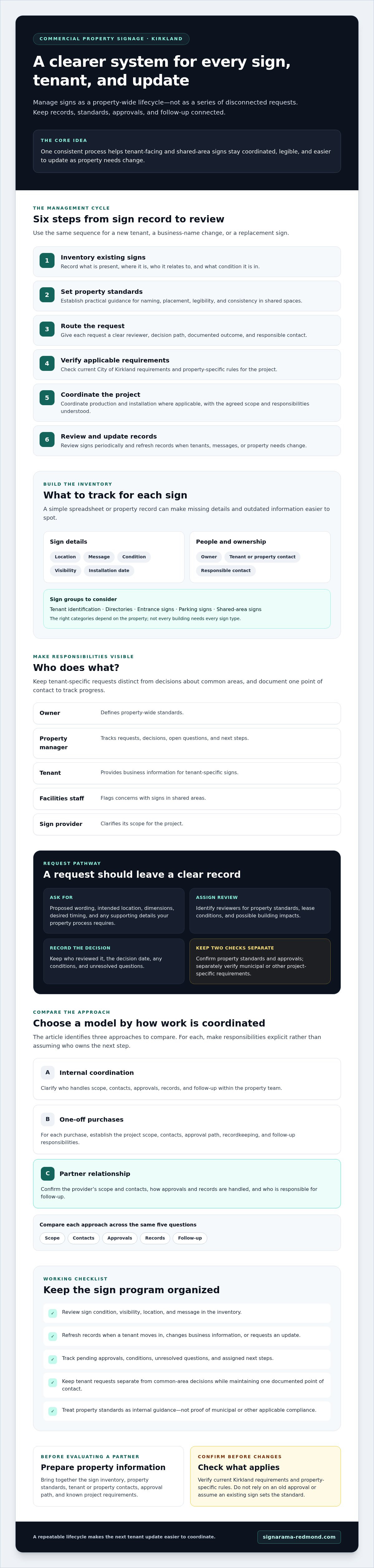
Think of the work as a lifecycle: inventory existing signs, establish standards, route requests for approval, confirm project requirements, coordinate production and installation where applicable, then review the signs periodically. Clear records show what exists and needs attention, instead of relying on memory when a tenant change comes up.
Which signs belong in a commercial property inventory?
Group signs by location and purpose. Depending on the property, categories may include tenant identification, directories, entrance signs, parking signs, and signs in shared areas. Not every building needs every category. For each sign, record its location, owner, message, condition, installation date, and responsible contact when known. A simple spreadsheet or property record can make missing details and outdated information easier to spot.
Who should own sign decisions for a Kirkland property?
Set roles before requests arrive. The owner may define property-wide standards, while the property manager tracks requests and decisions. Tenants can provide business information for their signs, facilities staff can flag shared-area concerns, and a sign provider can clarify its scope. Keep tenant-specific requests separate from common-area decisions. Assign one documented point of contact to track approvals, open questions, and next steps.
This structure doesn’t mean every sign needs the same treatment. It means each request has a path, a record, and a responsible person. For projects in Kirkland, verify current city requirements and property-specific rules rather than relying on an old approval or assuming a previous sign sets the standard. That foundation helps the process work smoothly, whether the task is a new tenant sign or an update to existing information.
How to build a property-wide sign management process
A repeatable workflow helps property teams handle signs consistently without treating every request as a new project. Use the same sequence for a new tenant, a revised business name, or a replacement sign: audit what exists, apply property standards, route the request, verify applicable requirements, and review the result. Each change then has a clear next step and a documented decision trail.
Start with a sign audit and property standards
Use the property inventory as a working record. For each sign, note its location, message, condition, visibility, and relevant tenant or property contacts. Then set practical standards for naming, placement, legibility, and consistency in shared spaces. Keep the standards specific to the property and treat them as an internal guide, not proof that a sign meets municipal or other applicable requirements.
Refresh the record when a tenant moves in, changes its business information, or requests an update. A new tenant request may need proposed wording and a location; a routine correction may only require confirming the new wording and identifying the affected sign. In either case, recording the change helps prevent outdated information from lingering in directories or other property signs.
Route tenant requests through clear approval steps
Give tenants a consistent way to submit requests. Ask for proposed wording, the intended location, dimensions, and desired timing, along with any supporting details required by your property process. Assign reviewers for property standards, lease conditions, and possible building impacts. Record who reviewed the request, the decision date, any conditions, and unresolved questions so the team can follow up without relying on memory.
Keep two checks distinct. First, confirm the property’s standards and approval process. Separately, verify whether municipal requirements or other project-specific approvals apply. A landlord’s approval doesn’t replace a required municipal review, and checking municipal rules doesn’t automatically satisfy lease or property standards. For current local code, consult the City of Kirkland’s Kirkland Municipal Code for signs, then confirm how the requirements apply to the particular project rather than assuming every sign follows the same path.
Close the loop by updating the inventory after a change, noting outstanding work, and setting a reminder to revisit sign condition and accuracy. This turns commercial property sign management Kirkland into an ongoing process, not a collection of disconnected purchases. If you are considering a sign-and-graphics partner, use the workflow and open questions to clarify the scope of Signarama’s sign and graphics offering.
How to compare commercial sign management options in Kirkland
The right approach depends on how often signs change, how much coordination your team can take on, and which responsibilities need outside support. For commercial property sign management Kirkland, compare the work and accountability each option covers, not just the sign itself. Internal coordination, one-off purchases, and an ongoing partner relationship can each make sense in different situations.
Internal coordination: Property staff manage requests and records directly. This keeps decisions close to the property, but requires a clear owner for approvals, documentation, and follow-up.
One-off sign purchasing: The team sources signs as needs arise. This may suit occasional changes, but confirm who coordinates tenant details and keeps property-wide standards consistent.
Partner relationship: A provider may be able to support some stages of the work. Confirm the exact scope in writing rather than assuming it includes ongoing coordination or property management.
To compare options fairly, build a simple table with columns for scope, assigned contacts, approvals, documentation, and follow-up responsibilities. Fill in each column for every approach. This makes gaps visible, such as having a sign provider but no named person responsible for tenant communication or approval records.
Questions to ask a sign provider before choosing
Ask which stages the provider can support, such as consultation, design, production, installation, or later updates. Confirm who handles tenant communication, site details, approval coordination, and schedule changes. Request examples relevant to your property type, and verify that they reflect genuine work. A provider’s sign-and-graphics offering alone doesn’t establish that every stage is available.
What belongs in a useful scope of work?
Make the written scope specific enough to guide daily decisions. List sign categories and locations, expected deliverables, review responsibilities, and exclusions. Clarify how revisions, tenant turnover, damaged signs, and new requests will be handled. Name who checks property approvals and whether anyone will confirm if municipal permits or other requirements apply. Don’t leave those responsibilities implied.
Before selecting a partner, ask for written confirmation of the services available for your property and location. Keep the final record with the property’s sign inventory and approval history. A clear scope helps the owner, property manager, tenants, and provider work from the same expectations, while leaving room to choose a different approach if the property’s needs change.
How Kirkland property managers can keep sign programs organized
A useful sign program needs regular attention, but the right review cadence depends on the property. A site with frequent tenant changes may need more frequent updates than one with stable occupancy. Build reviews around actual conditions and changes, and keep a running log so issues don’t disappear between check-ins. This makes commercial property sign management Kirkland an ongoing operational task rather than a scramble prompted by a complaint.
Use a simple review cycle and change log
During each review, check for signs that are damaged, difficult to read, obstructed, or out of date. Compare tenant names and locations against current records, and note approvals or questions that remain unresolved. A practical change log can include:
Date and location: When the issue was identified and where the sign is located.
Issue and responsible person: What needs attention and who will follow up.
Decision and status: What was approved or remains open, and whether the update is complete.
Recheck directory and wayfinding information when tenants move, rename their businesses, or change access details. A sign can be in good physical condition and still send visitors to the wrong place. Record the correction and update the relevant property information once the change is confirmed.
Verify Kirkland and property-specific requirements
For each proposed project, check current City of Kirkland guidance for the specific sign type, site, and work involved. The city’s codes and laws portal is a starting point for locating municipal information. Don’t assume that an earlier sign approval, another property’s experience, or an internal standard answers the requirements for a new project. Confirm details with the appropriate city contact when they’re unclear.
Run a separate property review as well. Check lease terms, owner standards, and the applicable building or site approval process. These checks address different questions: municipal guidance doesn’t replace property approval, and property approval doesn’t establish that municipal requirements have been met.
Escalate concerns about accessibility, visibility, or signs in shared spaces when the team can’t confidently assess them. Ask an appropriate authority or qualified professional to review relevant accessibility questions, and consult qualified help if a proposed sign may affect circulation, sightlines, or shared-area use. Document the question, reviewer, and decision so assumptions don’t become informal policy.
If you are considering outside help with signs or graphics, review Signarama’s signs and graphics offering and confirm whether the location and services fit your Kirkland property.
Choosing a commercial sign partner for your Kirkland property
A useful partner is one whose confirmed scope matches the work your property needs. Some teams may need signs or graphics for a specific tenant update; others may be looking for support across a broader set of property signage needs. For commercial property sign management Kirkland, compare what a provider can commit to in writing with the responsibilities your team needs covered. Don’t assume that selling signs and graphics includes approvals, installation, maintenance, or ongoing coordination.
Prepare for an initial property signage discussion
Bring information that makes the conversation specific: an inventory or site plan, location notes, current sign photos, tenant contacts, and any property standards already in use. Separate immediate needs, such as a damaged or outdated sign, from longer-term goals like consistent tenant identification or clearer wayfinding. Share known approval questions and ask the provider to identify what remains uncertain, including which approvals are still the property’s responsibility.
This preparation helps distinguish a defined sign request from a larger management need. If you’re seeking more than signs or graphics, spell out the expected role and ask whether the provider can confirm that scope. Signarama offers signs and graphics. Ask directly whether it can support property-management coordination and whether its services are available for your Kirkland property.
Agree on responsibilities before work begins
Before moving forward, ask for written details that name the requested deliverables, review contacts, communication steps, and process for documenting changes. Confirm how tenant information will be reviewed, who provides property details, and who will follow up on unresolved questions. If your request includes design, production, installation, permitting, maintenance, or portfolio coordination, verify each item separately rather than treating it as part of a general offer.
Keep a simple responsibility list alongside the proposal. For each task, note whether the provider, property team, tenant, or another reviewer is responsible. Confirm who checks municipal requirements and property approvals; don’t assume those checks transfer to the provider. A clear record makes it easier to compare proposals and spot gaps before work begins.
You don’t need every detail settled before starting a conversation. Prepare your property information, explain the immediate need and longer-term priorities, and ask what scope can be confirmed.
Make your property’s sign program easier to manage
A clear inventory, documented approval path, and practical review routine give your team a stronger foundation for commercial property sign management Kirkland. Keep tenant updates and shared-property standards distinct, and verify city requirements and property rules for each project. When comparing providers, focus on written scope and confirmed responsibilities rather than assumptions about what a partner can handle.
Signarama offers signs and graphics, but confirm directly which services are available for your property and location. Bring your property information, current priorities, and approval questions to an initial discussion, then agree on responsibilities before work begins.
Discuss your commercial property signage needs with Signarama and confirm what support may fit your property.
Frequently Asked Questions
What does commercial property sign management include?
Commercial property sign management can include maintaining an inventory, coordinating tenant requests, applying property standards, documenting approvals, and tracking updates. The exact scope varies by property and provider. For a Kirkland property, confirm who handles each task and whether design, production, installation, permitting coordination, or ongoing maintenance is included. Don’t assume these responsibilities are part of a sign purchase or a provider’s general offer.
How do property managers organize signs for multiple tenants?
Start with a location-based inventory that records each sign’s message, condition, tenant, and responsible contact. Add written property standards and a consistent request and approval process. Keep dated decision records, then update directories and wayfinding information when tenants move, rename their businesses, or change access details. Adapt the process to the building’s leases and operating responsibilities so everyone knows who reviews and coordinates each change.
Do commercial signs in Kirkland need permits?
Permit requirements can depend on the sign, site, and proposed work, so don’t assume every sign follows the same process. Check current City of Kirkland guidance and the property’s approval rules before ordering or installing a sign. Confirm who is responsible for checking requirements and coordinating any approvals that may apply. A property manager’s or landlord’s approval shouldn’t be treated as a substitute for checking municipal requirements.
Who is responsible for tenant signs in a commercial property?
Responsibility depends on lease terms, property rules, and where the sign will be located. A tenant may propose identification for its business, while the owner or manager may set property-wide standards or control shared areas. Put review roles and approval steps in writing. This helps tenants, managers, facilities staff, and any sign provider understand who makes decisions, who supplies information, and who tracks the request.
How often should commercial property signs be reviewed?
There isn’t one review schedule that fits every property. Check signs when tenants change, messages become outdated, damage affects legibility, or property operations shift. A documented periodic review can help catch issues between those events. Set the cadence to match sign condition, tenant activity, and your team’s capacity. Record findings and follow-up so a sign that needs attention doesn’t get lost among routine property tasks.
What should I ask a sign management provider before hiring them?
Ask which services are included, who coordinates tenant communication, how revisions are documented, and how updates are handled. Confirm separately whether design, production, installation, permitting coordination, or ongoing maintenance is available. Request a written scope that identifies responsibilities, exclusions, and follow-up steps. Verify local service availability and relevant experience rather than assuming a provider serves your property or manages every part of the process.
Can one sign provider manage every sign on a commercial property?
A provider may support several sign types, but available services and project scope vary. First list the property’s sign categories and management needs, then ask which stages the provider can handle. Confirm exclusions, approval responsibilities, communication expectations, and local availability in writing. Signarama offers signs and graphics, but confirm directly whether its services cover your Kirkland property before treating it as a complete solution.


Signarama Redmond, WA
Summer Hours (July - August) - MON-THUR: 8.00AM - 6.30PM, FRI - SUN: CLOSED
contact
Signarama Redmond, WA