Signarama Santa Rosa, CA
Your local team for quality signs in Sonoma, Marin, Napa and Lake Counties


Laguna Treatment Plant, Phase 1: Bringing Water Treatment to Life
Nov 16, 2026 by Matthew Vella
Laguna Treatment Plant, Phase 1: Bringing Water Treatment to Life
A wastewater treatment plant contains processes most people rarely see. Pipes, tanks, clarifiers, filtration systems, and treatment equipment do essential work, but the machinery alone cannot explain what happens at each step.
For the City of Santa Rosa’s Laguna Treatment Plant, signage helps make that complex environment more accessible to visitors. A series of blue TOUR STOP displays provides explanations and diagrams at different points in the facility, while coordinated graphics carry the water theme into the entrance, corridors, and interior spaces.
In Phase 1 of the signage project, Signarama Santa Rosa’s work brought together custom tour-stop signs, printed interpretive panels, large-format wall graphics, entrance treatments, and additional facility signage at 4300 Llano Road in Santa Rosa. The photographs show these different applications working in settings ranging from equipment-filled outdoor process areas to interior hallways and doorways.
The central idea is straightforward: put understandable information where people encounter the process it explains.
Turning an Industrial Site Into an Educational Experience
An industrial facility and a visitor-facing exhibit have different communication needs. Technical equipment is designed to perform a job; interpretive signage is designed to help people understand it.
At Laguna Treatment Plant, the tour-stop displays bridge that difference. They stand close to processing structures, pipes, tanks, and other equipment. Each display identifies a stage or topic and uses a combination of short explanations and illustrated diagrams to present the information.
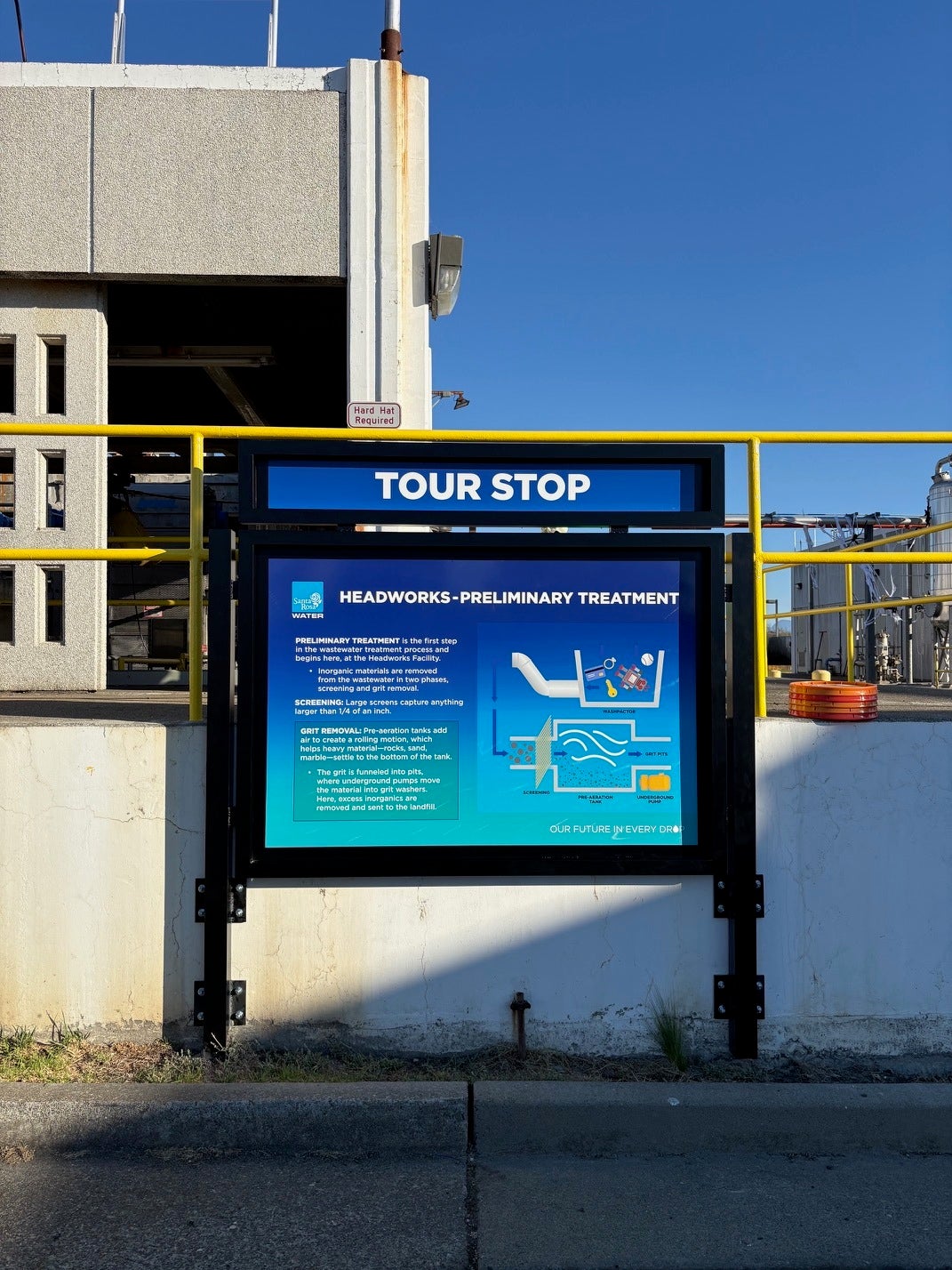
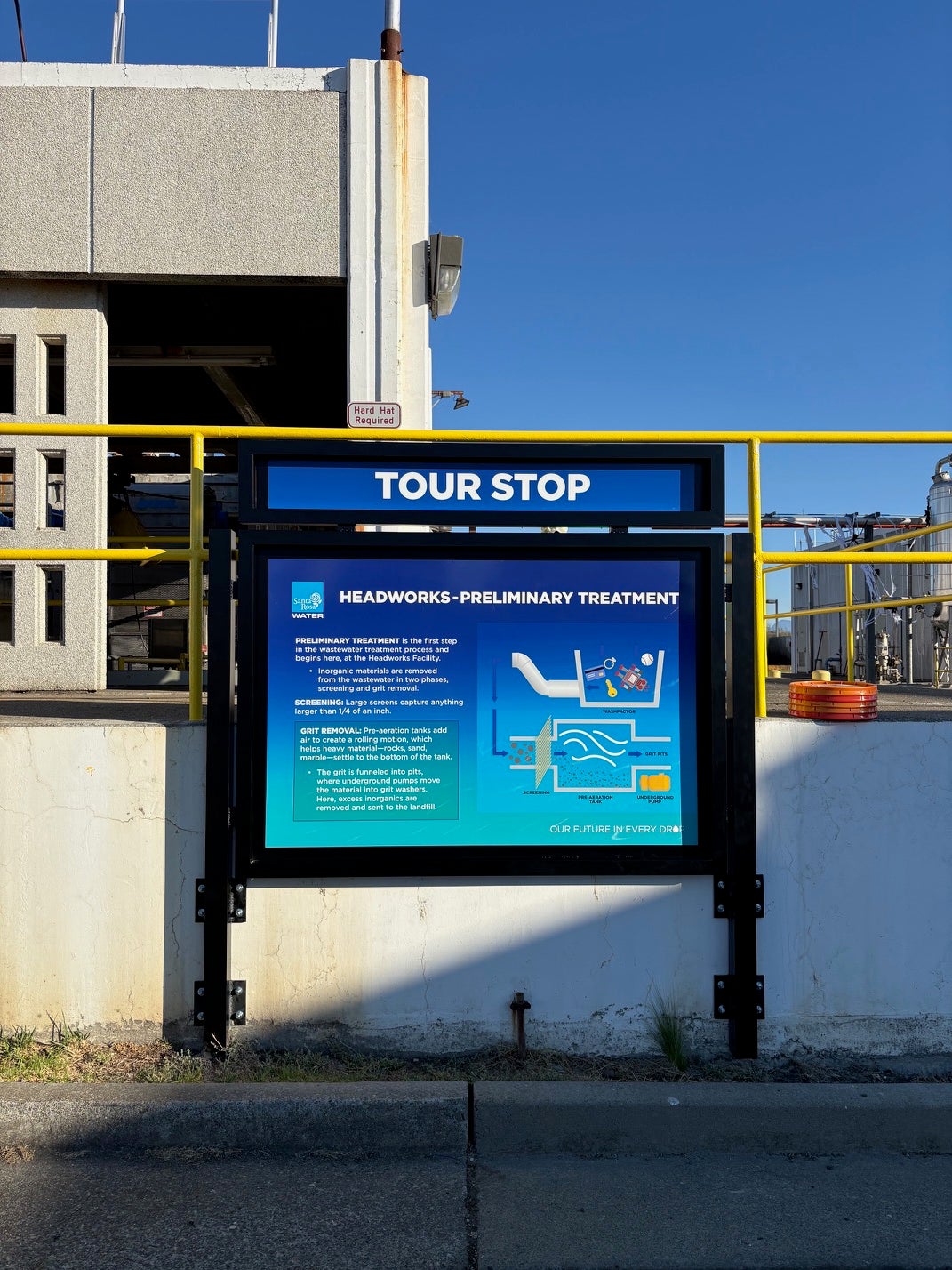
The same visual structure repeats from one stop to another. A blue header reads TOUR STOP, and the main panel carries the Santa Rosa Water identity, an explanatory title, graphics, and the closing phrase “Our Future in Every Drop.”
That repetition matters. Once a visitor recognizes the appearance of a tour stop, the next panel is easy to identify, even when the surrounding equipment changes dramatically.
The work order for this phase specified ten tour-stop sign assemblies, with printed graphics and field installation. The completed photographs show both freestanding signs anchored to concrete and a sign mounted directly against an existing industrial wall.
Following the Stages of Water Treatment
The supplied photographs document displays covering several different parts of the treatment process. Together, they provide a useful sequence of topics without requiring every visitor to already understand the terminology.
Headworks: Preliminary Treatment
One tour-stop panel is labeled HEADWORKS—PRELIMINARY TREATMENT. It explains the initial removal of inorganic material and includes a diagram illustrating screening and grit removal.
The sign sits against a low industrial wall, with yellow safety railings and plant structures visible behind it. That setting makes the graphic more than a stand-alone poster: the text and illustration appear directly within the environment the visitor is learning about.
Primary and Secondary Treatment
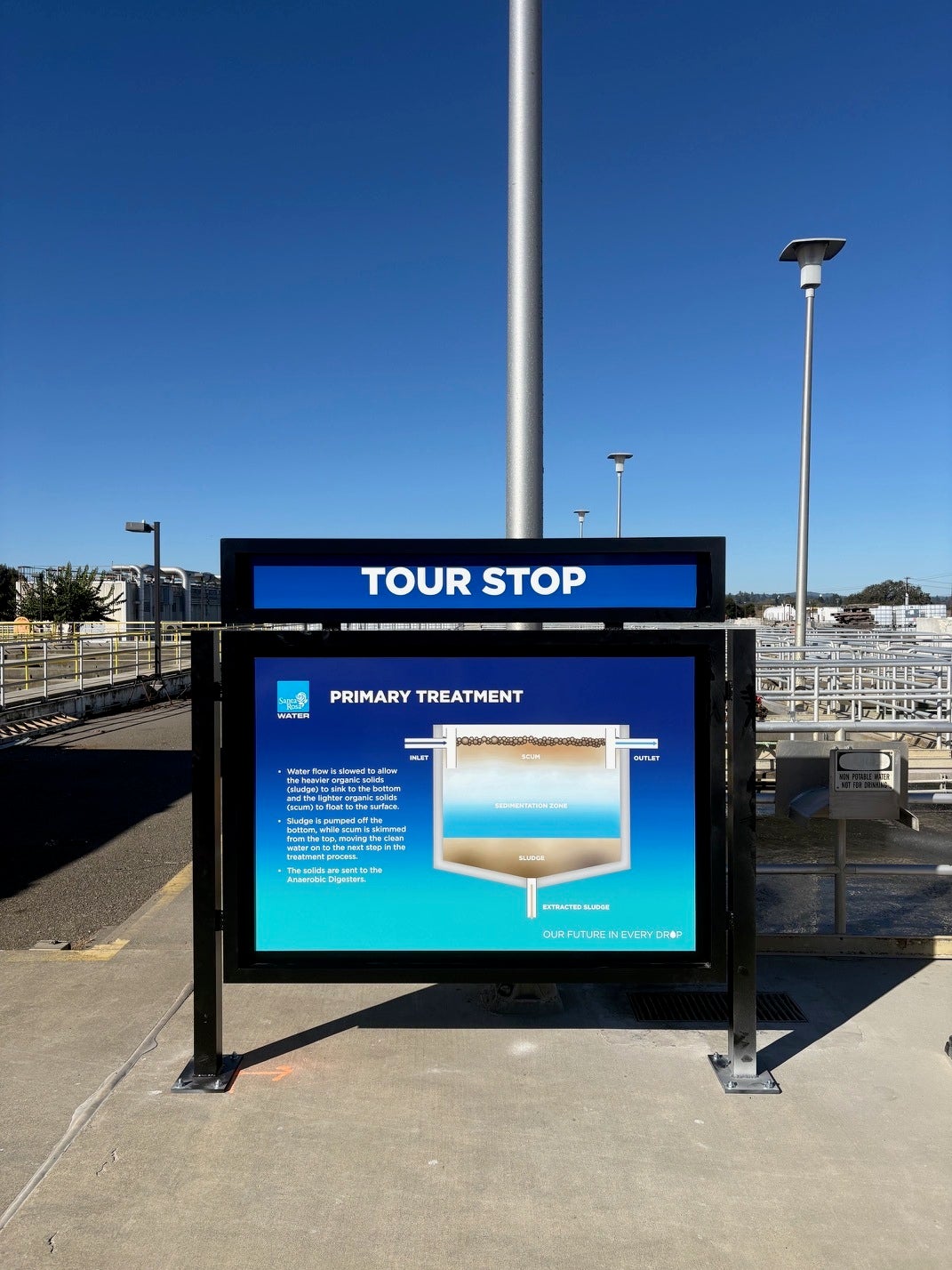
Another panel is devoted to PRIMARY TREATMENT, showing a cross-section of a treatment tank and labeling areas such as sludge and scum. The panel stands in front of railings and treatment infrastructure.
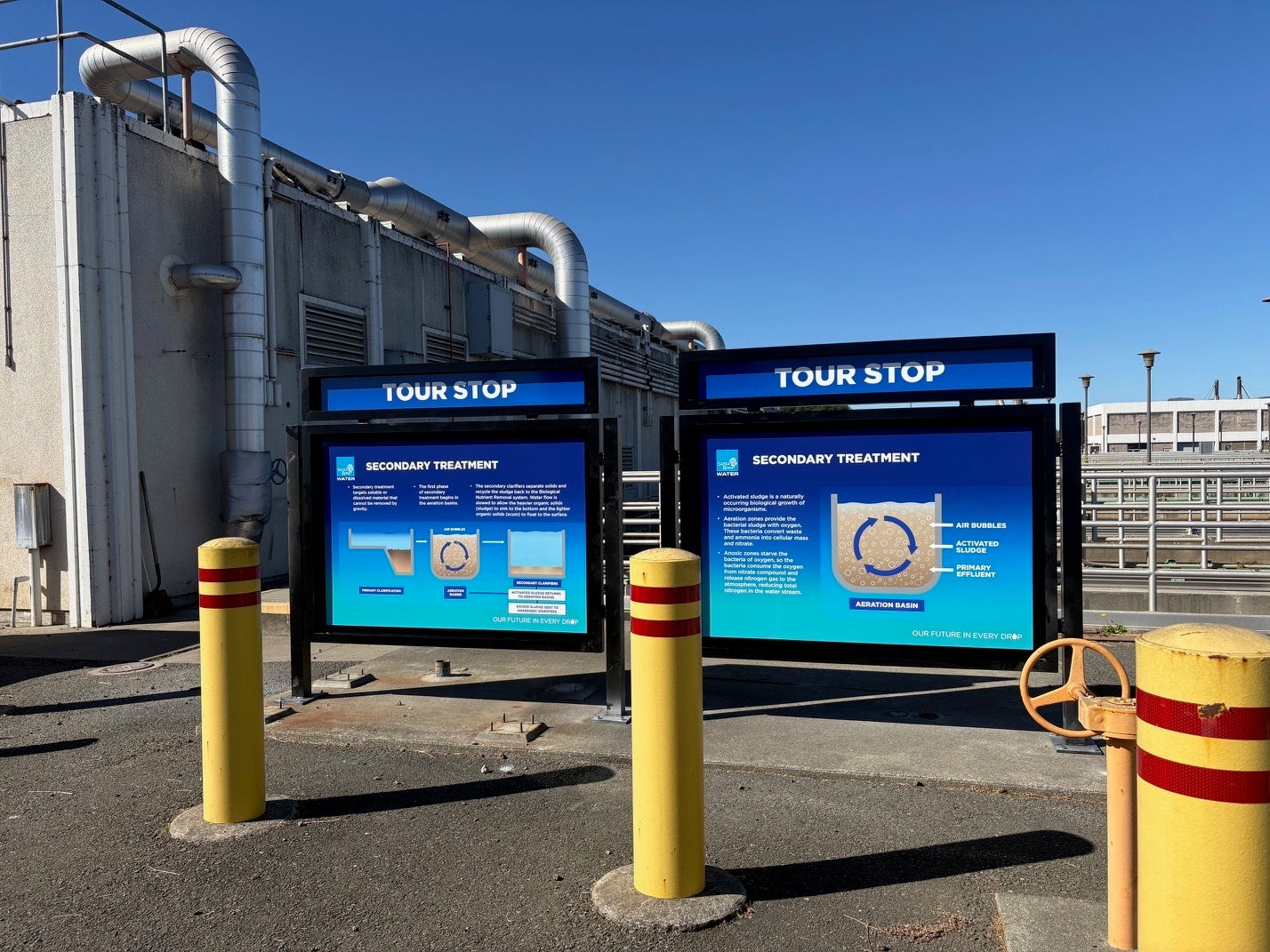
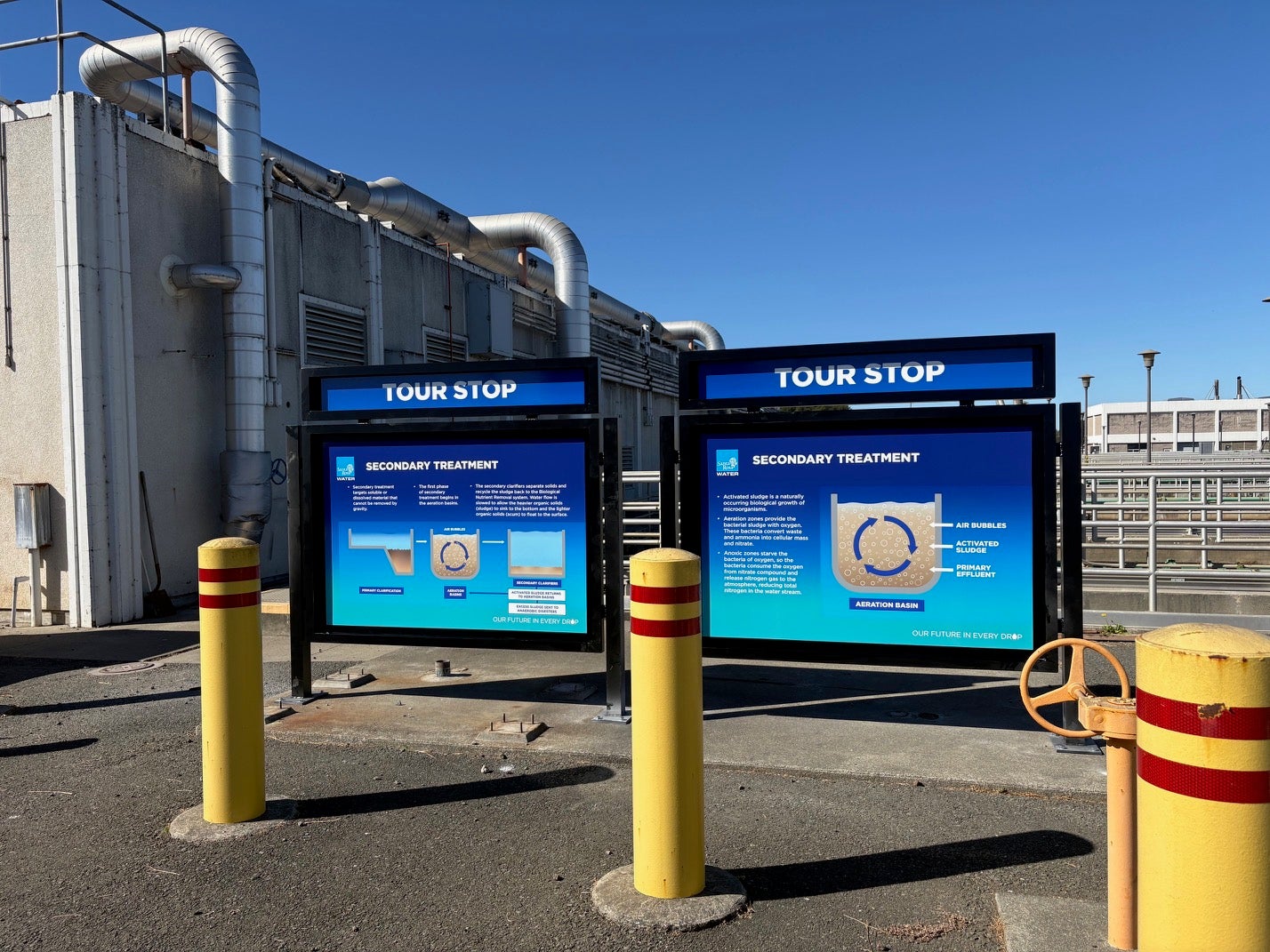
Two neighboring SECONDARY TREATMENT displays expand the story. One illustrates the progression through aeration and clarifiers; the other focuses on the activated-sludge process, including air bubbles and organisms involved in treatment.
The photographs show the two secondary-treatment signs installed beside one another. Their matching black frames, blue headers, and turquoise-to-blue graphics create a deliberate pair, even though the educational content differs.
A separate SECONDARY CLARIFIERS panel continues the explanation with a diagram showing material settling and being separated during treatment.
For someone visiting the plant, this is a useful example of how a complex topic can be divided across several stops rather than crowded into one oversized display.
Tertiary Treatment and UV Disinfection
The TERTIARY TREATMENT panel is mounted to a large concrete wall. Its diagram illustrates filtration, continuing the process after earlier treatment stages.
The ULTRAVIOLET DISINFECTION display covers another topic: using UV light as part of the disinfection process. That sign sits along a paved area beside a large facility structure.
These two displays use the same recognizable visual language while adapting to different locations. One is wall-mounted; the other is supported by a freestanding frame.
Anaerobic Digestion, High-Strength Waste, and Laboratory Testing
Other photographed stops address topics that may be less familiar to visitors.
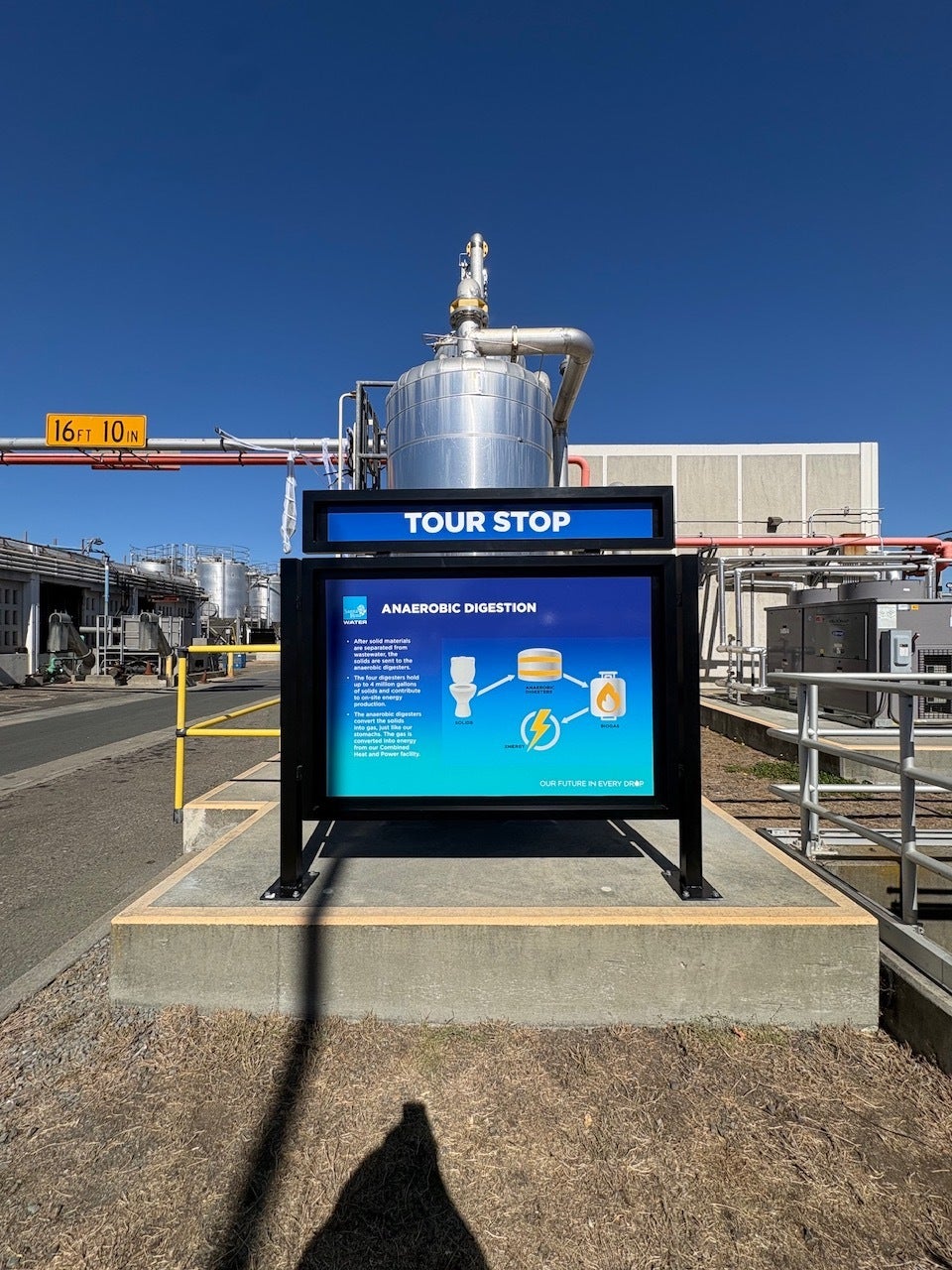
An ANAEROBIC DIGESTION panel uses a series of illustrations to explain the treatment of solids and the production of biogas. The HIGH-STRENGTH WASTE panel includes a process diagram and an analogy using hot-air balloons to help communicate scale.
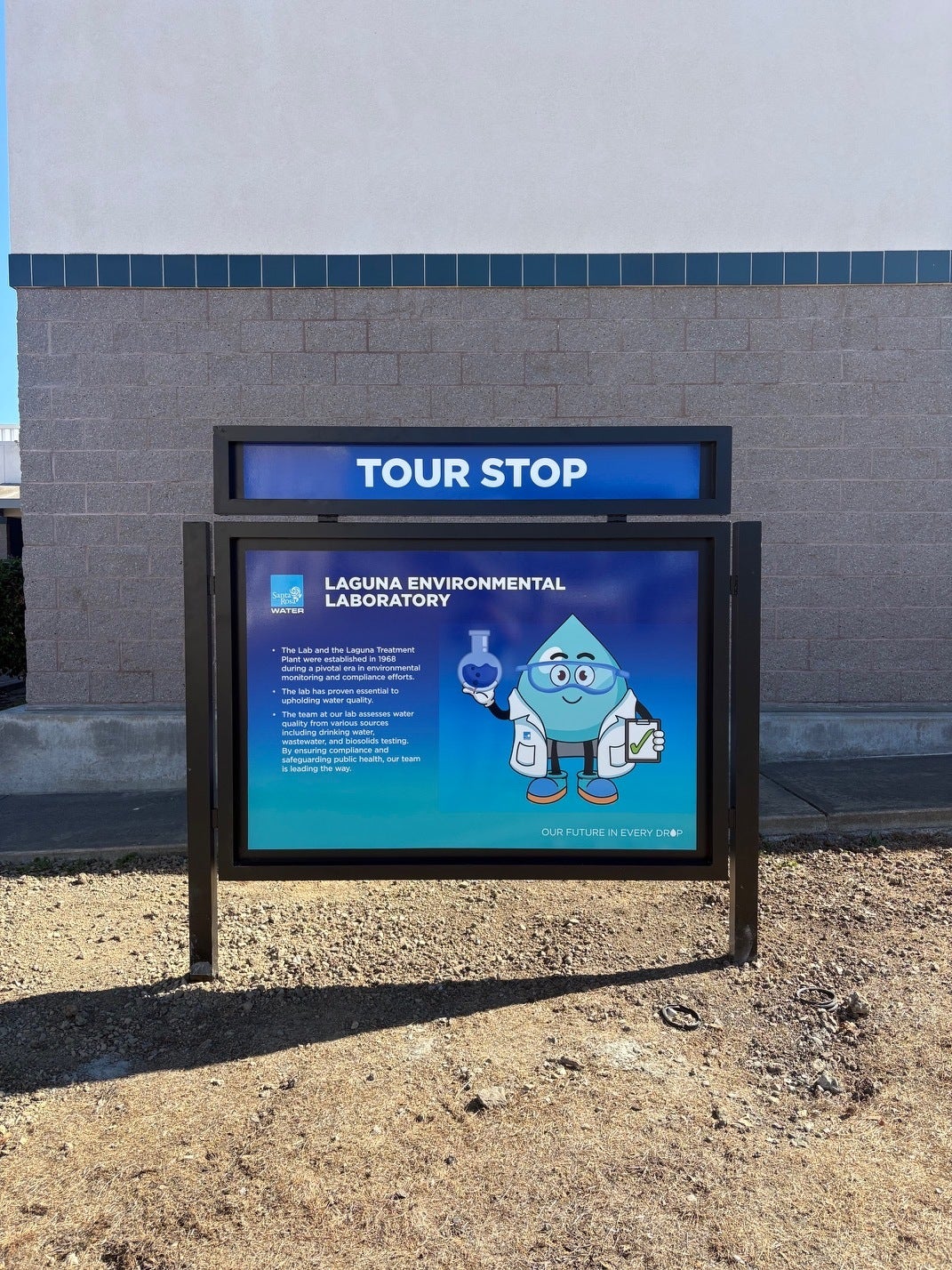
At the LAGUNA ENVIRONMENTAL LABORATORY stop, a friendly illustrated water-drop character accompanies text about the laboratory’s role in water-quality testing.
These panels show different ways to make technical content approachable. Some rely on process diagrams. Another introduces a character. Each preserves the common tour-stop identity so the content still feels like part of one program.
Consistent Displays, Different Installation Conditions
The tour-stop photographs show why standardized appearance does not necessarily mean identical installation conditions.
Several frames stand independently on concrete pads or paved surfaces, using substantial black legs and base plates. Other displays are positioned against structures with mounting brackets. Some are surrounded by open treatment tanks and railings; others sit beside stainless-steel vessels, utilities, or building walls.
The work order calls for custom-fabricated components and printed, laminated graphics. For the tour-stop assemblies, it specifies a header graphic and a larger main-panel graphic, along with field installation.
That helps explain the finished look: a consistent interpretive system designed to be repeated across a facility, while accommodating the conditions at individual tour locations.
It also illustrates the practical side of environmental graphics. Beyond making a panel visually clear, a project must account for where it will stand, what it will attach to, and how people will encounter it.
Bringing the Water Theme Through the Front Entrance
The visitor experience is not limited to the outdoor tour stops.
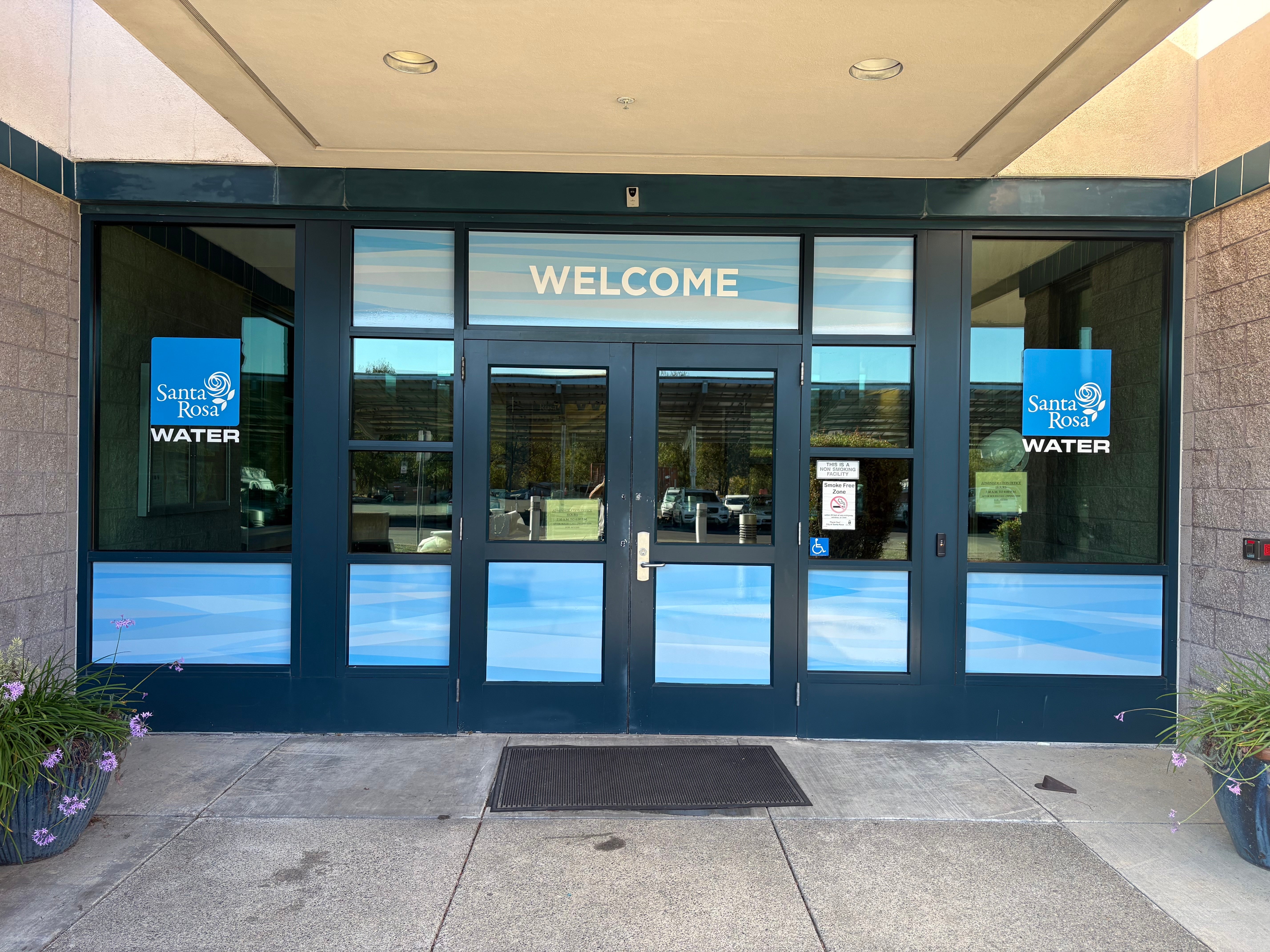
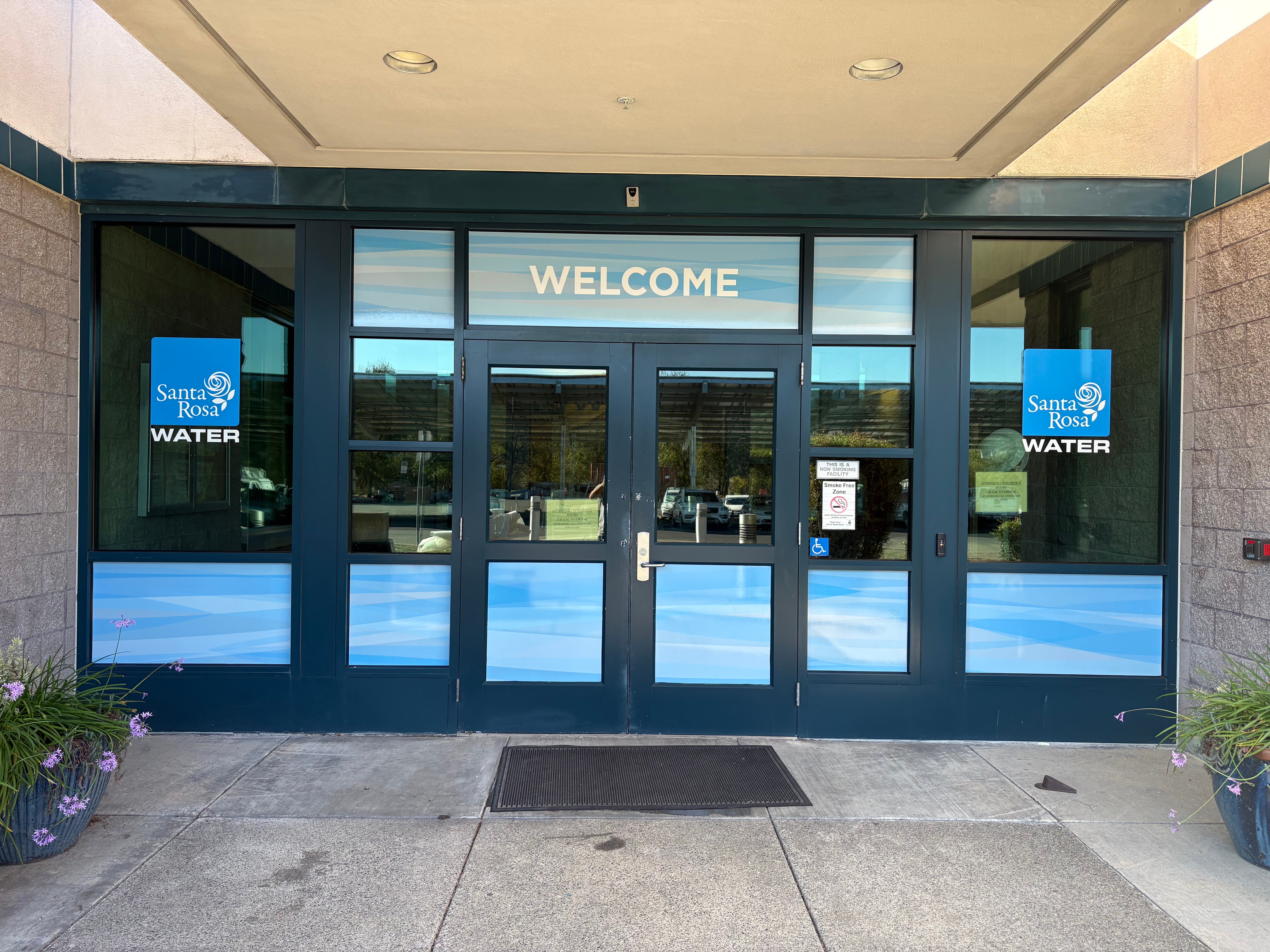
At the main entrance, the photographs show a large WELCOME message above the doors, Santa Rosa Water branding on the side windows, and pale blue wave-like graphics across the lower glazing and door panels.
The window treatment brings color and identity to the doorway without removing the recognizable structure of the building entrance.
The work order specified printed entry graphics, branded logos, and a white cut-vinyl welcome message. It also listed separate graphics for interior doors and windows.
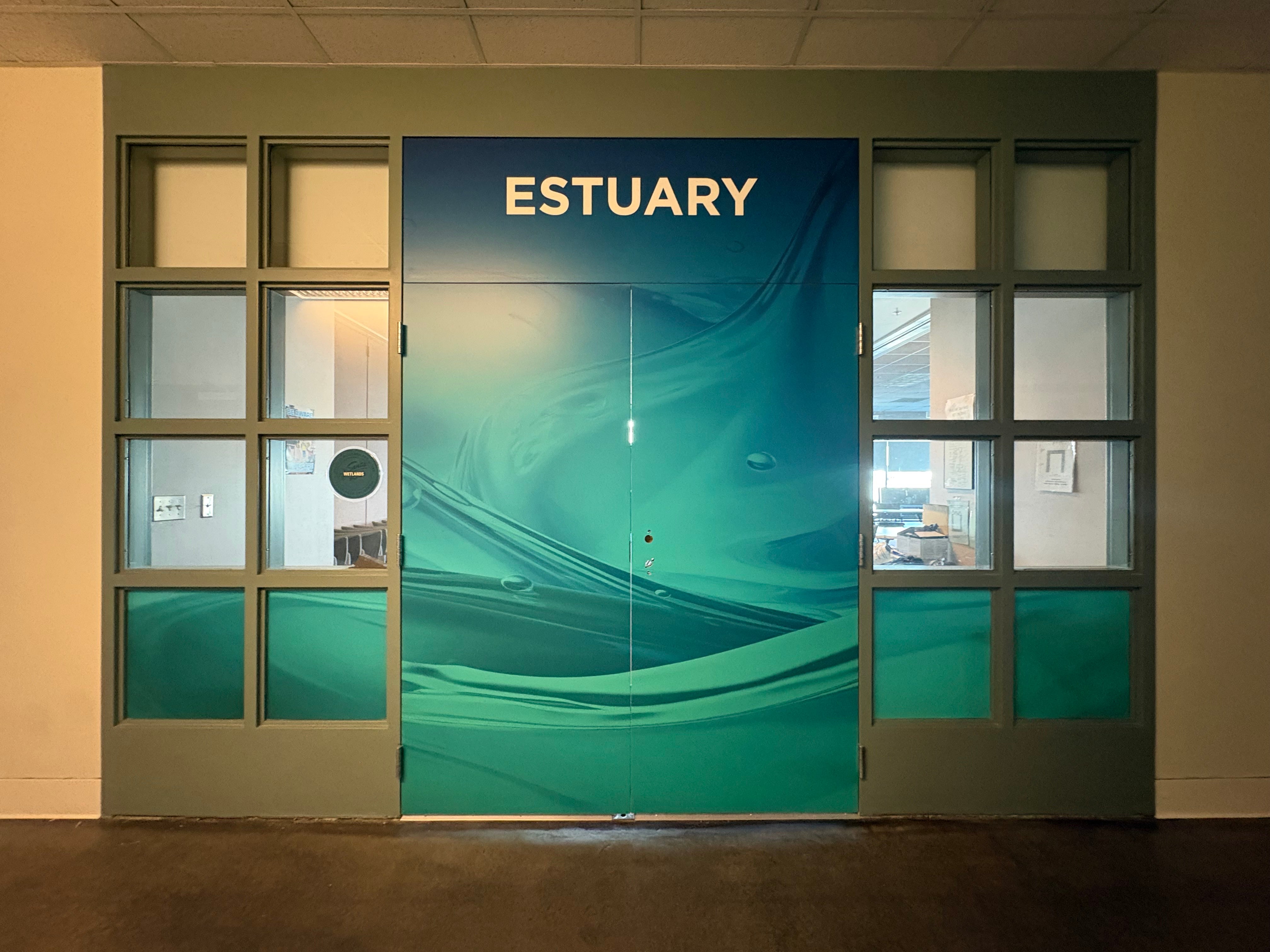
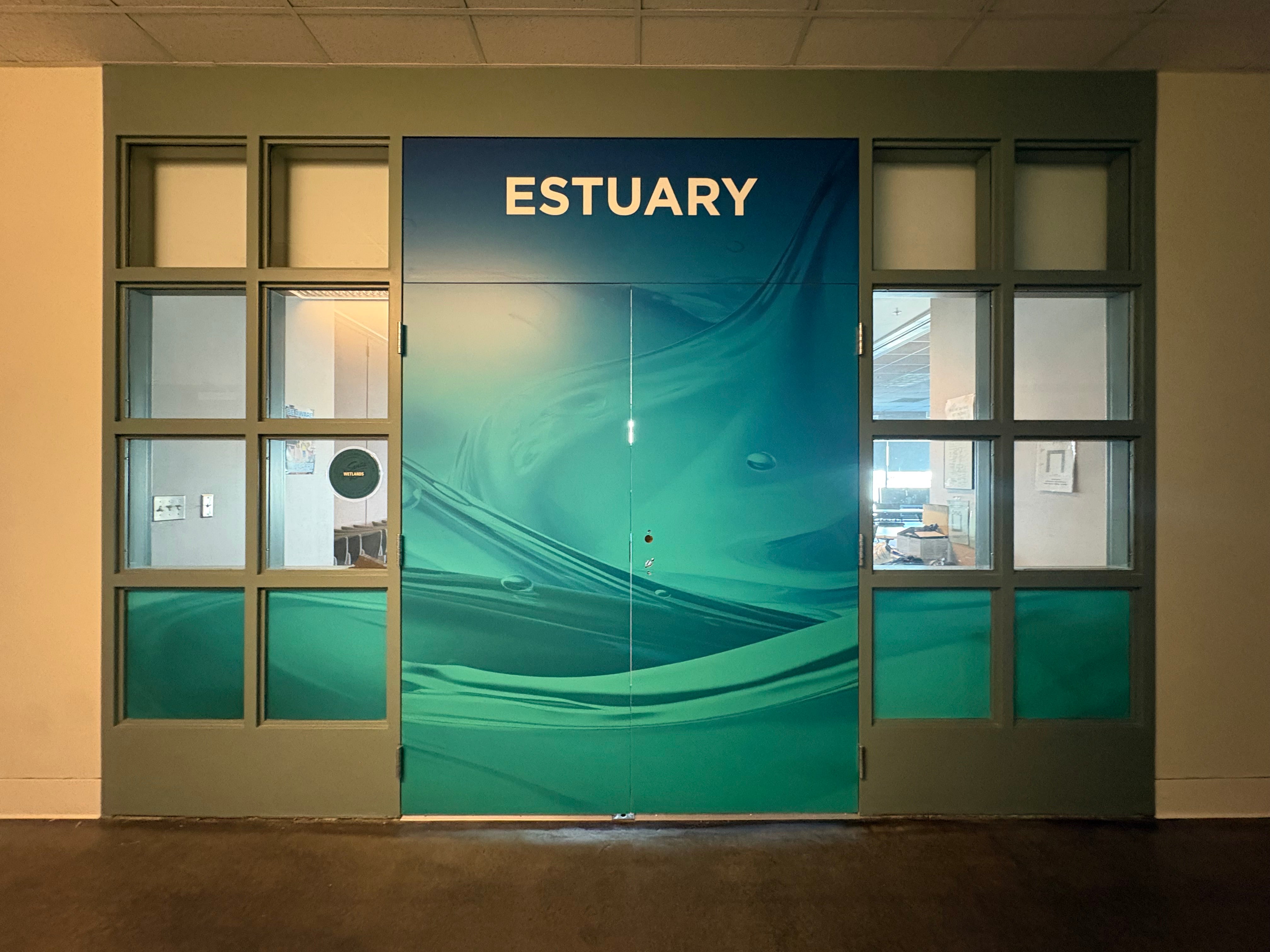
One photographed interior doorway is labeled ESTUARY. A sweeping blue-and-green water graphic spans the pair of doors and the area above them, making the doorway itself part of the visual story.
The treatments are different in scale and purpose, but they share the same subject matter: water, movement, and the Santa Rosa Water identity.
Interior Wall Graphics That Change the Feel of the Space
Inside the building, the wall graphics are expansive.
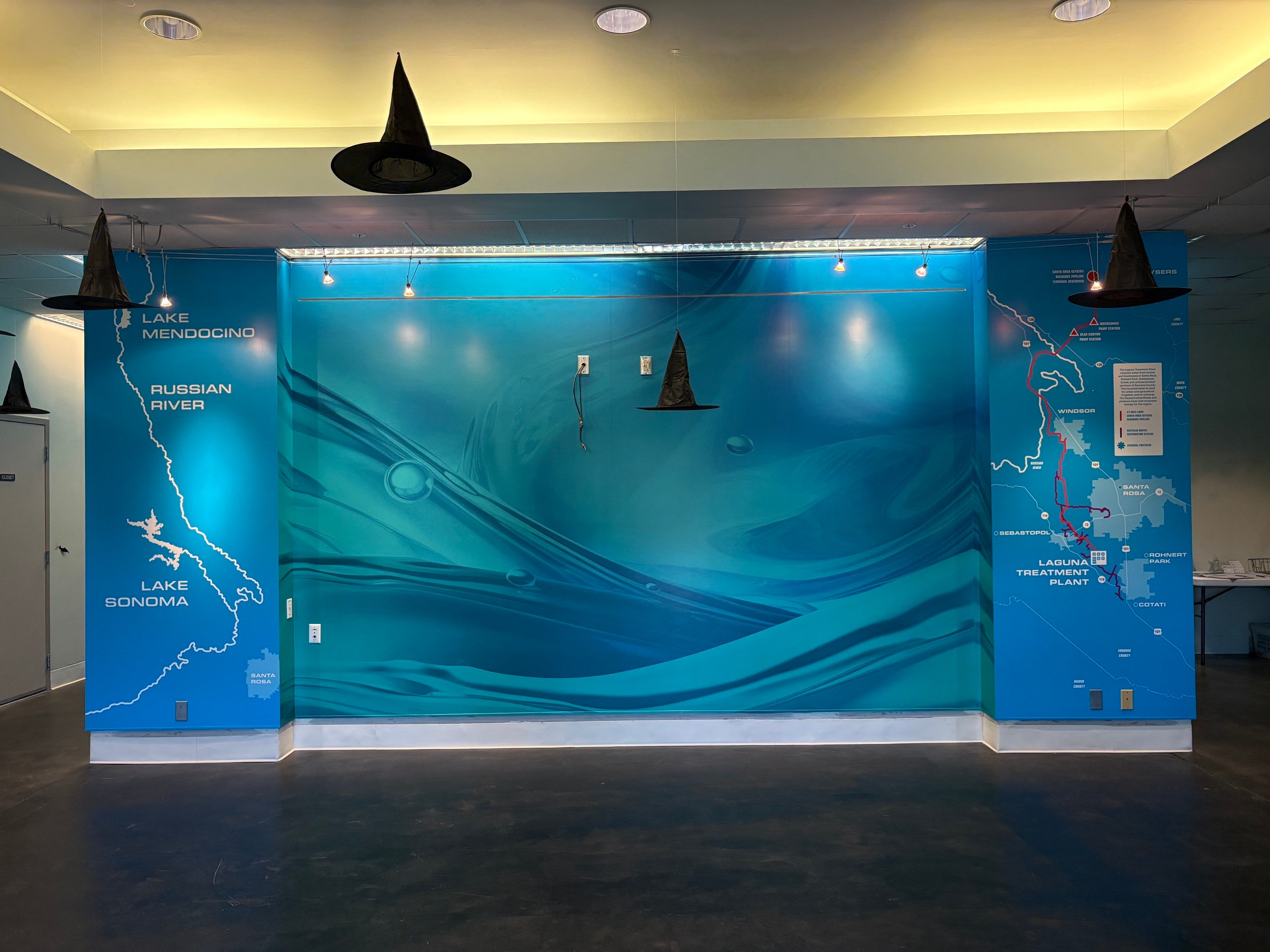
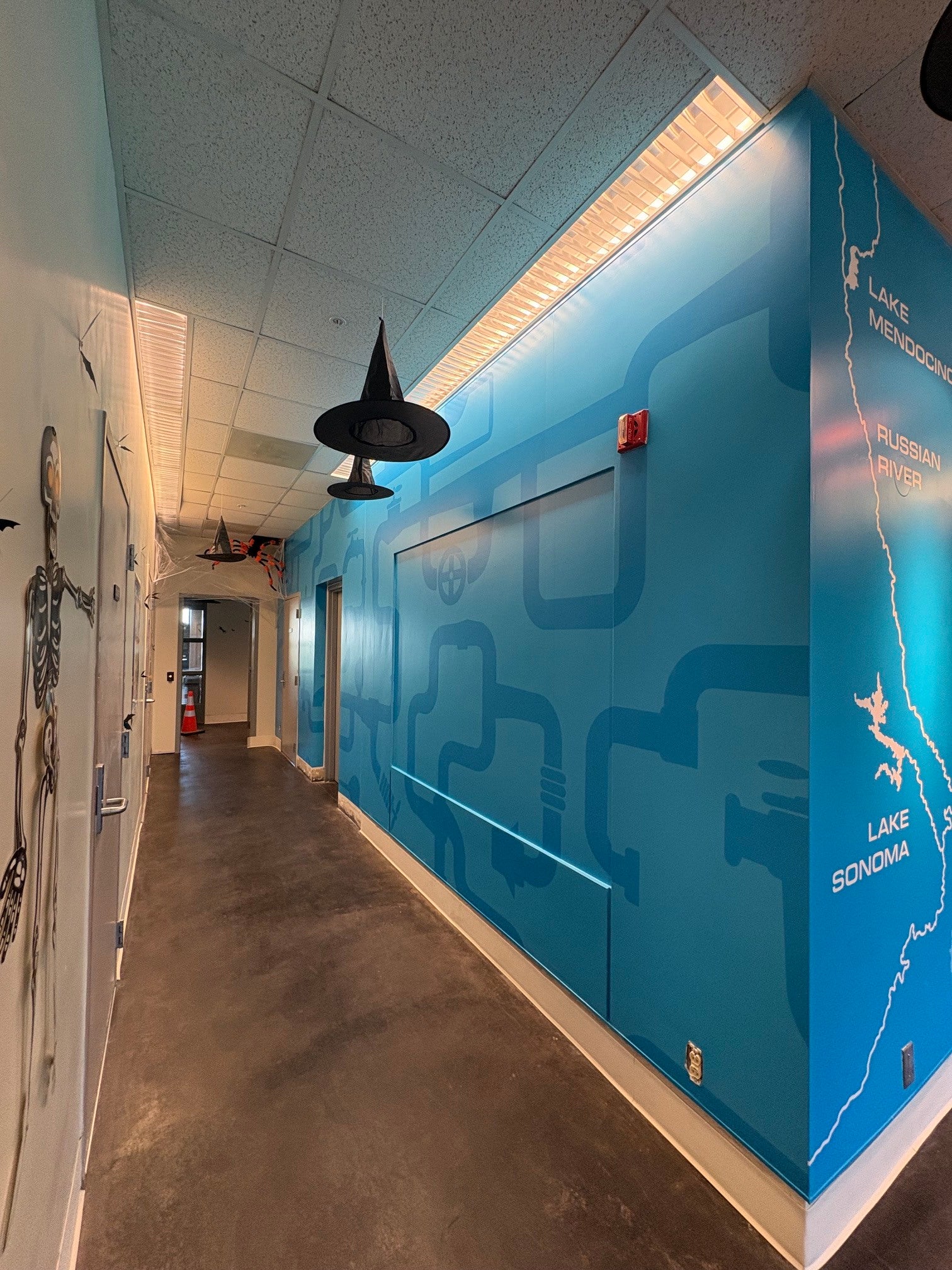
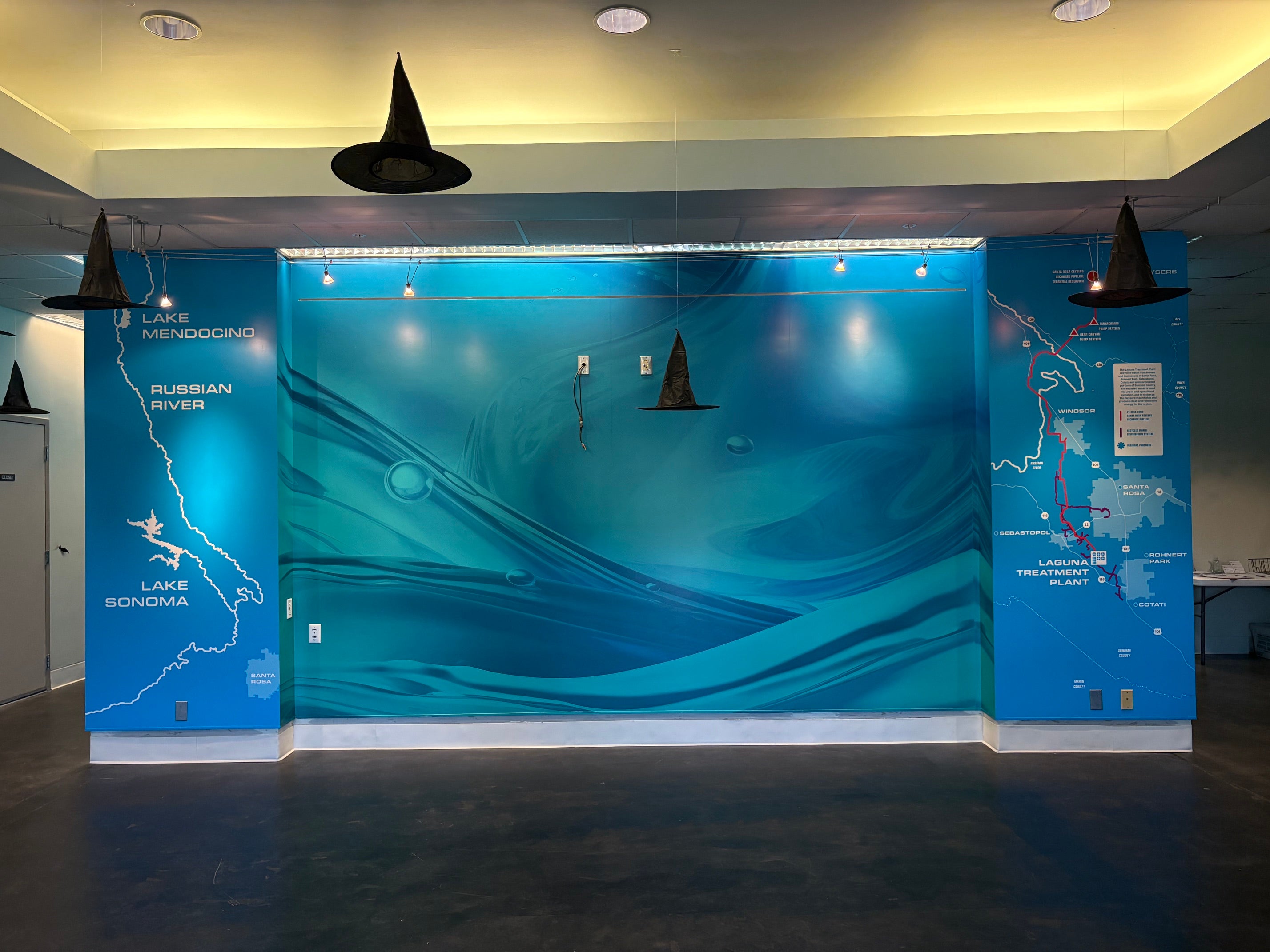
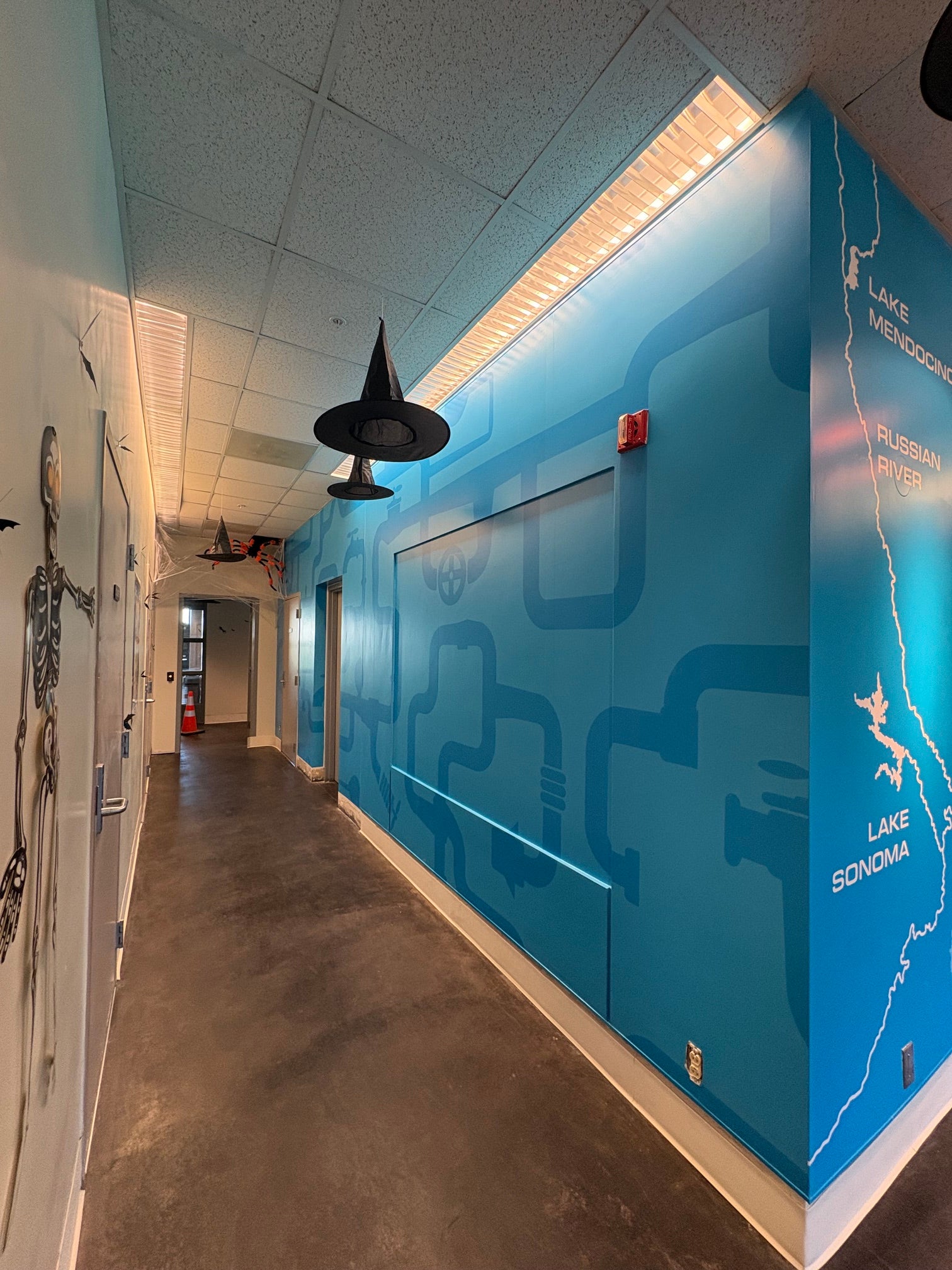
A broad blue-green installation fills a large feature wall, with layered abstract wave forms that suggest moving water. On either side, neighboring sections include geographic references such as Lake Mendocino, the Russian River, and Lake Sonoma, along with maps and related information.
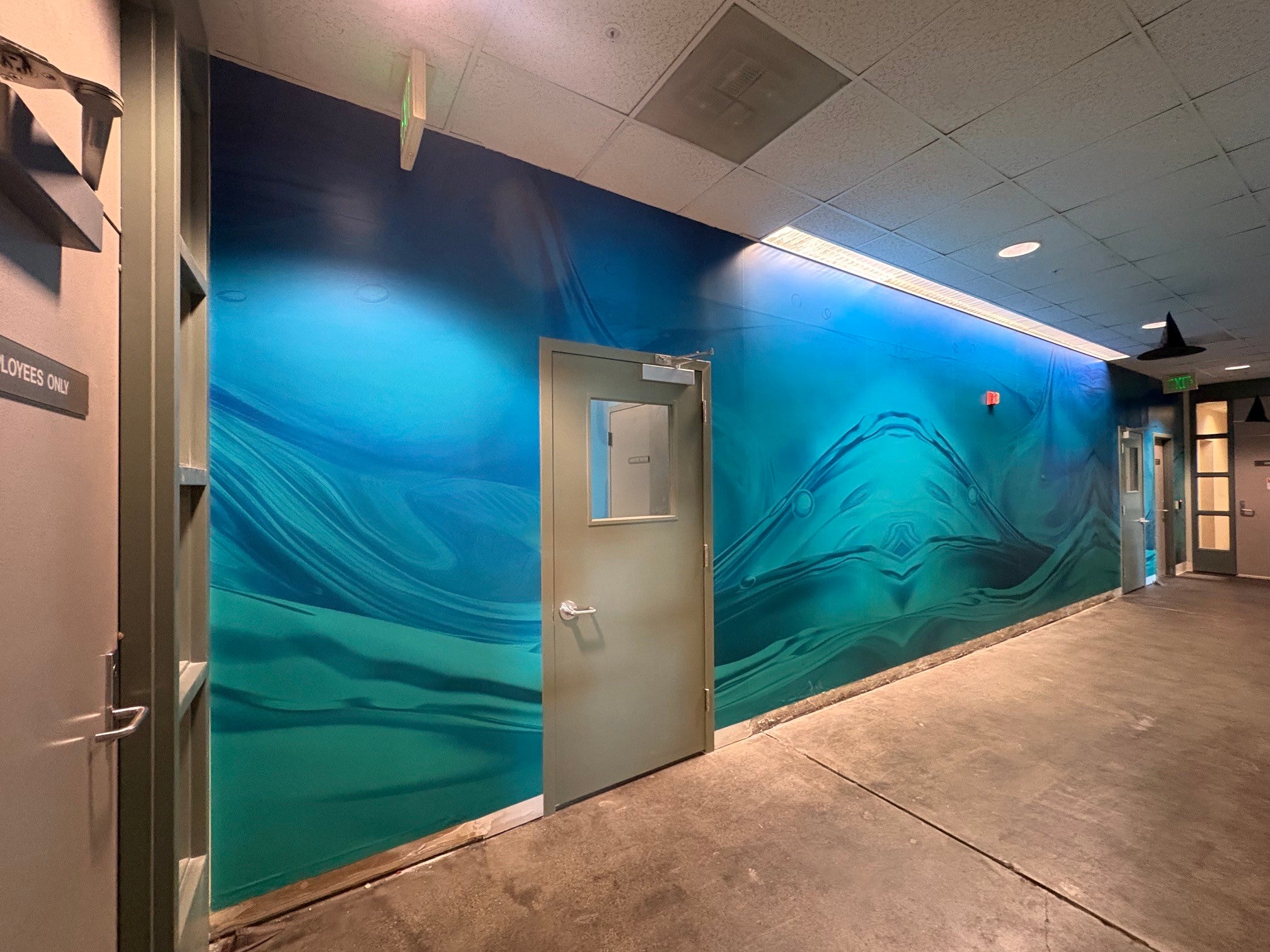
Elsewhere, corridor walls are covered in a turquoise graphic featuring silhouettes of pipes, valves, and other water-system components. Another hallway uses flowing, almost photographic water textures in shades of blue and green.
The effect is different from the detailed outdoor tour panels. Rather than requiring visitors to stop and read a block of explanatory text, these graphics create an immediate visual connection to the subject of the facility.
The work order identifies four large interior wall-graphic sections, including a 485-inch-wide by 96-inch-high application—just over 40 feet wide. Other specified areas measure 150, 252.5, and 297.5 inches wide.
Those dimensions put the project in a different category from small wall decals. The graphics were planned around large architectural surfaces, including walls interrupted by doors, corners, trim, and other existing features.
The photos show how the designs continue through the corridors while leaving important doors, fixtures, and access points recognizable.
Graphics That Work With Doors, Windows, and Existing Architecture
Large-format interior graphics have to live with the architecture already there.
In the corridor photographs, pipe illustrations continue across long walls and around door openings. The visual treatment changes direction at corners, and different wall sections use related but distinct artwork. Doors remain visibly separate from adjacent walls, with their handles and labels accessible.
The Estuary doors demonstrate another approach: instead of treating a door as an interruption, the water artwork becomes part of its surface.
The work order also includes printed frosted-film pieces for water-quality laboratory and office windows, plus infographics specified on clear acrylic and smaller informational signs.
Not all of these items appear individually in the supplied photographs, so the photographed work and broader work-order scope should be distinguished. Together, however, the documented items show how the facility’s graphics package extends beyond the main mural walls.
Matching Production Materials to Each Surface
This first phase used different construction and printing approaches depending on the application.
For major wall graphics, the work order specifies 3M IJ180CV3 printable vinyl with 3M 8520 matte cast laminate. Other sign categories use printable vinyl paired with 3M 8518 gloss laminate, sometimes mounted on 3 mm aluminum composite material (ACM).
The lobby infographic specifications call for second-surface printing on quarter-inch clear acrylic, using mounting hardware. Entrance graphics, frosted window films, and tour-stop displays each have their own production details.
Those specifications are not interchangeable. A graphic that wraps a long interior wall is a different product from an outdoor explanatory panel, a frosted-glass treatment, or an acrylic display.
The work order also includes field-installation services and aerial-lift installation for specified outdoor facility signs. The photographs confirm the completed appearance of the featured tour stops and interior graphics; other items listed in the order are best treated as documented scope unless photographed separately.
A Coordinated First Phase, Not Just a Collection of Signs
The work order for the featured scope also lists exterior wayfinding, directional tour signage, pole banners, outdoor facility panels, and other support items. These supplement the more prominent tour-stop displays and interior murals shown in this Phase 1 photo set. Items not pictured are described as documented scope, not as independently verified completed installations.
That breadth makes Phase 1 of the Laguna Treatment Plant signage project distinctive.
The outdoor interpretive signs address visitors who are learning about specific equipment and processes. Building entrance graphics identify the facility and welcome people in. Interior wall graphics create a coherent visual environment, while maps, laboratory information, and smaller displays add detail where needed.
The pieces serve different purposes, yet a repeated palette of blues and greens, shared Santa Rosa Water branding, and water-related imagery connects them.
For institutions and public facilities, that is an important design consideration: the most successful program may use several sign types rather than forcing one format to do every job.
What This Project Demonstrates
The finished photographs show two very different visual experiences.
Outside, black-framed TOUR STOP displays stand among working industrial equipment. They provide a place for technical explanations and diagrams directly at the relevant location.
Inside, water-inspired graphics stretch across large walls, corridors, glass, and doors. They make the subject of the facility immediately visible, even when someone is not standing in front of an educational panel.
Both are valuable. The exterior displays support learning; the interior graphics establish context and a recognizable environment.
For Signarama Santa Rosa, this first phase demonstrates how large-format printing, custom signage, specialty substrates, and on-site installation can contribute to one coordinated public-information project.
A Closer Look at Phase 1
The photographs capture the scale and variety of this work—from a single interpretive panel beside equipment to a broad mural spanning much of an interior corridor.
Taken together, these Phase 1 installations show a facility where signage does more than identify a room or direct someone down a path. It helps explain what happens here and provides a visual thread between the different parts of the visitor experience.
Phase 1 of a Larger Effort
The work and photographs featured here document Phase 1 of the Laguna Treatment Plant signage project. They show the educational tour stops, entrance treatments, and interior environmental graphics included in this first phase. Additional project phases are outside the scope of this article; their details and completion status are not presented here.
Frequently Asked Questions
Does this article cover the entire Laguna Treatment Plant signage project?
No. This article documents Phase 1 only. The photographs and work-order details discussed here belong to the initial phase. Any additional phases should be documented separately when their scope and completion details are confirmed.
What signage did Signarama Santa Rosa provide in Phase 1 at Laguna Treatment Plant?
The Phase 1 work order covers tour-stop educational signs, entrance and door graphics, large interior wall graphics, wayfinding and directional signs, window treatments, infographic displays, pole banners, and other facility-signage components. The supplied photos show the tour-stop exhibits and several interior and entrance applications.
How many tour-stop signs were specified?
The work order specifies ten tour-stop sign assemblies. The photos show educational displays on topics including preliminary, primary, secondary, and tertiary treatment; clarifiers; UV disinfection; anaerobic digestion; high-strength waste; and the environmental laboratory.
What makes an educational tour-stop sign different from a directional sign?
A directional sign primarily helps people find a location or route. An interpretive tour-stop sign explains a process or feature at a specific point in the visitor experience, typically using both concise text and illustrations. This first phase included both types.
Were the large interior murals printed wall graphics?
Yes. The work order specifies large-format printed vinyl wall applications with matte laminate. The photographed installations include flowing water imagery, map-related content, and pipe-inspired illustrations across long hallways and feature walls.
How large were the interior wall graphics?
The largest specified main interior wall section was 485 inches wide by 96 inches high, or a little over 40 feet wide. Other listed sections varied in width and were planned for different walls.
Did the project include glass and door graphics?
Yes. The documented scope includes entrance logos and welcome lettering, full-color interior door and window graphics, and frosted-film sections. The supplied photos show the welcome entrance and Estuary doorway.
Were all the signs made from the same material?
No. The work order includes printed vinyl, cast laminates, aluminum composite panels, acrylic displays, frosted film, and custom-fabricated sign components. Material and finishing choices varied by application.
Did Signarama Santa Rosa handle installation?
Yes. Field installation appears throughout the work order, and the supplied photographs show multiple completed signs and graphics at the plant. The work order also specifies aerial-lift installation for certain outdoor facility signs.
Have a Facility, Campus, or Public Space That Needs to Tell a Bigger Story?
A complex environment may need more than a standard identification sign. It may need directional information, educational displays, large wall graphics, and consistent branding across very different surfaces.
Signarama Santa Rosa can help organizations plan and produce coordinated signage for public facilities, campuses, industrial sites, visitor centers, and other multi-area properties.
Bring your site photographs, existing graphics, technical content, and project requirements. We can discuss the signs and materials that make sense for each location.
Contact Signarama Santa Rosa to discuss your next facility-signage or environmental-graphics project.

Signarama Santa Rosa, CA
contact
Signarama Santa Rosa, CA