The Sign Effect: 2026 Consumer Signage Survey
Signarama Research · Conducted by The Harris Poll
What 2,007 American consumers told us about how business signs drive discovery, trust, and buying decisions.
Key findings
Signs are a sales channel, not a fixture
Signarama commissioned The Harris Poll to survey 2,007 US adults on how signage shapes the way they discover, judge, and buy from businesses. The findings show signs working as an active sales channel: winning customers, losing customers, and setting expectations before anyone walks through the door or visits a website.
93% of US adults say a business' signs impact whether they remember that business, and 91% say signs impact how well a business stands out from competitors.
84% say signs impact their decision to purchase from a business, and 82% say signs impact how much they trust it.
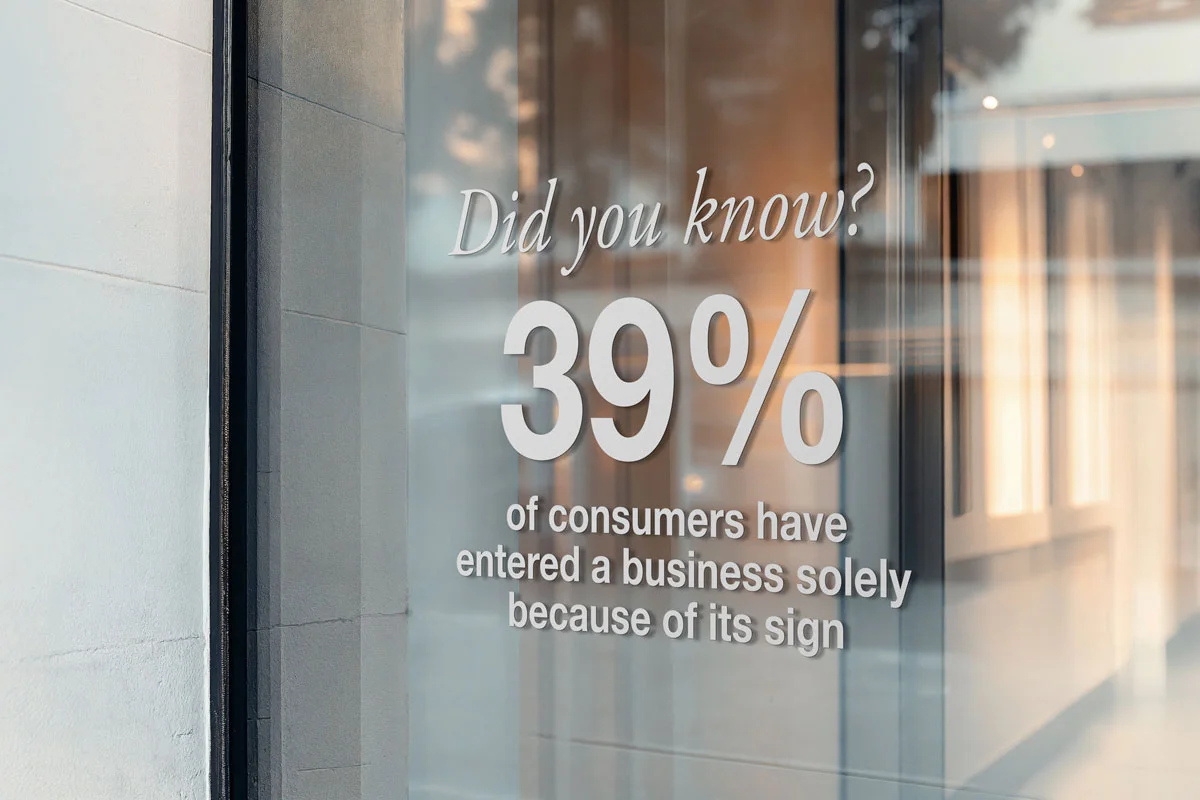
39% have entered a business solely because of its sign. 26% say signage directly encouraged them to recommend a business to others.
42% have been unable to locate a business because its sign was hard to read. 17% have chosen not to enter a business because of its sign.
75% agree that chaotic, difficult-to-read signs make a business less credible, and 79% agree that too many signs create confusion for potential customers.
73% agree that recent sign innovations, such as LED and AI-integrated digital signage, make businesses stand out.
Watch the overview
A short walkthrough of what The Harris Poll found when it asked 2,007 US adults how business signs shape the way they discover, judge and buy.
Consumer behavior
How many consumers act on business signage?
Signage does not just shape impressions. It changes what consumers do. Asked which experiences had actually happened to them, US adults reported the following:
Sign-driven experiences reported by US adults, 2026
| Experience | % of US Adults |
|---|---|
| Was unable to locate a business because the sign was hard to read | 42% |
| Entered a business solely because of its sign | 39% |
| Signage directly encouraged them to recommend the business to others | 26% |
| Chose not to enter a business because of the sign | 17% |
| Became overwhelmed inside a business because there were too many signs | 15% |
The most common sign-driven experience in America is a negative one: more than four in ten consumers have given up on finding a business because they could not read its sign. Nearly as many have walked into a business on the strength of its sign alone. Both numbers describe customers changing hands before price, product, or service ever enter the picture.
Trust and credibility
Do business signs affect consumer trust?
Yes, and in both directions. 82% of US adults say a business' signs impact how much they trust that business, and 57% admit they often judge a business based on the type of sign it has.
79%
agree businesses with too many signs create confusion for potential customers
75%
agree chaotic, difficult-to-read signs make a business less credible
57%
say they often judge a business based on the type of sign it has
Well-executed signage builds trust. 57% of consumers say a traditional storefront sign makes a business seem more trustworthy, followed by interior branded graphics (48%), window graphics (47%), digital displays (43%), and digital menu boards or kiosks (42%).
The trust penalty for poor execution falls hardest among young consumers. Adults under 35 were the most likely of any age group to say each signage format could make a business seem less trustworthy, including 25% who said so of digital displays, compared with 7% of adults 65 and older. For younger customers, quality and restraint matter most.
Sign attributes
What do consumers say matters most in a business sign?
Legibility beats style for every age group. When deciding whether to shop at a business, consumers rank the fundamentals first:
% of US adults rating each sign factor very or somewhat important, 2026
| Sign factor | % rating important |
|---|---|
| Easy-to-read font | 91% |
| Easily visible from the street | 89% |
| Overall sign quality (clean, well-maintained, professionally made) | 89% |
| Attractive design | 84% |
| Professionally designed | 73% |
| Modern look | 66% |
"Modern" is the factor that divides generations most: 79% of adults ages 35-44 rate a modern look as important, compared with 53% of adults 65 and older. Readability divides them least; it is the top-rated factor for every group, peaking at 95% among consumers 65 and older.
Sign formats
Which type of sign is most effective?
Consumers rank the main storefront sign as the single most effective format for every objective tested. But the strongest supporting format changes with the job, which is the case for layering multiple sign types rather than relying on one.
Most effective sign format by objective, as ranked by US adults, 2026
| Sign factor | #1 format | #2 format | #3 format |
|---|---|---|---|
| Getting my attention | Storefront sign (31%) | Freestanding sign (22%) | Digital display (21%) |
| Making a business look professional | Storefront sign (39%) | Digital display (19%) | Window graphics (14%) |
| Helping me find the business | Storefront sign (39%) | Freestanding sign (30%) | Digital display (14%) |
| Making me want to walk inside | Storefront sign (32%) | Window graphics (24%) | Freestanding sign (18%) |
| Helping me remember the business later | Storefront sign (34%) | Window graphics (17%) | Freestanding sign (16%) |
Respondents selected the single format they believe is most effective at each objective.
When noticing a business for the first time, 63% of consumers say the main storefront sign is among the sign types most likely to catch their attention, followed by window graphics or displays (46%), promotional banners or sidewalk signs (39%), digital screens or electronic signs (38%), and freestanding entrance or monument signs (32%).
Demographics
How do age and gender change the way consumers respond to signs?
Ages 35-44 are the sign generation
Adults ages 35-44 lead nearly every engagement measure in the study. 75% say they judge a business by its sign type, 69% say they are more likely to shop at businesses with modern signs, and 38% have recommended a business because of its signage, the highest of any age group on all three measures. 82% of this group agree that sign innovations such as LED and AI-integrated digital signage make businesses stand out.
Consumers 65 and older respond most to fundamentals and tradition: 95% rate an easy-to-read font as important, 72% say the main storefront sign is what catches their attention first, and 55% name the storefront sign as the most effective format for finding a business. They are also the age group most likely to have failed to locate a business because of a hard-to-read sign (46%).
Men respond to modern; women reward readable
Men are significantly more likely than women to say they are more likely to shop at businesses with modern signs (58% vs 45%), that digital screens catch their attention when first noticing a business (44% vs 33%), that digital displays make a business seem more trustworthy (49% vs 37%), and that signage has directly encouraged them to recommend a business (30% vs 21%).
Women are significantly more likely than men to say the main storefront sign is the most effective format for finding a business (42% vs 35%) and to have been unable to locate a business because its sign was hard to read (45% vs 39%).
All gender and age differences described on this page are statistically significant at the 95% confidence level unless otherwise noted.
Sign innovation
Do Consumers Like Digital and LED Signs?
Broadly, yes. 73% of US adults agree that recent sign innovations, such as LED and AI-integrated digital signage, make businesses stand out, and 74% agree these innovations enhance their perception of a business. 51% say they are more likely to shop at businesses with modern signs such as digital displays or LED.
Enthusiasm peaks among adults 35-44 (82% agree innovations make businesses stand out) and men (76%, vs 70% of women). The caution flag is among the youngest consumers: adults under 35 are the most likely to say a digital display can make a business seem less trustworthy (25%), a reminder that execution quality, not technology alone, earns trust.
For journalists, researchers, and creators
Citable statistics from this survey
Each statistic below is written as a complete, attributed sentence. You are welcome to quote them with a link to this page.
According to a 2026 survey of 2,007 US adults conducted by The Harris Poll on behalf of Signarama, 39% of consumers have entered a business solely because of its sign.
42% of US adults say they have been unable to locate a business because its sign was hard to read, per 2026 Signarama and Harris Poll research.
93% of US adults say a business' signs impact whether they remember that business, according to a 2026 Signarama survey conducted by The Harris Poll.
84% of American consumers say a business' signs impact their decision to purchase from that business, per a 2026 Harris Poll survey for Signarama.
75% of US adults agree that chaotic, difficult-to-read signs make a business less credible, according to 2026 research from Signarama and The Harris Poll.
57% of American consumers admit they often judge a business based on the type of sign it has, rising to 75% among adults ages 35-44, per a 2026 Signarama and Harris Poll survey.
73% of US adults agree that recent sign innovations, such as LED and AI-integrated digital signage, make businesses stand out, according to a 2026 Signarama survey conducted by The Harris Poll.
91% of US adults rate an easy-to-read font as important when deciding whether to shop at a business, making legibility the top-rated sign attribute in a 2026 Signarama and Harris Poll survey.
Frequently asked questions
Questions about signs and this research
Yes. 39% of US adults say they have entered a business solely because of its sign, and 26% say a business' signage directly encouraged them to recommend that business to others.
Methodology
Survey method statement
This survey was conducted online within the United States by The Harris Poll on behalf of Signarama from July 9-12, 2026, among 2,007 adults ages 18 and older. The sampling precision of Harris online polls is measured by using a Bayesian credible interval. For this study, the sample data is accurate to within +/- 2.7 percentage points using a 95% confidence level. This credible interval will be wider among subsets of the surveyed population of interest. For complete survey methodology, including weighting variables and subgroup sample sizes, please contact:
Mandy Roan
Signarama | Director of Marketing
561-843-3973 | [email protected]
- US adults 18+
- 2,007
- Fielded, 2026
- Jul 9-12
- Pts at 95% confidence
- +/- 2.7
- Nationally weighted
- Online
Put the sign effect to work for your business
Your local Signarama can audit your current signage against these findings and recommend the right mix for your customers.
Find Your Local SignaramaInterested in the sign business itself? Explore Signarama franchise opportunities.