Your local team for custom business signs & vehicle graphics.


What Type of Sign Is Best for My Business? Complete Commercial Sign Guide
Aug 24, 2026 by




What Type of Sign Is Best for My Business? Complete Commercial Sign Guide
Choosing a business sign sounds simple until you start looking at the options.
Should you use channel letters or a cabinet sign?
Should your sign be illuminated?
Would dimensional letters look better?
Do you need a monument sign near the road?
What if your storefront doesn't have enough visibility?
And what type of sign will hold up best in Florida weather?
The right answer depends on your location, visibility, building, brand, budget, operating hours, landlord requirements and local sign regulations.
Quick Answer: What Type of Sign Is Best for a Business?
For many retail businesses, restaurants, medical offices and commercial storefronts, channel letters are one of the most effective exterior sign options because they're highly visible, professional and can be illuminated at night.
However, they aren't automatically the best choice for every business.
Depending on your property and goals, the best solution might instead be:
Channel letters
Dimensional letters
Cabinet signs
Monument signs
Pylon signs
Post-and-panel signs
Window graphics
Wall graphics
Lobby signs
ADA signs
Directional and wayfinding signs
Vehicle graphics
At Signarama Carrollwood, we recommend starting with the problem the sign needs to solve rather than starting with a particular product.
Ask:
Where will customers see my business?
How far away will they be?
How fast will they be traveling?
Does the sign need to work at night?
What does my building allow?
What image do I want my business to communicate?
Those answers usually make the right type of signage much easier to identify.
The Most Common Types of Business Signs
Here are the major commercial sign types and where each one works best.
Sign Type | Best For | Illumination Available? | Typical Visibility |
|---|---|---|---|
Channel Letters | Storefronts, restaurants, retail | Yes | Excellent |
Dimensional Letters | Offices, upscale storefronts, interiors | Optional | Good |
Cabinet Signs | Retail, plazas, existing sign structures | Yes | Excellent |
Monument Signs | Offices, communities, schools, medical | Yes | Excellent |
Pylon Signs | Roadside businesses, shopping centers | Yes | Excellent at distance |
Post & Panel Signs | Offices, properties, directional signs | Usually no | Good |
Window Graphics | Storefront advertising/privacy | No | Close range |
Wall Graphics | Interiors, branding, offices | No | Interior |
Lobby Signs | Reception areas | Optional | Interior |
ADA Signs | Commercial interiors | Usually no | Interior |
Vehicle Graphics | Mobile advertising | No | Mobile |
Let's look at each in more detail.
1. Channel Letter Signs
What Are Channel Letters?
Channel letters are individually fabricated letters or logos commonly mounted to the exterior of commercial buildings.
They're one of the most recognizable types of storefront signage.
You'll commonly see them on:
Restaurants
Retail stores
Gyms
Medical offices
Banks
Shopping centers
Professional offices
Grocery stores
Franchise locations
Are Channel Letters Good for a Business?
For many storefront businesses, yes.
Channel letters offer several advantages:
Excellent visibility
Professional appearance
Custom shapes and logos
Day and nighttime visibility
LED illumination
Strong brand presence
Long-term exterior use
There are several configurations available.
Front-Lit Channel Letters
The face of each letter illuminates.
This is probably what most people picture when they think of an illuminated storefront sign.
Reverse-Lit or Halo-Lit Channel Letters
Light projects behind the letters and creates a halo on the wall.
This creates a sophisticated architectural appearance.
Front-and-Back-Lit Channel Letters
These combine illuminated faces with halo illumination.
Raceway-Mounted Channel Letters
The letters are attached to an aluminum raceway, which is then attached to the building.
This can reduce the number of penetrations into the wall and simplify certain installations.
Direct-Mounted Channel Letters
Individual letters are attached directly to the building façade.
This can provide a very clean appearance when the building and installation conditions allow it.
Best for: Businesses needing strong storefront visibility and nighttime identification.
2. Dimensional Letter Signs
Dimensional letters provide depth without necessarily using the traditional channel-letter construction.
They can be manufactured from materials such as:
Acrylic
PVC
Aluminum
Metal
High-density materials
Combination materials
Dimensional lettering works particularly well when you want a clean, architectural appearance.
You'll commonly find it on:
Professional offices
Medical practices
Law firms
Corporate offices
Retail stores
Reception areas
Interior feature walls
Dimensional Letters vs. Channel Letters
The primary difference is construction and illumination.
Channel letters are fabricated hollow letters that commonly contain LED illumination.
Dimensional letters are generally solid or layered materials.
If nighttime illumination isn't necessary, dimensional letters can provide a premium appearance without the complexity of internally illuminated channel letters.
Best for: Professional, architectural or upscale branding where depth matters but internal illumination isn't necessary.
3. Cabinet Signs
A cabinet sign is an enclosed sign structure that typically contains an aluminum frame with an acrylic, polycarbonate or other sign face.
Many cabinet signs are internally illuminated.
You've probably seen them on:
Shopping centers
Restaurants
Older retail buildings
Convenience stores
Freestanding sign structures
Commercial plazas
Cabinet signs can be very practical because a relatively large graphic area can be illuminated within one structure.
They can also be useful when a property already has an existing cabinet that can potentially be updated for a new tenant.
Cabinet Sign vs. Channel Letters
Channel letters provide individually shaped letters and often create a more dimensional architectural appearance.
Cabinet signs provide one continuous illuminated sign area.
Which is better depends on:
Brand design
Building architecture
Existing sign structures
Budget
Landlord criteria
Sign code
Desired appearance
Best for: Businesses needing a large illuminated sign area or properties with existing sign cabinets.
4. Monument Signs
A monument sign is a freestanding sign installed relatively close to ground level.
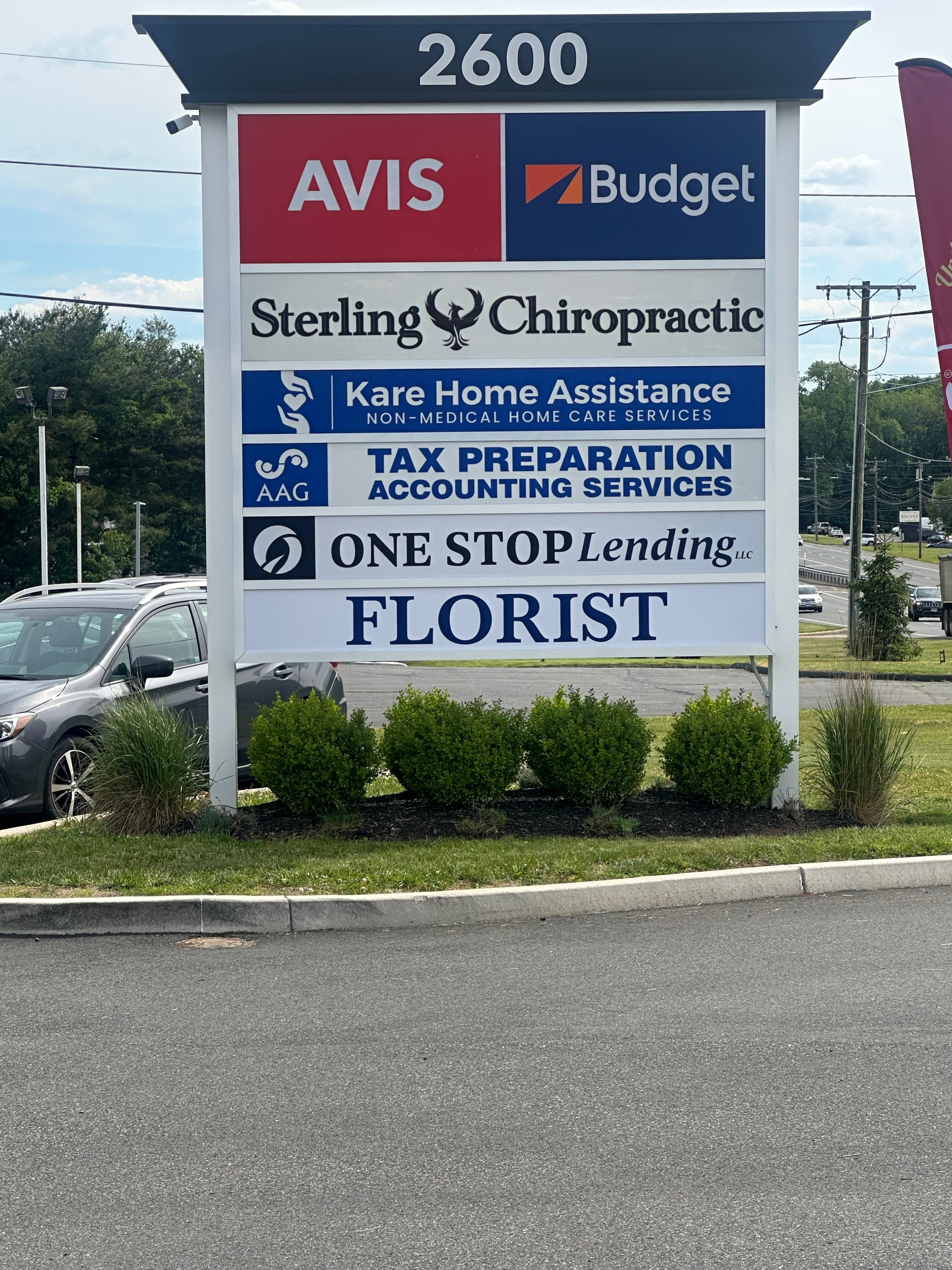
These are commonly used at entrances to:
Office buildings
Medical centers
Apartment communities
Condominiums
Schools
Churches
Business parks
Shopping centers
Residential communities
Monument signs can be constructed using combinations of:
Aluminum
Masonry
Faux stone
Brick
Stucco
Acrylic
Dimensional letters
Illuminated cabinets
LED displays
When Is a Monument Sign Better Than a Building Sign?
Imagine your building sits 200 feet from the road.
You can install beautiful channel letters on the building, but drivers may have difficulty seeing them.
A monument sign positioned closer to the roadway may provide much stronger visibility.
That's why many properties use both.
The monument identifies the property from the road, while the building sign identifies the specific business.
Best for: Properties set back from the road or businesses that need strong entrance identification.
5. Pylon Signs
A pylon sign is a tall freestanding sign designed to provide visibility from a significant distance.
They're especially useful where traffic moves quickly.
Common locations include:
Shopping centers
Gas stations
Hotels
Restaurants
Automotive dealerships
Highway-adjacent businesses
Large commercial developments
Why Are Pylon Signs So Effective?
Height.
A building or monument sign can become hidden behind:
Trees
Other buildings
Parked vehicles
Landscaping
Traffic
Other roadside structures
A pylon sign elevates the business identity above many of these visual obstacles.
Multi-tenant pylon signs can also identify several businesses within the same shopping center.
Best for: High-traffic roads and businesses needing long-distance visibility.
6. Post-and-Panel Signs
Post-and-panel signs consist of one or more posts supporting a sign panel.
They're relatively simple but extremely useful.
Common applications include:
Business identification
Property entrances
Directional signage
Construction sites
Real estate developments
Parking areas
Temporary property identification
They can be manufactured using aluminum, composite materials and other exterior-grade products.
Best for: Cost-effective property identification and directional applications.
7. Window Graphics
Your storefront windows are valuable advertising space.
Window graphics can transform unused glass into:
Branding
Advertising
Privacy
Business identification
Promotional messaging
Decorative design
Options include:
Cut Vinyl Lettering
Excellent for:
Business hours
Phone numbers
Website addresses
Logos
Door identification
Printed Window Graphics
Full-color printed vinyl can display photography, branding and promotional graphics.
Perforated Window Vinyl
Perforated vinyl allows printed graphics to be visible from outside while maintaining some visibility through the glass from inside.
Frosted Vinyl
Frosted film creates the appearance of etched or frosted glass and is commonly used for privacy.
Best for: Retail storefronts, offices, restaurants, salons and businesses with large glass areas.
8. Wall Graphics and Murals
Not every important business sign is outside.
Wall graphics can transform blank interior walls into branded environments.
Businesses use wall graphics for:
Company logos
Mission statements
Core values
Brand storytelling
Photography
Decorative patterns
Employee environments
Customer experiences
Large-format wall graphics can cover anything from a small feature wall to thousands of square feet.
They're particularly effective in:
Offices
Schools
Gyms
Restaurants
Retail stores
Corporate facilities
Healthcare facilities
A well-designed wall graphic can turn the building itself into part of the brand experience.
Best for: Businesses wanting to transform interior spaces without permanent architectural construction.
9. Lobby and Reception Signs
Your exterior sign gets people through the door.
Your lobby sign helps reinforce the brand once they're inside.
Lobby signs can be made using:
Acrylic
Dimensional letters
Metal
PVC
Printed graphics
Standoff-mounted panels
Illuminated letters
Backlit logos
One popular design combines a clear or frosted acrylic backer with dimensional lettering mounted using decorative standoffs.
Another clean option is installing dimensional letters directly onto the wall.
Best for: Offices, medical practices, law firms, corporate facilities, financial businesses and professional reception areas.
10. ADA Signs
ADA signage is an essential component of many commercial facilities.
Depending on the application, compliant signs may require features such as:
Raised characters
Braille
Appropriate character size
Proper contrast
Correct mounting height
Correct placement
Pictograms
Examples include:
Restroom signs
Room identification
Exit signs
Stair identification
Accessible-room signage
Permanent-space identification
ADA signs shouldn't be treated as decorative signs alone.
They need to satisfy applicable accessibility requirements.
Best for: Commercial buildings, offices, schools, healthcare facilities, multifamily properties and public accommodations.
11. Directional and Wayfinding Signs
Good signage doesn't only tell customers that they've reached your business.
It tells them where to go next.
Wayfinding systems can include:
Entrance signs
Exit signs
Parking signs
Building identification
Floor directories
Room identification
Directional arrows
Department identification
Pedestrian signs
This becomes especially important for:
Hospitals
Medical offices
Schools
Apartment communities
Office campuses
Shopping centers
Large commercial facilities
Confusing wayfinding creates a poor customer experience.
A properly planned sign system makes a property easier to navigate.
Best for: Larger facilities and properties with multiple destinations.
12. Vehicle Graphics and Wraps
Sometimes your best sign isn't attached to your building.
It's driving around Tampa.
Commercial vehicle graphics can turn:
Cars
Pickup trucks
Vans
Box trucks
Trailers
Fleet vehicles
into mobile advertising.
Options range from simple door lettering to full vehicle wraps.
Vehicle Lettering
Good for displaying:
Company name
Logo
Phone number
Website
Services
Partial Vehicle Wrap
Combines printed graphics with the vehicle's original paint.
Full Vehicle Wrap
Covers most of the visible painted surface with printed and laminated vinyl.
Vehicle graphics can be especially valuable for service businesses whose vehicles travel throughout the community every day.
Best for: Contractors, landscapers, plumbers, electricians, HVAC companies, delivery businesses, mobile services and other local companies.
Illuminated vs. Non-Illuminated Signs: Which Is Better?
One of the biggest decisions when choosing a sign is whether it should illuminate.
Choose an Illuminated Sign When:
Your business operates at night
Your location receives evening traffic
Visibility from the road is important
Other businesses around you have illuminated signs
Your sign needs to identify the business 24/7
Examples include restaurants, gyms, retail stores, convenience stores and many medical facilities.
Choose a Non-Illuminated Sign When:
The business operates primarily during daylight
Exterior lighting already illuminates the sign
The sign is primarily decorative
Budget is limited
The property doesn't allow illuminated signage
Neither is universally better.
The correct decision depends on how and when customers need to see the sign.
What Is the Best Sign for a Retail Store?
For many retail storefronts, illuminated channel letters are an excellent primary sign choice.
A complete retail signage package may include:
Channel Letters + Window Graphics + Door Hours + Interior Branding + Directional Signs
If the store sits far from the road, a monument or pylon sign may also be important.
What Is the Best Sign for a Restaurant?
Restaurants often benefit significantly from nighttime visibility.
Common restaurant signage includes:
Illuminated channel letters
Blade signs
Monument or pylon panels
Window graphics
Menu graphics
Directional signs
Interior wall graphics
Door graphics
The main exterior sign should be readable quickly by drivers and pedestrians.
What Is the Best Sign for an Office?
Professional offices may prioritize appearance differently from retail businesses.
Common choices include:
Dimensional letters
Halo-lit letters
Monument signs
Lobby signs
Frosted window graphics
Suite identification
ADA signs
Wayfinding
A professional office may benefit more from sophisticated architectural signage than from extremely bright advertising signage.
What Is the Best Sign for a Medical Office?
Medical facilities often need a complete wayfinding system rather than just one sign.
That might include:
Monument Sign → Building Identification → Entrance Identification → Lobby Directory → Directional Signs → ADA Room Signs
The goal isn't simply branding.
Patients need to find the correct building, entrance, department and room without confusion.
What Is the Best Sign for an Apartment or Condominium Community?
Multifamily properties commonly need:
Monument entrance signs
Building numbers
Unit identification
Directional signs
Parking signs
Pool signs
Clubhouse signs
ADA signs
Regulatory signs
Property maps
Consistency is important because dozens or even hundreds of individual signs may form one complete wayfinding system.
What Is the Best Sign for a School?
Schools may use:
Monument signs
Electronic message centers
Building identification
Directional signs
ADA signs
Room identification
Wall graphics
Gymnasium graphics
Donor recognition
Parking and traffic signs
Large wall graphics are particularly useful for incorporating school colors, mascots, motivational messaging and school identity into interior spaces.
What Is the Best Sign for a Church?
Church signage often needs to serve both identification and communication.
Common options include:
Monument signs
Electronic message centers
Building signs
Directional signs
Parking signs
Interior wayfinding
Wall graphics
A roadside monument sign with an electronic message center can allow a church to communicate service times, events and announcements in addition to identifying the property.
What Is the Best Sign for a Warehouse or Industrial Business?
Industrial properties often need signage that emphasizes visibility and navigation.
Options include:
Large building letters
Aluminum panel signs
Monument signs
Directional signs
Dock identification
Safety signage
Parking signs
Door numbers
Vehicle graphics
Because industrial buildings can be very large, sign scale becomes especially important.
A sign that looks large on a computer screen may appear surprisingly small once installed on a 100-foot-wide building.
How Large Should My Business Sign Be?
One of the most common sign-design mistakes is making the sign look good on the design proof without considering how it will look from the road.
A sign should be designed for its actual viewing environment.
Consider:
Distance from the road
Traffic speed
Building setback
Sign height
Letter height
Viewing angle
Contrast
Landscaping
Nearby buildings
Competing signs
Daytime visibility
Nighttime visibility
If drivers have only a few seconds to identify your business, simplicity matters.
What Makes a Business Sign Easy to Read?
Good sign design isn't simply about making the logo large.
Several factors work together.
Contrast
Letters need sufficient contrast against the background.
Letter Height
Letters must be large enough for the expected viewing distance.
Font
Extremely thin, decorative or complicated fonts can become difficult to read from a distance.
Spacing
Crowded letters and graphics reduce readability.
Message Length
A roadside sign isn't a brochure.
Someone traveling 40 miles per hour cannot process ten lines of information.
Visual Hierarchy
Customers should immediately understand the most important information.
Usually that's your business name or brand.
Should I Put My Phone Number on My Building Sign?
Usually, the primary purpose of a permanent storefront sign is identification.
Adding:
Company Name + Phone + Website + Services + Slogan + Social Media + Email
can create clutter.
For many storefront signs, the business name and logo should dominate.
Phone numbers, websites and additional messaging can instead be placed on:
Window graphics
Door graphics
Vehicle graphics
Temporary banners
Other marketing materials
Good signage communicates quickly.
What Sign Material Is Best for Florida Weather?
Florida creates unique challenges for exterior signage.
Signs may experience:
Intense UV exposure
Heat
Heavy rain
Humidity
High winds
Tropical storms
Hurricanes
Common exterior sign materials include:
Aluminum
Acrylic
Polycarbonate
Exterior-grade vinyl
Properly finished metals
Exterior-rated LEDs
Engineered structural components
Material selection should consider the expected lifespan and installation environment rather than simply choosing the least expensive material.
Does My Business Sign Need a Permit?
Many permanent exterior business signs require permits.
The exact requirements depend on:
Jurisdiction
Sign type
Sign size
Illumination
Structural attachment
Electrical work
Location
A Tampa mailing address does not necessarily mean the property falls within the City of Tampa.
Some properties are located in unincorporated Hillsborough County or another municipality.
Read our complete guide: Does My Business Sign Need a Permit in Tampa?
Does My Landlord Decide What Sign I Can Have?
If you're leasing commercial property, your landlord may have significant control over your signage.
Many shopping centers have sign criteria regulating:
Letter height
Sign width
Colors
Materials
Illumination
Mounting
Raceway construction
Logo dimensions
Sign placement
Before designing or manufacturing a permanent sign, obtain the property's sign criteria.
You may need both:
Landlord Approval + Government Permit Approval
before installation.
How Much Does a Business Sign Cost?
Business signage can range from a few hundred dollars for simple graphics to tens of thousands of dollars for large illuminated or freestanding signs.
The price depends on:
Sign type
Size
Materials
Illumination
Engineering
Permitting
Installation
Electrical requirements
Site conditions
For detailed pricing examples, read:
How Much Does a Business Sign Cost in Tampa, FL? 2026 Pricing Guide
What Is the Best Sign If I Have a Small Budget?
Instead of asking:
“What is the cheapest sign?”
ask:
“What gives me the most useful visibility within my budget?”
For one business, that might be dimensional letters.
For another, it could be window graphics.
For a contractor, investing the same amount into vehicle graphics could generate more visibility than an expensive interior lobby sign.
A sign professional should help prioritize the investment based on how customers actually find and interact with the business.
Should I Buy My Sign Online?
Online sign suppliers can work well for certain standardized products.
But permanent commercial signage can involve much more than printing the sign itself.
A complete project may require:
Site survey
Measurements
Design
Landlord approval
Code review
Engineering
Permitting
Fabrication
Electrical coordination
Installation
Inspection
Ordering a sign before understanding these requirements can create expensive problems if the sign doesn't fit, isn't allowed, or cannot be installed as expected.
Should I Use One Sign Company for the Entire Project?
For larger commercial projects, having one company coordinate the process can simplify communication.
Instead of separately managing:
Designer → Engineer → Permit → Fabricator → Installer
a full-service sign company can help coordinate these stages as one project.
At Signarama Carrollwood, our approach is to understand the customer's objective first and then help develop the appropriate sign solution.
That can include:
Consultation → Site Survey → Design → Permitting & Engineering Coordination → Production → Installation
when required for the project.
How Do I Choose the Right Sign for My Business?
Use these seven questions.
1. Where will people see the sign?
From the sidewalk?
Parking lot?
Across the street?
A road traveling 45 mph?
2. How far away will they be?
Viewing distance directly affects letter size and overall sign scale.
3. Does the sign need to work at night?
If yes, consider illumination.
4. Is my building easy to see from the road?
If not, consider monument or pylon signage where allowed.
5. What does my landlord allow?
Obtain the sign criteria before finalizing the design.
6. What does local sign code allow?
Maximum area, placement, height and sign type may be regulated.
7. What is my total budget?
Consider the complete project:
Design + Sign + Engineering + Permit + Installation + Electrical
not just manufacturing.
Quick Business Sign Selection Guide
If you're still unsure where to start, use this simplified guide.
I have a retail storefront:
Start with channel letters or another prominent building sign.
My building is far from the road:
Consider a monument or pylon sign where permitted.
I need customers to see me at night:
Consider illuminated signage.
I want an upscale office appearance:
Consider dimensional or halo-lit letters.
I have large storefront windows:
Consider window graphics.
I need privacy in an office:
Consider frosted vinyl.
I have blank interior walls:
Consider wall graphics or murals.
I need professional reception branding:
Consider a dimensional lobby sign.
Customers have difficulty navigating my property:
Develop a wayfinding sign system.
I operate service vehicles:
Consider vehicle lettering, graphics or wraps.
I'm opening a new commercial location:
Plan the complete sign package rather than ordering individual signs one at a time.
Frequently Asked Questions About Business Signs
What is the most popular type of storefront sign?
Channel letters are one of the most common choices for permanent commercial storefront signage because they provide dimensional branding and can be illuminated.
What is the best sign for nighttime visibility?
Illuminated channel letters, cabinet signs, monument signs and pylon signs can all provide excellent nighttime visibility depending on the property.
What is the difference between channel letters and dimensional letters?
Channel letters are fabricated letters that can contain internal LED illumination. Dimensional letters are generally solid or layered letters that provide depth but are not necessarily internally illuminated.
Is a monument sign better than a building sign?
They serve different purposes. A monument sign can provide roadside identification, while a building sign identifies the actual storefront or building. Many properties benefit from both.
What is the best sign for a business located far from the road?
A monument or pylon sign may provide better roadside visibility, subject to local sign regulations and property conditions.
Should my business sign be illuminated?
If customers need to identify the business after sunset, illumination can significantly improve visibility.
How much does a commercial sign cost?
Costs range from hundreds of dollars for basic signage to tens of thousands for large illuminated, engineered or freestanding signs. Size, materials, illumination, permitting and installation all affect pricing.
Does a commercial sign require a permit?
Many permanent exterior signs do. Requirements vary based on jurisdiction, sign type, size, illumination, attachment and other factors.
Can a sign company design my sign if I already have a logo?
Yes. Your existing logo and brand standards can be adapted to an appropriate sign system while considering fabrication, readability and installation requirements.
What if I don't know what type of sign I need?
That's normal. A site survey and discussion about visibility, branding, budget and property requirements can help determine the most appropriate options.
Need Help Choosing the Right Business Sign in Tampa?
You don't need to know the difference between a channel letter, raceway, cabinet, monument sign or perforated window film before contacting a sign company.
That's our job.
Tell us:
Where your business is located.
What you want customers to see.
What problem you're trying to solve.
What kind of image you want your business to project.
From there, we can help determine an appropriate solution.
Signarama Carrollwood provides custom commercial signage for businesses throughout Tampa and the surrounding area, including:
Channel letters
Dimensional letters
Cabinet signs
Monument signs
Pylon signs
Lobby signs
ADA signage
Window graphics
Wall graphics and murals
Vehicle graphics and wraps
Directional and wayfinding signage
Custom commercial signs
Whether you're opening a new location, replacing an outdated sign, rebranding an existing business or simply trying to improve visibility, our team can help evaluate the project from concept through production and installation.
Contact Signarama Carrollwood at 813-252-9833 to schedule a consultation or request a quote for your commercial sign project.

Signarama Carrollwood, FL
contact
Signarama Carrollwood, FL