




Signage Requirements for Danbury Small Businesses: Permits, Placement, and Installation Basics
Jun 15, 2026 by Signarama Danbury

Installing a business sign without checking the rules first is one of the most avoidable and costly mistakes a small business owner can make in Danbury. A sign that goes up without the proper permit can be ordered down by the Zoning Enforcement Officer. The combined cost of removal, refabrication, and retroactive permitting can quickly increase the total project cost.
Here is what business owners planning signs in Danbury, CT, need to know about sign permits, placement requirements, and installation standards before anything gets ordered or installed.
Why Do So Many Danbury Small Businesses Run Into Signage Problems?
Most sign code issues in Danbury trace back to one of two root causes. Knowing both upfront prevents the most common and costly mistakes:
- Wrong department contact: Sign permits in Danbury are zoning permits, not building permits. The Zoning Enforcement Officer handles approvals. Submitting to the Building Department causes delays and can leave a business in violation without realizing it.
- Wrong set of rules: The Downtown Transit Oriented Development (D-TOD) zone and the Main Street Historic Overlay Zone each operate under separate sign standards, documented in Sections 8.E.4 and 7.E.6 of the City of Danbury Zoning Regulations. A sign that meets standard commercial zone requirements can still be non-compliant in these districts.

What Types of Business Signs Require a Permit in Danbury, CT?
Section 10.B.1 of the Danbury Zoning Regulations states that a zoning permit is required before any new sign is erected on a property. This applies to commercial and industrial zones across the city.
The table below reflects the general permit picture for common sign types:
| Sign Type | Permit Required |
|---|---|
| Wall-mounted building signs | Yes |
| Channel letter signs | Yes |
| Monument and freestanding signs | Yes |
| Lighted and illuminated cabinet signs | Yes |
| Post and panel signs | Yes |
| Banners and temporary event signs (events ≤10 days) | No, with conditions |
| Window vinyl and window graphics | No, if ≤15% of window area |
| Vehicle wraps and fleet graphics | No permit required |
| A-frame and sidewalk signs | Prohibited (standard zones) / Permitted with conditions (D-TOD only) |
| Real estate and for-sale signs | No, if non-illuminated and under 6 sq ft / 6 ft tall |
Which Signs Are Usually Exempt From the Permit Requirement in Danbury?
The most clearly documented permit-free category covers temporary signs tied to qualifying short-term events. Under Section 10.B.1.h of the Danbury Zoning Regulations, one temporary sign is permitted per event (such as a farmers market, festival, or carnival) operating for 10 days or fewer, provided the sign meets the general provisions in Section 8.E.5.
Additional exemptions may apply under Danbury’s zoning regulations, including:
- Interior signs not visible from a public street or right-of-way
- Small directional signs on private property below a specified area threshold
- Certain real estate and construction signs within defined size limits
The complete and confirmed list of Danbury-specific exemptions is in Sections 8.E.7 and 8.E.8 of the City of Danbury Zoning Regulations.
How Do You Apply for a Sign Permit in Danbury, CT?
Sign permit applications in Danbury are submitted to the Zoning Enforcement Officer through the city's Permit Center at 155 Deer Hill Avenue. The Planning and Zoning Department can be reached by phone at (203) 797-4525. Working with a sign company in Danbury, CT, that prepares permit-ready drawings can help reduce application delays and revisions.
1. Confirm Your Property's Zoning District
Your district determines which sign types, sizes, and placements are allowed. The D-TOD and Main Street Historic Overlay zones impose stricter rules. Use the official Danbury Zoning Regulations page to identify the section that applies to your address.
2. Review the Applicable Sign Regulations
Standard commercial and industrial zones fall under Section 8.E.3. Businesses in the D-TOD zone reference Section 8.E.4. Businesses in the Main Street Historic Overlay reference Section 7.E.6. Read the relevant section before preparing your application materials.
3. Prepare Scaled Drawings of the Proposed Sign
The application requires a drawing at 1"=10' or larger, showing all dimensions, colors, materials, and all text, logos, and graphic elements as they will appear on the final sign.
4. Prepare a Site Plan Showing Placement
The site plan must indicate exactly where the sign will be placed on the property, including elevation drawings, mounting connection details, and the existing sign inventory on-site.
5. Compile Property and Contractor Information
The application must include the name, address, and phone number of the property owner, the sign owner, and the sign contractor or installer.
6. Calculate and Pay the Permit Fee
The current fee for sign permits submitted separately from a construction project is $20.00 per $1,000 of sign value, minimum $75.00, per the City of Danbury Permit Price List effective July 1, 2024. An additional $60 State Land Use fee applies to all zoning permit applications under Connecticut General Statutes § 22a-27j.
7. Wait for Approval Before Scheduling Installation
A sign installed before permit approval is a zoning violation. The Zoning Enforcement Officer can order the sign removed, and any permit application submitted after a violation is flagged will be charged at double the standard fee under the June 2025 amendment to Section 10.B.2 of the Danbury Zoning Regulations.
Where Can a Business Sign Be Placed on a Commercial Property in Danbury?
Placement errors are among the most common reasons sign permit applications get rejected or revised. Danbury's zoning regulations define sign placement by type, district, and physical installation method.
Key placement considerations for commercial signage in Danbury:
- Wall signs must stay within specified projection limits and not extend above the roofline in most districts
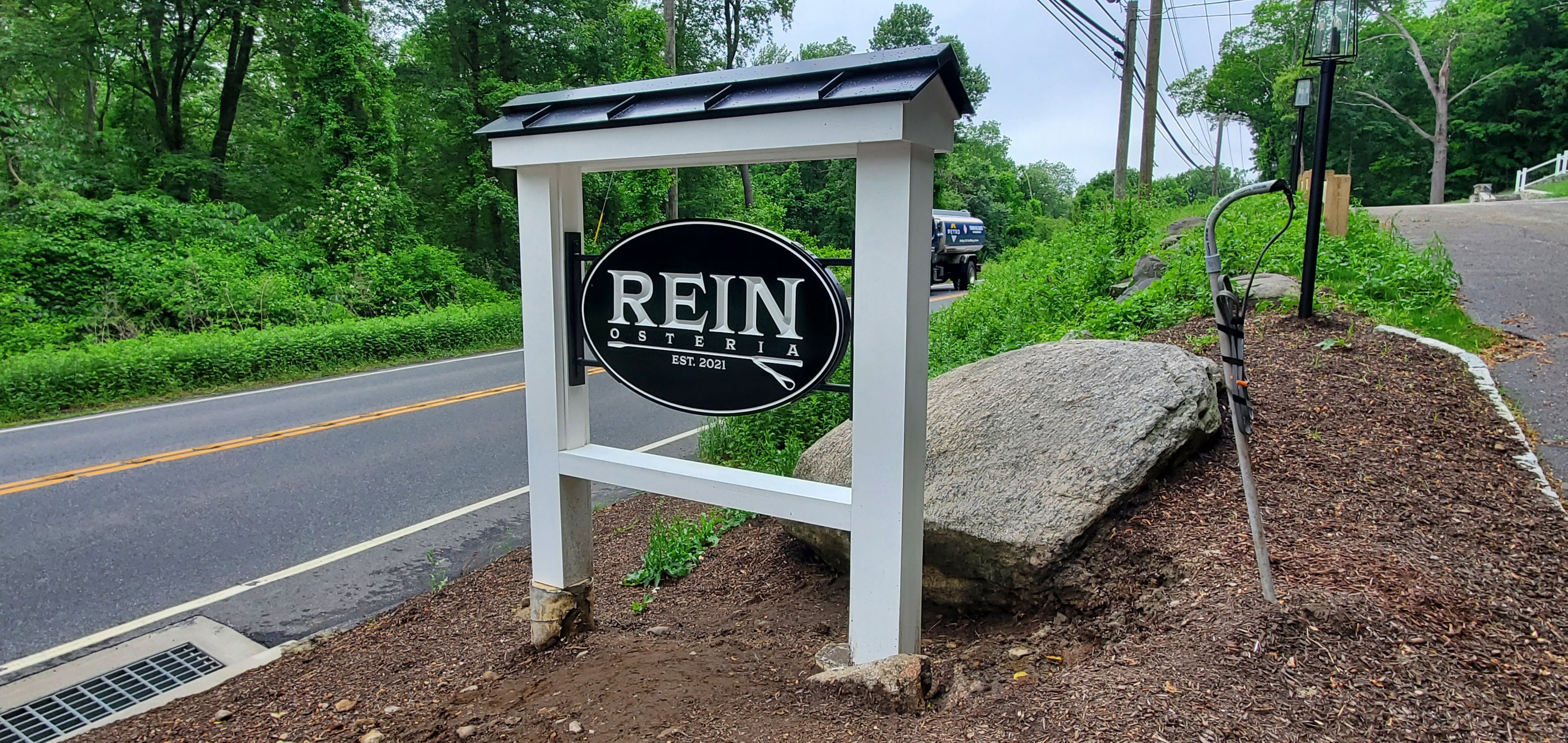
- Freestanding and monument signs are subject to setback requirements from property lines and public right-of-way
- Height maximums vary by sign type and zoning district
- Intersection sight lines restrict signs that would impair driver visibility near road crossings
- Historic and downtown zones add design review requirements for sign materials, illumination type, and visual compatibility with adjacent structures
How Does Your Lease Agreement Affect Sign Placement in Connecticut?
For tenants in commercial spaces, the lease can restrict signage independently of city zoning requirements. A landlord's sign approval does not satisfy Danbury's permit process, and a city permit does not override lease-based restrictions.
Before submitting a permit application, tenants should confirm the following in writing with their landlord or property manager:
- Whether exterior signage on the building face, monument sign, or window is permitted under the lease
- What size, color, material, or mounting method restrictions apply
- Whether the landlord must approve the final design before a city permit is submitted
- Whether the property management office handles permit applications directly for the building
This review protects the tenant from investing in a permitted sign that still violates lease terms.
What Do Small Businesses in Danbury Need to Know About Sign Installation?
Professional installation is a code compliance issue, not just a quality preference. Danbury's permit process accounts for the physical installation method as part of the application review.
Signs requiring structural wall attachment or any electrical connection for illumination may require a building permit in addition to the zoning permit.
Compliant installation means:
- Mounting strictly according to the connection details shown on the approved site plan.
- Using the materials and methods listed in the permit application.
- Completing any inspections required as part of the approved permit process.

What Happens If a Sign Is Installed Without a Permit in Danbury?
An unpermitted sign can be ordered removed by the Zoning Enforcement Officer in writing. Non-compliance with that order triggers penalties under two separate Connecticut statutes:
- Civil penalty up to $2,500 for failure to comply with a removal order, under Connecticut General Statutes § 8-12
- Daily fines up to $150 per day for each day the violation continues, under Connecticut General Statutes § 8-12a
The June 2025 amendment to Section 10.B.2 of the Danbury Zoning Regulations adds a third consequence: any permit application filed after a violation is identified is charged at double the standard fee. Retroactive compliance costs significantly more than getting it right the first time.
Frequently Asked Questions (FAQs)
Can I repair or repaint an existing business sign without pulling a new permit?
Yes, in most cases. Under Section 8.E.9 of the Danbury Zoning Regulations, an existing sign structure that conforms to current standards can be repaired or repainted without a new sign permit, provided no other change is made to the sign. If the repair involves a structural change, a size increase, or a change in illumination type, a new permit is required before work begins.
Are flashing, animated, or digital LED signs allowed in Danbury, CT?
No. Section 8.E.6 of the Danbury Zoning Regulations prohibits signs that incorporate flashing, animated, rotating, beacon, strobe, chasing, or zip light illumination in all zoning districts. Signs with visible moving parts or audio and video advertising devices are also prohibited.
Do sign rules change if my business is in a multi-tenant building or strip mall?
Yes. In commercial zones, wall sign allowances are calculated based on the portion of the exterior building wall that corresponds to each individual business, not the entire building frontage. Each tenant's permitted sign area is proportional to the length of wall that their space occupies.
How long is a sign permit valid once it is issued in Danbury?
Sign permits in Danbury are issued as zoning permits. Under Section 10.B.1.d of the Danbury Zoning Regulations, a zoning permit becomes void if the authorized work is not commenced within one year of the issue date, or not completed within three years of the issue date. Work that starts but stalls past the three-year window requires a permit renewal before it can be completed.
What happens to an existing sign that no longer meets current Danbury code?
A nonconforming sign, meaning one that was legally installed under older rules but no longer meets current standards, may remain in place but cannot be expanded or made larger. Under Section 8.E.9 of the Danbury Zoning Regulations, if that sign is removed for any reason, the replacement must fully comply with current sign regulations. The nonconforming status does not transfer to a new sign.

Where Can Danbury Businesses Get Permit-Ready Signs Designed, Built, and Installed?
Finding a trusted sign company in Danbury, CT, that manages design, fabrication, and permitted installation under one roof can simplify the process significantly. Signarama Danbury has been serving businesses in Danbury, Brookfield, and across western Connecticut for over 20 years, handling every stage of the signage process under one roof.
Request a free consultation and get guidance before starting your sign project.


Signarama Danbury, CT
contact
Signarama Danbury, CT