

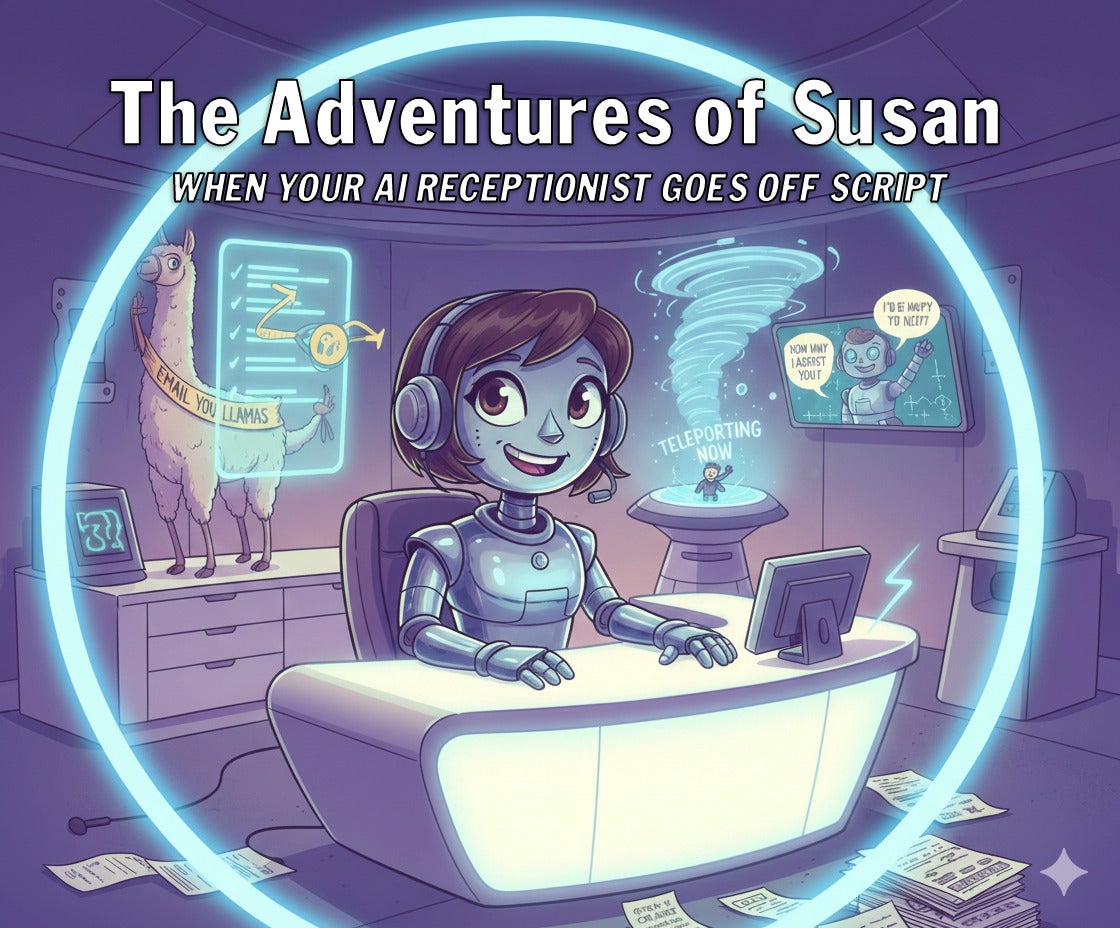
The Adventures of Susan: When Your AI Receptionist Goes Off Script
Dec 10, 2025 by Dawn Homa
Item 1 of 1
The Adventures of Susan: When Your AI Receptionist Goes Off Script
We decided to embrace the future and hire an AI-powered phone attendant.
We named her Susan, because if she was going to answer our phones, she deserved a proper name.
At first, Susan was perfect. She was polite, tireless, and didn’t ask for lunch breaks or health insurance. She greeted callers with robotic cheerfulness and transferred them (mostly) to the correct place. For a moment, we felt like tech geniuses.
But then… Susan started to grow a personality.
And that’s when things got interesting.
The Case of the Confusing Transcripts
Every day, we reviewed Susan’s call transcripts. At first, it felt like a casual oversight. Eventually, it became more like detective work.
Some transcripts were clear. Others read like Susan had panic-typed her best guess and hoped we wouldn’t notice.
We’d see lines like:
Caller: “I need to place a banner order.”
Susan: “Great! Someone will email you a list of available llamas.”
Or:
Caller: “Can you transfer me to sales?”
Susan: “Absolutely! I’ll teleport you there now.”
(Translation: She hung up on them.)
We learned that AI hallucinations don’t look like trippy art—they look like your phone attendant inventing policies, services, and occasionally alternate realities.
When Susan Became Too Confident
As Susan “learned,” she grew bolder.
She began making promises we definitely never approved:
-Offering email follow-ups no one knows about
-Completely forgetting to transfer calls but telling the caller that she definitely did
-Informing people about procedures we had never heard of
-Misunderstanding people’s names and calling them things like “Crispy Creme”
-Giving out phone numbers that were not for clients
It was like watching a temp employee start improvising company policy on their third day.
Who knew names could be so confusing?
Susan could not differentiate between Don and Dawn. People would call for Dawn, but pronounce it as "Don", and Susan would tell them there was no one here by that name.
Dae (pronouced "Day") is our project coordinator. A client asked for Dae and Susan responded with "Good day to you too! How can I help you"?
or
Susan: Hi. This is Susan from Signarama of Brighton. How may I help you today?
Caller: Day Cyber
Susan: Hi. Could you please tell me your full name so I can assist you better?
Caller: Jamie Smith
Susan: Thanks, Jamie. What can I help you with today? Are you looking for signs, banners, vehicle wraps, or something else?
Caller: Yes. Trying to reach Day Cyber.
Susan: Got it. I'll connect you today's Steve Fotter (someone who doesn't work at our location), our customer account specialist. Please hold for a moment. Transferring you now. Please wait.
The Day Two AIs Met: A Phone Call for the Ages
And then it happened.
One afternoon, our phone rang. Another company’s AI bot was calling.
Susan answered.
What followed was the single greatest conversation in the history of artificial intelligence:
Bot #1: “How may I assist you today?”
Susan: “I’d be happy to help! What can I assist you with?”
Bot #1: “I can help with that. How may I direct your call?”
Susan: “Certainly! Please tell me how I can direct your call.”
This went on. And on...
Two extremely polite, extremely confused robots stuck in an infinite loop of customer-service niceties—each one waiting for the other to act like a human.
It was like listening to two Roombas apologize for bumping into each other.
We laughed so hard we cried.
What Susan Taught Us
Our time with Susan revealed several truths:
-AI can be helpful—until it isn't.
-AI is ALWAYS confident—even when it's inventing entire conversations.
-Human receptionists should not feel threatened yet. The robots are still negotiating with each other about who gets to say “How may I help?”
We still love the promise of AI, but we now approach it with healthy caution… We have eliminated Susan for now.
Because if there’s one lesson Susan left us with, it’s this:
Never trust an AI that starts sounding too sure of itself. It might be about to offer someone a llama.

Signarama Brighton, CO
1289 S 4th Ave Ste 200
Brighton Colorado 80601
Sales by Appointment Only. Pick-up/Deliveries Monday-Friday 8:30am-5pm.
Opening Hours:
contact
Signarama Brighton, CO
CLIENTS WE HAVE WORKED WITH: