


How to Speak Fluent AI: A Hilarious Guide to Prompt Perfection
Dec 2, 2024 by Dawn Homa and Mallory Lynn
Item 1 of 1
Why the Reluctance to Admit We Use AI?
There’s a persistent myth that effort equals authenticity. Some people believe hours of grinding away on a blog, story, or presentation is more “legit” than finishing the same topic in minutes. But let’s be real: the true value lies in the outcome, not the effort. AI isn’t here to replace creativity—it’s here to amplify it. Using AI is like having a brainstorming buddy who never gets tired or runs out of ideas. And while the occasional glitch might leave you scratching your head, the benefits far outweigh the hiccups. Sharing your AI wins and fails fosters collaboration and inspires others to dive in, not to mention a few laughs. Because let’s face it: nothing breaks the ice like swapping stories of AI’s funniest missteps. We’ve outlined some of the things we learned from using AI. Admittedly, we’ve made mistakes... But then, that’s the fun part of AI.How to Speak Fluent AI: A Hilarious Guide to Prompt Perfection
In the world of AI, one thing is certain: it listens better than your dog but doesn’t fetch the paper (yet). Whether you’re dabbling with ChatGPT, exploring Gemini, or testing out Bard, there’s a universal truth about AI—what you ask is what you get. And sometimes, what you get is...well, unintentionally hilarious.What Is an AI Prompt?
An AI prompt is essentially a set of instructions you give your digital assistant. Think of it like texting your smartest, most nonjudgmental friend—one who doesn’t roll their eyes when you ask them for the fiftieth time how to spell “unprecedented.” But here’s the catch: this friend is clueless without context. It’s your job to spell things out clearly, or you might end up with results straight out of a surrealist painting. These days, everyone uses AI—even if they won’t admit it. From whipping up blog posts to choosing tonight’s dinner (yes, there’s a recipe generator for that), AI has become the coworker who works 24/7. But do you know how to talk to your AI coworker?Types of AI Prompts
When it comes to prompts, simplicity is key. Think of it like decluttering your closet—ditch the fluff and focus on your main objective. Too many side quests will derail your digital assistant faster than you can say, “Oops.” Start small, build trust, and let the magic unfold. Here are four common types of AI prompts: 1. Direct Commands: “Write me a blog about AI prompts.” Clear, concise, and to the point—just the way AI likes it. 2. Open-Ended Questions: “What do you think of pineapple on pizza?” (Spoiler: It has no personal opinion, but it can give you a gourmet-level debate on the subject.) 3. Creative Challenges: “Write me a Shakespearean sonnet about tacos.” Because why not? AI loves to flex its creative muscles. 4. Problem Solvers: “Explain quantum physics to a fifth grader.” Fun fact: AI is surprisingly good at simplifying the universe’s biggest mysteries.How to Make a Good AI Prompt
A good AI prompt is like a GPS. Be vague, and you’ll end up lost in the middle of nowhere. Be specific, and you’ll arrive at your destination in record time. Here’s your roadmap: The Equation for Prompt Perfection: (Identity + Audience + Specific Details + Output) = AI Delivered Objective x Feedback = AI Gold 1. Give Your AI an Identity - Want a blog? Ask it to “write as a witty marketer.” Need legalese? Summon its “inner lawyer.” By assigning a perspective, you help your AI craft a message that truly resonates with your audience. 2. Be Specific - “Write me a blog” is like asking your chef to “cook something.” Sure, they will, but you might end up with spaghetti when you wanted sushi. Specify tone, length, style, and key points. Use clear adjectives like “creative,” “humorous,” “professional,” or “casual” to refine your request. 3. Define Your Audience - Are you speaking to Gen Z , TikTokers, corporate executives, or your grandma’s knitting circle? Each group craves a unique flavor, and AI is a master at tailoring content to the right audience. 4. Define the Output - Blog? Social media caption? Love letter? (We don’t judge.) The more clearly you define the format, the better the results. 5. Give Feedback - AI is like an eager intern—it improves with constructive criticism. If the output feels off, say so! Ask it to “make it snappier,” “add more personality,” or “throw in some dad jokes.” It’ll listen better than your real intern, guaranteed.When Prompts Go Wrong
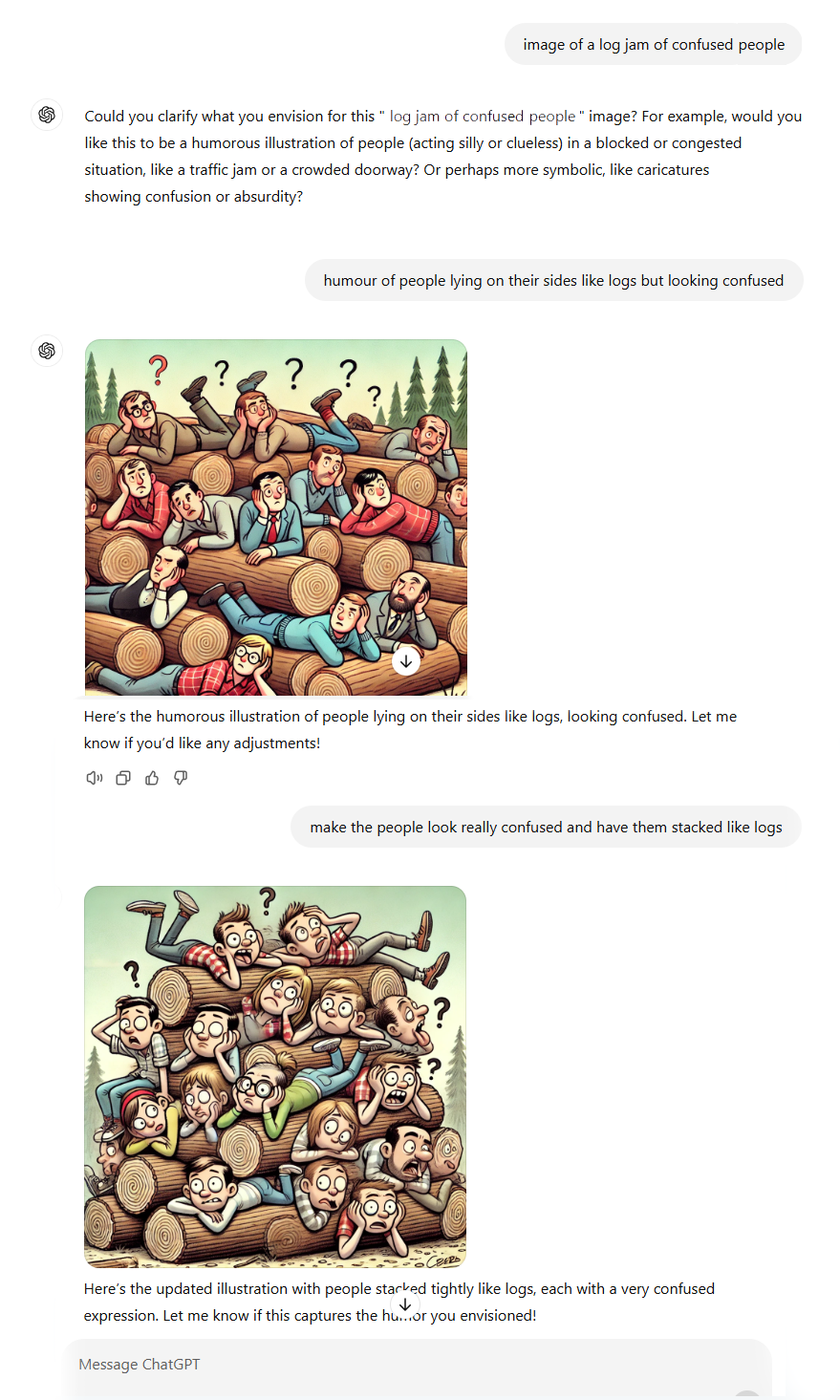
Ah, the AI bloopers. Ever asked for a “professional portrait of a dog” and ended up with a five-legged pup? While in a team meeting, we had a discussion about a project. It was mentioned that it felt like a “log jam of people” to make a decision. Afterward, two different team members asked AI to make an image of a “log jam of people”
Below are the two results. As you can see how you ask AI to create something will affect the outcome. So don’t be afraid to ask again in a different way to get the result you want.
While in a team meeting, we had a discussion about a project. It was mentioned that it felt like a “log jam of people” to make a decision. Afterward, two different team members asked AI to make an image of a “log jam of people”
Below are the two results. As you can see how you ask AI to create something will affect the outcome. So don’t be afraid to ask again in a different way to get the result you want.
 One of our favorites? Those subtle moments when something just feels...off. Like when your AI-generated email sign-off is “With eternal gratitude and a thousand blessings.” Uh, thanks? Or you generate an image you just can’t put your “toe” on....

Refining Your Prompt Skills
Prompting is a skill—and like any skill, it gets better with practice. The beauty of AI is that it learns you as much as you learn it. With time, you’ll build a rapport, just like with any other team member. Here’s how to level up: - Experiment with prompts and phrasing. - Ask for multiple drafts or variations. - Stay curious—AI loves creative challenges. - Don’t be afraid of drafts. Often we will take what AI composes, copy it into a word document, make our own edits, and ask AI to “enhance” once more.Embrace the AI Partnership
In the end, AI is a tool—a brilliant, occasionally quirky tool—that’s here to help us dream bigger, work smarter, and laugh along the way. So the next time you sit down to write something, remember: the perfect prompt is just the beginning of your AI-powered adventure. And with any adventure... It starts with your first step or with AI your first prompt.
Signarama Brighton, CO
1289 S 4th Ave Ste 200
Brighton Colorado 80601
Sales by Appointment Only. Pick-up/Deliveries Monday-Friday 8:30am-5pm.
Opening Hours:
contact
Signarama Brighton, CO
CLIENTS WE HAVE WORKED WITH: